
Jazzmen dropping dead in circumstances that are unusual even by their standards. Incontrovertible, if circumstantial, evidence of a real-life vagina dentata. These two sets of mysteries set the stage for the events of Moon Over Soho, events that will show readers more about Constable Peter Grant, much more about his mentor in magical policing Detective Chief Inspector Thomas Nightingale, and leave slightly less property damage across greater London than Grant’s previous adventure. But only slightly less.
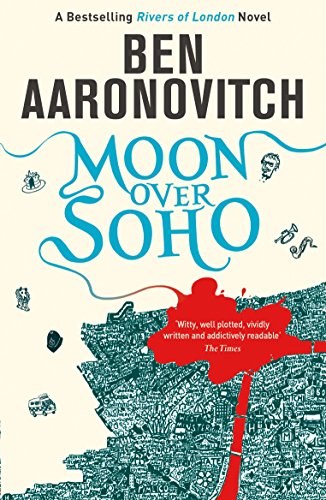
Moon Over Soho has the three things that I said made Rivers of London terrific fun to read — humor both line-by-line and over longer stretches, unrestrained love for twenty-first century London (The opening sentence is “It’s a sad fact of life that if you drive long enough, sooner or later you must leave London behind.”), and good balance of magic and mundane — and deepens them over the course of its heroes’ capers. By the end of it, readers know and appreciate Grant and Nightingale better. They can see how London itself is starting to change because of the events of which the police pair are just a part. The supporting cast are taking on greater depth, and readers can see how they might be the protagonists of their own stories. Molly, for example, who is presented in the first book as an unknowable and fearsome automaton, practically an extension of the house, might be someone comprehensible after all. Which of course leaves Grant, a Black Londoner, with unsettling questions about her apparent unending servitude.
Like any good mystery writer, Aaronovitch gives readers crucial information right up front, even though they may not realize its importance until much later.
Vestigia is the imprint magic leaves on physical objects. It’s a lot like a sense impression, like the memory of a smell or a sound you once heard. You’ve probably felt it a hundred times a day, but it all gets mixed up with memories, daydreams and even smells you’re smelling and sounds you’re hearing. Some things, stones, for example, sop up everything that happens around them even when it’s barely magical at all — that’s what gives an old house its character. Other things, like the human body, are terrible at retaining any vestigia at all — it takes the magical equivalent of a grenade going off to imprint anything on a corpse. (p. 12)
Which is why Grant is surprised to hear a saxophone solo emanating from an expired jazzman.
“How did you spot this?” I asked.
“I check all the sudden deaths,” said Dr Walid. “Just on the off-chance. I thought it sounded like jazz.”
“Did you recognise the tune?”
“Not me. I’m strictly prog rock and the nineteenth-century romantics,” said Dr Walid. “Did you?”
“It’s ‘Body and Soul’,” I said. “It’s from the 1930s.”
“Who played it?”
“Just about everybody. It’s one of the great jazz classics.
“You can’t die of jazz,” said Dr Walid. “Can you?”
I thought of Fats Navarro, Billie Holiday and Charlie Parker who, when he died, was mistaken by the coroner for a man twice his actual age.
“You know,” I said, “I think you’ll find you can.” (p. 13)






 Al Singh
 Doug Merrill
 Doreen Sheridan
 Emily Lauer
 John Pitzel
 Lars N. Goldschlager
 Laura Eilers
 Professor X
 Robert Maedgen
 Sylvere Ap Leanan
 The Shire