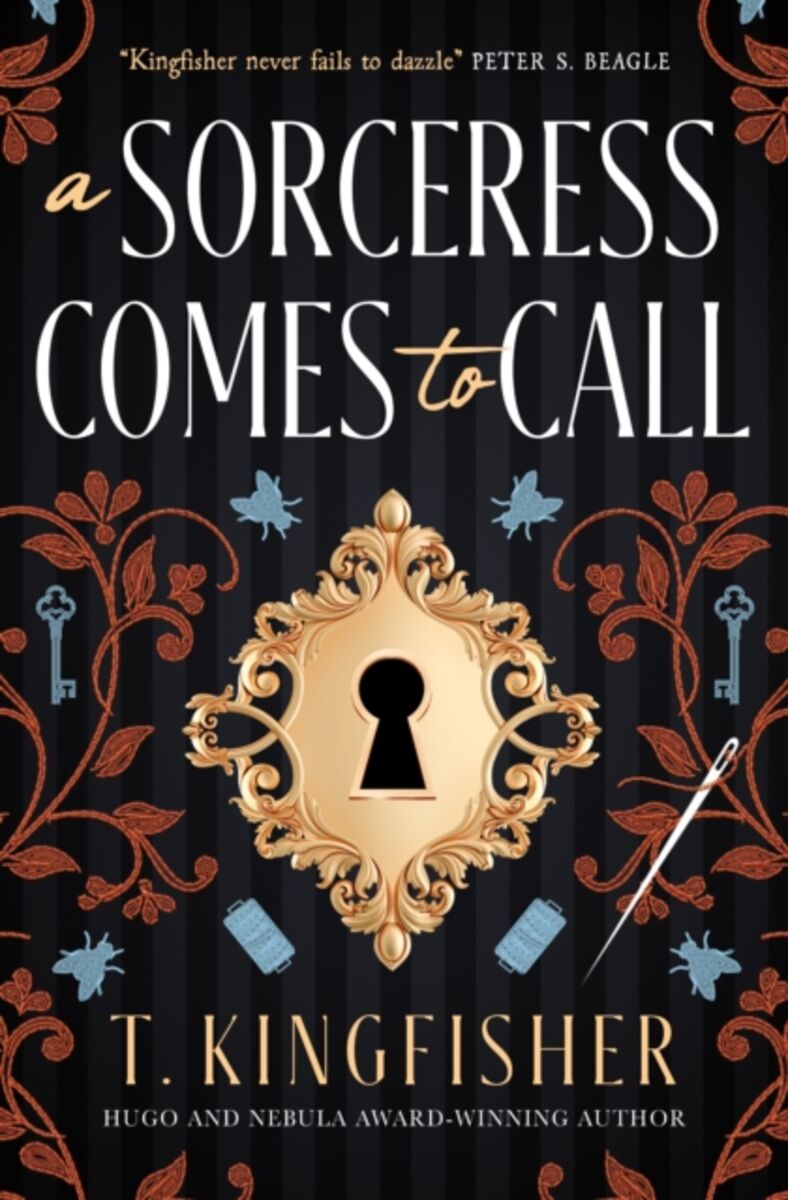
In her Acknowledgments, Kingfisher writes that A Sorceress Comes to Call “isn’t technically a Regency [romance] but it’s in the same ballpark, right?” (p. 369) Then, just so that you know it’s T. Kingfisher speaking, she says something about reanimated dead horses. Then there’s the matter of sorcery, which Kingfisher shows readers is real on the very first page. Coredlia’s mother has taken the two of them to church, as she does every Sunday, to observe the proprieties and be seen by local society. To make sure that Cordelia also scrupulously observes propriety, her mother has made her obedient, which is essentially a form of sorcerous possession, with her mother completely in control of Cordelia’s bodily movements. It’s a form of sorcery that few would believe in, in these modern days, let alone that it could be done invisibly.
Evangeline makes Cordelia obedient when she transgresses, which is surprisingly often considering Cordelia as a normal fourteen-year-old, but not surprising at all when it quickly becomes clear how controlling Evangeline is, and how abusive Cordelia’s life is. Doors are never to be closed, Cordelia is never to have any secrets from her mother, and the category of secrets is expansive. By the time the book begins, Cordelia is no longer attending school, though outings on her horse, Falada, have enabled her to make friends with Ellen, a daughter of a nearby landowning family who is about Cordelia’s age.
“Does your family think you’re keeping secrets when you [close a door]?”
The silence went on long enough that Cordelia looked up, and realized that Ellen was giving her a very penetrating look. She had a pink, pleasant face and a kind manner, and it was unsettling to suddenly remember that kind did not mean stupid and Ellen had been talking to her for a long time.
“Oh, Coredlia…” said Ellen finally. (p. 16)
Cordelia’s father hasn’t been around for a very long time. Evangeline has a benefactor, which is how the two of them are able to maintain their barely genteel lifestyle. Cordelia understands that this arrangement is not quite respectable, but it is not like she can do anything about it, even if she were inclined to. The plot of A Sorceress Comes to Call gets going when the benefactor drops Evangeline, forcing her to seek a new means of support. She decides to seek a suitable country squire to wed, and also to claim that Cordelia is seventeen, and thus marriageable.
Kingfisher introduces the novel’s other point-of-view character by having her wake up with a premonition of Doom.
Hester had felt such a nameless fear once before in her life, when she looked into the eyes of a young man that her parents had picked out for her. She had gathered her courage and cried off the wedding. It had cost her dearly but she stood her ground in the face of all opposition. Her parents had raised her to be good and biddable and not cause a fuss and it had shocked both them and Hester herself to learn how much stubbornness she had saved up over the course of those years.
Years later, when the young man’s proclivities came to light, she was held to have had a lucky escape. By then, of course, it was much too late. … She had been considered firmly “on the shelf” by the time that word came down of what he had done, and the hanging that had followed. (p. 24)
By the time of A Sorceress Comes to Call, Hester is a spinster edging toward elderly, with a bad knee and a surprisingly successful sideline in breeding geese. (Apparently A Sorceress Comes to Call was partly inspired by a Grimm fairy tale called “The Goose Girl,” but I don’t know the tale and only encountered the connection when I started to put these notes together. Cordelia’s horse shares a name with the horse in the Grimm tale, which would have been a clue if I knew the source at all.) Hester is firmly ensconced in the grand country house she grew up in, the seat of the Chatham family, of which her brother Samuel is now head. He’s also the Squire that Evangeline has set her sights on marrying. (Just a side note, as a former international relations person, it was occasionally jarring for me to see the Squire’s home referred to as Chatham House. I have no idea what prompted Kingfisher to choose that particular name, or indeed whether she knows its other context.)
If most romances have a marriage plot, then this in-the-ballpark-of-a-Regency has an anti-marriage plot. Can the Squire, who is bluff, hearty and chivalrous be brought to see through the schemes of a sorceress? Especially when she is not above possession and murder? Can Cordelia find a way to be free?
Evangeline contrives for the Squire to invite her and her daughter to stay with him. Hester soon realizes that she will need reinforcements, and so she persuades her brother to throw a house party, where the guests will expect to stay for at least a few weeks. This supporting cast rounds out the novel nicely, bringing more personalities into play, and giving Kingfisher the opportunity for more witty observations and counterpoints to Evangeline’s machinations. This is a deadly battle, but two stipulations keep it from being a naked power play. First, the wedding ritual will break any other spells, so Evangeline cannot simply enchant Samuel or make him obedient all the way to the altar. Second, appearances must be maintained because if Evangeline’s facade fails then her scheme will fall apart. Politeness and apparent kindness, with daggers drawn where nobody can see.
Hester’s reinforcements consist of Lord Richard Evermore, Samuel’s long-time friend and Hester’s true love, whom she could not bring herself to marry years ago when it was an open question; Imogene Strauss, a close friend of Hester’s, resourceful and a card sharp nonpareil; and Penelope Green, a former flame of Samuel’s, the very embodiment of style. One of the many enjoyable parts of the book is Kingfisher’s portrayal of the upstairs/downstairs relationships, constrained by their roles but humane nonetheless. Of course it helps that Samuel is both wealthy and fair, and that everyone else on the estate sees through Evangeline’s act.
Hester and Cordelia’s maid Alice are discussing the abject fear that the girl harbors for her mother.
The words came out all in a rush. “Ma’am, somebody’s doing something bad to that girl and I’m afraid for her.”
Hester sat back, startled. “Something bad?”
Alice nodded. “Don’t rightly know what,” she admitted. “But she acts like my little cousin did, and it turned out that the neighbor was … well, never mind that, ma’am.”
“Ah,” said Hester, a world of understanding packed into that syllable. She and Alice shared a look that for once had nothing to do with rank. “And you think …?”
“Something like that, ma’am. When her mother shows up, she flinches like she’s expecting the belt. … And it ain’t a thing [the staff] can fix, either. Nor me. But maybe you can, ma’am.”
Hester let out a long sigh. “I don’t know,” she admitted. “I don’t think you’re wrong, but I don’t know what to do yet. I can’t just snatch a child away from her mother, even if her mother is … ah …”
Alice snorted. “Her mother’s a fair piece of work, if you’ll forgive me for speaking so bold, ma’am.”
“If anyone asks, I had very harsh words with you about speaking so of your betters and so forth.” Hester waved her hand.
“I was quaking in my boots, ma’am.”
“Yes, quite. … You did right telling me. I knew that something was wrong, but not how bad it was.”
“I think she tries to put a good face on it, ma’am. Afraid to make trouble, maybe, or just afraid that her mother’ll hear of it.” She scowled. “My little cousin did that too.”
“That neighbor was dealt with, I trust?”
Alice nodded solemnly. “Fell down a well. Terrible unlucky it was.”
“Well, accidents do happen.” (pp. 91–93)
When the butler is eventually enlisted, he is a delight, too. And it turns out that there is a love story in this not-quite-a-Regency after all. The protagonists are past the usual marriageable age, and the obstacles are not the obvious ones either.
What could she say? I can’t marry you because I look like this and you look like that. And I will grow older and fatter and frizzier, and eventually I will need a carry-chair instead of a cane. And meanwhile you will be tall and distinguished and you hair will go to silver gilt and everywhere we go, people will look at us and think “What is he doing, married to her?”
She’d told him as much the first time. He denied it, but he was still a man, even if she loved him, and he did not quite understand. She’d let him believe that she was unwilling to see that question in so many people’s eyes.
She had never had the courage, or the cruelty, to tall him the real truth. I don’t care about other people. Society can go hang. But if I ever looked in your eyes and saw that question, it would destroy me utterly. I could never pick up the pieces after that. There would be nothing left.
So she did not. (p. 148)
The tale remains tense until the end, and Kingfisher is not afraid to show Evangeline’s ruthlessness in the starkest terms. There is a happy ending, because that is part of this book’s promise, but it some tough and costly going to get there. I enjoyed every page.

 Al Singh
 Doug Merrill
 Doreen Sheridan
 Emily Lauer
 John Pitzel
 Lars N. Goldschlager
 Laura Eilers
 Professor X
 Robert Maedgen
 Sylvere Ap Leanan
 The Shire