
Daggerbound is the much-anticipated and long-awaited (by some, I was a fortunate reader-come-lately) sequel to Swordheart. In the preceding book, readers learned that centuries ago a mercenary commander got crosswise with a sorcerer and condemned to be forever bound to a magical sword, obliged to serve whoever owns and draws the sword. The commander’s top two lieutenants suffered the same fate, one bound to a dagger and the other to a warhammer. (At least according to the pre-release description of Shieldborn, which is scheduled for publication in August 2027.) As Daggerbound begins, the person who will become the new wielder knows nothing of the dagger’s magic. He is preoccupied with his own concerns; namely, he has decided to leave the scholarly order that he grew up in, and the delivery of the dagger to a distant sage will be the last task that he undertakes for them. He hasn’t informed the order of his decision, nor that he plans to keep the donkey, and his conscience is not particularly happy about either choice, but he has come to the conclusion that the order is impossible to reform, and so exit is his only option.
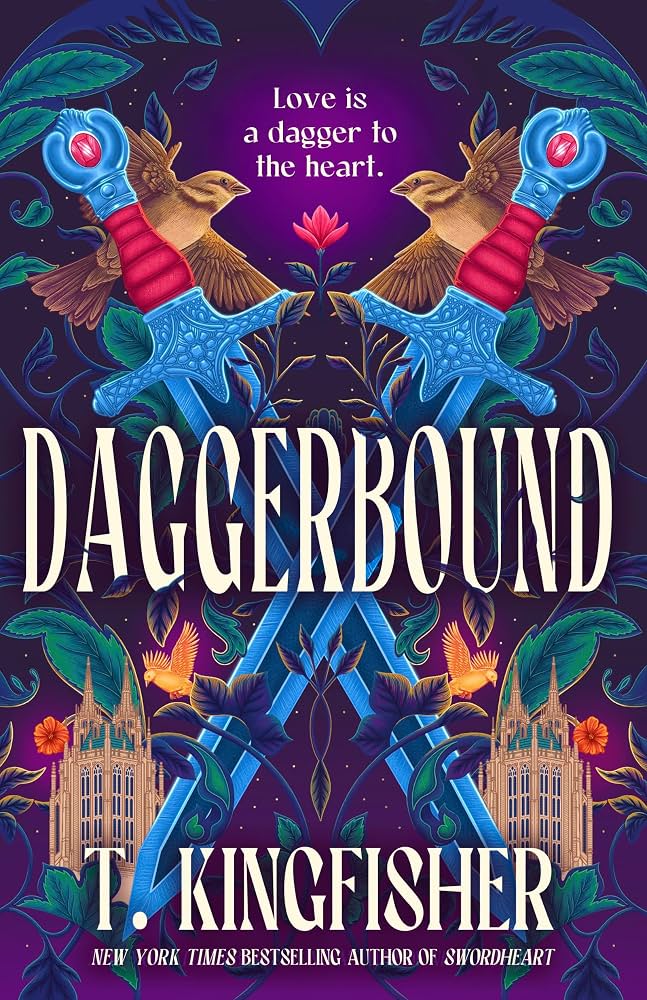
Readers of Clockwork Boys and The Wonder Engine will recognize the scholar as Learned Edmund. I was happy to see him again, and delighted that he is the star of his own book. Even better was that he has continued to compare his order’s teachings against reality, and to choose reality over dogma when the two conflict. He’s still nobody’s idea of a streetwise operator, but he is no longer completely unworldly.
Unfortunately for Edmund, his journey takes him on a bandit-infested stretch of road, and the predictable happens. Unfortunately for the bandits, Edmund unsheathes the dagger, and the unexpected happens: The Dervish appears in a burst of magic. He is a much more skilled fighter than the bandits, and soon overcomes them. Under his sorcerous obligations, he is bound to protect and obey Edmund. For his part, Edmund is by turns grateful, puzzled, intrigued and concerned. He is grateful to be saved from bandits of course, but he is puzzled about who or what the Dervish might be. Edmund thinks at first that he might be an angel, for he is one of the most beautiful men he has ever seen. The world of Daggerbound is one in which magic items as powerful as this dagger are exceedingly rare, so Edmund does not immediately make the connection. As he and the Dervish converse more, Edmund comes to understand some of his history and motivations. His scholarly instincts are intrigued, and he sets out to learn more of the nature of the spells binding him, how the magic works in practical terms, and eventually helps the Dervish to piece together more of his personal history.
Complications naturally ensue. One of them involves a dragon and not being eaten. Another involves an intelligent species previously unknown to the wider civilization shown in the books set in the world of the White Rat. Yet another involves the attraction he feels toward the Dervish, one he eventually realizes is reciprocated.
“Did you make no plans beyond leaving [your order]?” asked the Dervish. His voice was soft, but his silver eyes were sharp as scalpels. Of course, Edmund thought, it’s his future too, if we don’t find a way to break the curse.
“I thought perhaps I could work as a scribe, or a librarian, if the library in Archon’s Glory had an opening. Or … I knew a woman in Anuket City. An old friend.
He was only aware that warmth had crept into his voice when the Dervish said, “A woman, eh?” in a suggestive tone.
“Not like that! She—we weren’t—I was a great admirer of her, um, her—”
The Dervish didn’t say anything, but his eyebrows did not so much suggest as draw diagrams and point to them.
“—her indexes.”
“Is that what they call it these days?”
Edmund put his hands to his face. His cheeks felt hot. On one level, he knew that the Dervish was only teasing him, but he wasn’t used to being teased by extremely pretty men who had saved his life. (p. 63)
I chuckled many times while reading Daggerbound, and I was pleased to spot a reference to another Kingfisher book. “There was actually a school of thought that almost everyone had a talent for wonderworking, it was simply so incredibly specific that the circumstances never arose. Edmund decided against bringing that up [with the Dervish]. Though he had occasionally wondered what talent he would have, if that were true. Probably something like communicating telepathically with yeast.” (p. 172) That’s exactly the magical talent of the protagonist of A Wizard’s Guide to Defensive Baking, and it turns out to be very useful indeed, in the specific circumstances that arise.
Edmund’s and the Dervish’s own circumstances get increasingly tangled, and eventually the Temple of the White Rat gets called on for help. Bishop Beartongue explains her views on the untangling.
“If that’s the proper way,” the Dervish said carefully, “what’s the correct way?”
“Very similar, really.” The bishop picked up her notes and carefully tore them in half. “Except I’ve never met you. I certainly have no idea what you might be doing, and Zale [a formidable lawyer attached to the temple] is on some kind of paid leave. I heard they left the city, but beyond that, I couldn’t say.”
“Did I take the fastest coach in the yard?” asked Zale.
“You did not. You did, however, take a couple of chits letting you exchange post horses along the road.”
“How odd. I thought I hated riding horses.”
“Yes, it was something of a departure, wasn’t it?”
The Dervish gazed at her with admiration. “And here I thought you’d be on the side of law and order…”
“No, young man,” said Beartongue, despite being several centuries his junior. “I am on the side of justice. If we’re lucky, the two run in parallel. If they don’t, we bend the law to attain justice, not the other way around.” She made a shooing gesture. “Now go on, get going before I am forced to remember this meeting. And good luck to you both.” (p. 374)
I read Daggerbound in a great rush because I couldn’t wait to find out what happened next. I enjoyed every step—although some of the hesitancy of Edmund and the Dervish coming closer seemed out of character for both of them, and simply added because the conventions of romance required an internal obstacle—from a gnole’s droll observations about human behavior through the perils that Edmund and company face, and from Edmund’s scholarly intensity about knowledge to the Dervish’s practical action to keep them all alive. Writing up these notes, I realized how much I had forgotten since that great rush, and that has whetted my appetite to re-read soon.

 Al Singh
 Doug Merrill
 Doreen Sheridan
 Emily Lauer
 John Pitzel
 Lars N. Goldschlager
 Laura Eilers
 Professor X
 Robert Maedgen
 Sylvere Ap Leanan
 The Shire