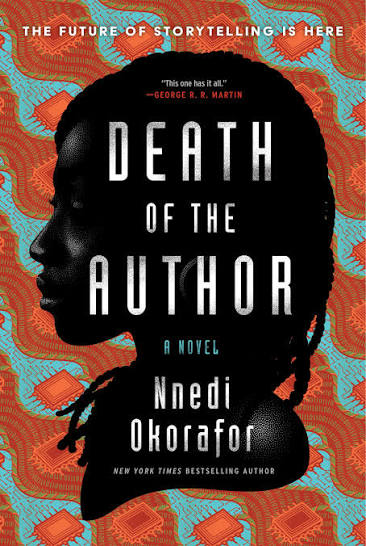
These notes are going to be a bit superficial because I read Death of the Author back in the summer when I was reading for the Hugo awards, but I wanted to say a little bit before too much of the book and my reactions faded from memory. First off, I put Okorafor’s book in first place on my ballot in the category of Best Novel. I liked the book’s ambition; I liked how Okorafor played with expectations; I liked how open the book felt, the way that it deployed multiple perspectives, the way that all of the important characters were complicated. One of the best aspects of Death of the Author was the sprawling Nigerian-American family at the heart of half of the book. Some parts of the family dynamics are common immigrant experiences—memories of the old country, the desire to pass some of those ways on to the next generation, fitting into the new country’s ways and also not fitting in, how much different people in the next generation want to be separate or blend in—some of the dynamics read like they are specifically Nigerian (or a particular segment of Nigerian; there are more than 240 million Nigerians, after all), and some of the dynamics arise from the particular personalities involved. Not many science fiction novels handle families, especially large ones, nearly as well as this one does, and Okorafor uses the numerous strong personalities to give a reader contrasting views of the same situations.
Those contrasting views are one example of a central concern of Death of the Author, which is who is telling the story, and how close to the truth are they coming? Is there just one story, and if not, what does that mean? It’s right there in the book’s first paragraphs.
What’s the story you want?
Honestly, I don’t see it. Even after everything, Zelu will always just be Zelu to me. What you think she is—it’s all made up. Life is short. Fortune is fleeting. Fame is just swirling dust. It’s people dreaming and perceiving while they say your name like it’s some tangible object, but it’s not. A name is just a name. A sound. (p. 1)
Okorafor even introduces her main character slantways. The first chapter is an interview with Chinyere, one of Zelu’s sisters. She’s a cardiovascular surgeon in Chicago, where the family has settled in America. She’s the oldest; Zelu comes next. Right from the start, there’s an author telling a story: the older sister talking about her next youngest sibling, and she does not hold back. “The fact is that Zelu never really cared about family. Zelu had to do her own thing. Then she’d expect everyone else to deal with her mess. We will always love Zelu. We hang in there for her. She never made it easy, though.” (p. 1)
By the end of the interview’s six pages, several things are clear. Zelu is a mess. Chinyere is not nearly as together as she thinks she is, despite her apparent success. Family members will go to great lengths for each other, but they are also all up in each other’s business all the time. Despite that, Chinyere at least barely acknowledges one of the most important parts of Zelu’s experience: she’s disabled, a wheelchair user. “She’s not the first person to have a disability. And I acknowledge that society has its biases, but we each move through the world in our own way. We all have a path.” (p. 2) The next few chapters introduce more of the family, and give more details about Zelu. She’s a writer and a teacher of writing. She’s more like her father than anyone else in the family, but that doesn’t mean that she fits in well.
Nigerians never knew how to deal with abnormalities, and Zelu had plenty of those. She was a thirty-two-year-old paraplegic woman with an MFA in creative writing. Her father was a retired engineer and her mother a retired nurse, and her siblings were a surgeon, a soon-to-be neurologist, an engineer, a lawyer, and a med school student. But not much had ever been expected of her. This was mainly due to her disability. She’d endured her share of theories about family curses, juju, and charms. Her relatives were more interested in who was to blame than they were in how she lived her life. (p. 17)
In short order, she loses her adjunct job, and her novel collects its tenth rejection, a form letter from a small press. “And ten years working on that fucking novel. Building those characters, those ideas. Researching everything: paintings, architecture, city maps, even the trees. Editing. Editing. And editing. Breaking. Rewriting. Editing some more. She’d channeled Toni Morrison, Jamaica Kincaid, Audre Lorde. At least, she thought she had. It seemed right in line. Yet it was rejected.” (p. 26) She has to move back to her parents’ house, and things are not looking good. She gets high a lot. She makes bad decisions; Okorafor is not shy about letting her characters make bad choices. Before she loses her apartment, while the rejection is still fresh, she makes another decision with
her mind cracked so wide open that all her demons had flown in. Zelu began writing.
This time, it was different. She didn’t want to write about normal people having normal problems, just be told all over again that her characters weren’t relatable. She didn’t want to research a world for years just to watch it burn. So she didn’t. She wrote about those who weren’t human. She wrote a world that she’d like to play in when things got to be too much, but which didn’t exist yet. She wrote something else, something new.
She wrote about rusted robots. (p. 27)
The other, interleaved half of Death of the Author is the novel that Zelu writes, Rusted Robots. It’s a first-person, post-human narrative of what the robots get up to when the humans have all gone. Some of them are Humes, like the narrator whose name is Ankara, humanoid robots that are much like humans and live for exchanging stories. Then there are AIs “known as NoBodies (because they had no bodies)” that considered stories “digital hallucinogens for Humes.” (p. 32) Conflict has not left the earth just because humans are no longer around to create it. Between the chapters of the mundane world, interviews with various family members, and the chapters of Rusted Robots Okorafor builds worlds that are linked to each other. The world of the third-person narrative about Zelu, the glimpses of the world as other people see it that the interviews provide, and the robot world that seems so real to Zelu. Her world gets more science-fictional too when her unlikely story becomes a runaway hit. Suddenly inventors know who she is and want her to try out new assistive technology. She seems to be leaving her old world behind. The robots, too, are leaving their old ways under pressure from internal and external conflicts.
Amid all of the success, Zelu makes some bad decisions, too. Circumstances change; character less so. Further developments call everything—everything—into question, and brought the book back to its beginning and its title, and show its ambition. How many authors? How many deaths? Who is telling what? I’ll give the last words to Zelu’s father, from fairly early in the book, when she has just started writing Rusted Robots.
That girl loved stories. If anyone had one to tell, she was there, ready to drink it. I was the same way when I was growing up. I loved where stories took me. How they made me feel. How they made everyone around me feel. Stories contain our existence; they are like gods. And the fact that we create them from living, experiencing, listening, thinking, feeling, giving—they remind me of what’s great about being alive. (p. 40)

 Al Singh
 Doug Merrill
 Doreen Sheridan
 Emily Lauer
 John Pitzel
 Lars N. Goldschlager
 Laura Eilers
 Professor X
 Robert Maedgen
 Sylvere Ap Leanan
 The Shire