Victor Sebestyen offers a readable, one-volume history of Budapest from its Roman beginnings as Aquincum (plus a little more than a page on pre-Roman findings) through the time of the book’s publication in 2022, although it is very light on the years after the anti-communist uprising of 1956. Out of the book’s 377 pages, the remaining 33 years of the communist era and the 33 years from the revolution of 1989 — in which Hungary played a pivotal role for all of Europe — to the present receive 10 pages each. Though post-1989 Budapest really only gets four pages, Sebestyen still finds space to misread Fukuyama; and though Viktor Orban had been prime minister for about fourteen years (in two separate periods) by the time of publication, Sebestyen only mentions him as a student-age speaker at the reburial of Imre Nagy. The book is much stronger on the Habsburg period, and particularly on the 19th century that saw explosive growth, the merger of Buda and Pest into a single city, and the construction of the city’s modern appearance. It’s a defensible choice, as the 19th century did so much to shape the city’s current character and appearance, but between this emphasis and effectively ending the story in 1956, Sebestyen leaves the book looking at the past and giving short shrift to the gorgeous and dynamic city that Budapest has become as the 20th century turned into the 21st.
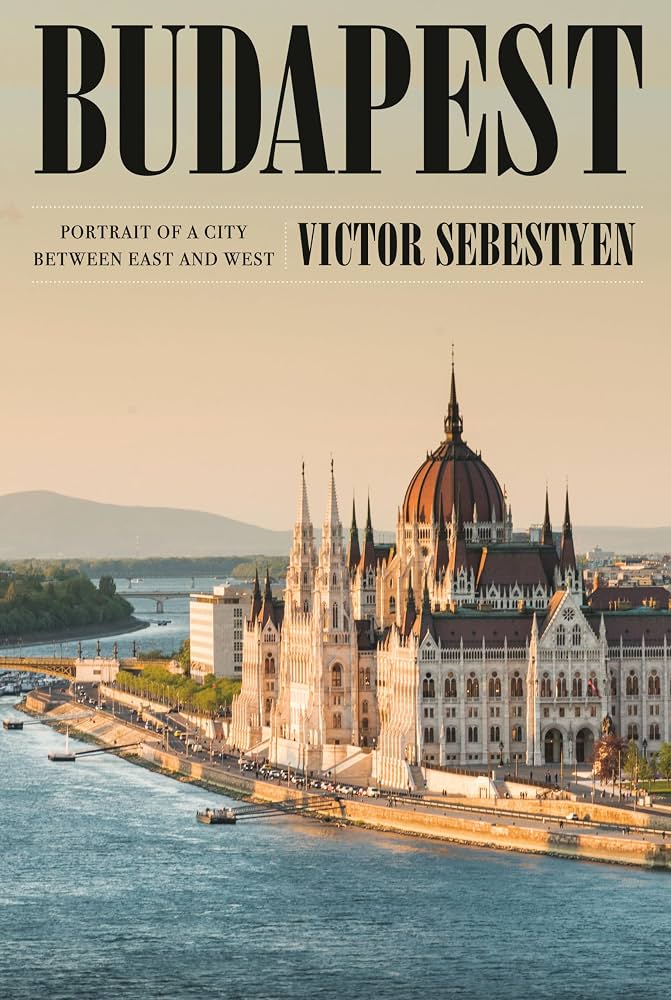
Two more minor quibbles. First, the book has the subtitle “Portrait of a City Between East and West,” which is true enough, but the same can be said (and often is) of every major city between Munich and Moscow in one direction and between Venice and Ankara in the other. Though the phrase may be good marketing, it’s hardly unique to Budapest. Similarly, when Sebestyen writes about Hungary’s battles against the Ottoman Empire (roughly pages 47 to 63) he writes of the Magyar nation as a bulwark of Christendom against invaders from the East. This term has also been applied to Poles (and the Polish-Lithuanian Commonwealth), Serbs, Croatians and even, as a little background searching showed, Albanians and Armenians. These examples point to my second quibble, which is that a little more comparative work would have improved the book. A sentence here and there about Vienna, Krakow or other Central European capitals would have helped to put Budapest into a broader context. Sebestyen is right when he writes in his introduction that Budapest
is at the crossroads of geographical regions and of civilizations, at the intersection of ancient trade routes. Mountains that gradually slope into gentle hills converge on a great river, the Danube, and a vast plain. Mediterranean Latin, Alpine German and Slavic peoples meet here. This is the focal point of Roman Catholic, North European Protestant and Greek Orthodox/Byzantine cultures. (p. 2)
All the more reason to place the city among its peers, to look around a bit even whilst concentrating on one urban area. Of course it helps to get the comparisons right. Sebestyen writes
Hungary had the largest ‘aristocracy’ in Europe which, unlike almost anywhere else, comprised a sizeable chunk of the population.
Numerically, this made a big difference, lasting until the 1930s. In Bohemia around the end of the eighteenth century the ratio of ‘commoners’ to nobles was 828:1, in Austria 350:1, in Lombardy and the Veneto 300:1, in Poland 190: 1; in Hungary it was 16:1 and among the Magyars 8:1. (p. 97)
It is my understanding that the szlachta, the noble estate in Poland-Lithuania, constituted approximately 10 percent of the population, and a larger share of the Commonwealth’s population could vote to elect the Polish king than the British parliament.
Quibbles aside, the book has considerable virtues, particularly for someone who is just getting to know the city’s history and is looking for a readable introduction. Sebestyen brings vivid anecdotes from the centuries of pre-Habsburg kings, although the one he singles out for depravity (Ladislaus IV) is small beans compared to, say, selected monarchs of Russia’s Rurikids and Romanovs. He explains the mystique of Matthias Corvinus, a king whose dynastic claim was shaky but who still has a hold on the Hungarian imagination. He is relatively sanguine about the century and a half that Budapest spent under Turkish suzerainty, numbering bathhouses, paprika “and of course coffee” (p. 64) among the legacies of the time of the pashas. He adds that the freedoms under the sultan’s rule were far greater than those under the communist commissars 400 years later. (p. 71)
Sebestyen spends more than a third of the book on the 19th century, following topics such as the literary revival of the Hungarian language, the construction of the first permanent bridge over the Danube, Jewish migration to the city, the failed revolution of 1848, and the city’s love for Empress Sisi (Elizabeth) who was consort to long-reigning Franz Joseph (r. 1848–1916) and instrumental in making the Habsburg realm into the Dual Monarchy of Austria-Hungary. Sebestyen captures the energy and dynamism of the city without losing readers in details. These were the years when the city established the look and layout that are still recognizable today. The bridge, built under the direction of István Széchenyi and chief engineer Adam Clark, a Scottish immigrant, is the city’s most symbolic crossing. Széchenyi is still regarded by some as the greatest Hungarian. Budapest’s coffeehouses became world renowned, while Hungary gave European culture the music of Liszt and Bartok.
The 20th century was less happy for Hungary and for Budapest. As the 19th came to an end, political leaders in Budapest could not see that other nations had the same aspirations that Hungarians did. Under the Dual Monarchy, Hungary ruled large swathes of what is now Romania, Slovakia and Croatia, but Magyar nationalism held sway in the parliament in Budapest and had little sympathy for the smaller nationalities. Losing World War I ended the Habsburg empire, and in the Treaty of Trianon the victorious allies awarded the majority of Hungary’s territory to newly independent countries. After a brief but traumatic Communist interim in 1920, Hungary came to be ruled by Miklos Horthy, a naval hero of the former empire. He was often called “an admiral without a navy and a regent without a king.” Budapest’s political class rejected Trianon with the phrase “No, no, never.” This uncompromising stance prevented normal relations with the neighbors, and pushed Hungary into an alliance with Nazi Germany. Hungarian troops joined the Axis invasion first of Romania and then of the USSR. When the Red Army turned the tide and headed west, one of the roads to Berlin ran through Budapest. The Soviet siege of Budapest lasted nearly three months, from December 1944 to February 1945; the civilian population was not evacuated, and tens of thousands died in those months. Sebestyen is not sparing when he writes about the folly of Budapest politicians between the wars, or about the suffering of the city’s people when war arrived on their doorstep. Horthy’s alliance with the Axis spared the city’s large Jewish population the fate of being conquered by the Nazis, but when Horthy fell to local fascists supported by the Nazis, the mass deportation of Jewish people was one of the fastest in Europe.
Conquest by the Red Army was followed by Soviet occupation, the installation of a communist government, and the privations of collectivization and a planned economy, all underpinned by secret police and occupying troops. Three years after Stalin died, a series of events in Budapest snowballed into a full-scale revolution against the communists and the Russian army. (Russian troops had been instrumental in putting down the Hungarian national uprising in 1848, which lived on in national memory.) Stalin’s statue, which had dominated Heroes’ Square in downtown Budapes, was cut down. The image of just its boots left standing on a plinth became a symbol of the revolution of 1956. Initially, the Red Army retreated from the city, and it seemed that Hungary might go its own way, that the Iron Curtain might be lifted. But mere days later, Soviet tanks returned and unleashed their firepower on the streets of Budapest. Sebestyen’s family fled Budapest in the immediate aftermath of the uprising. He was an infant at the time, but his sister is old enough to recall skiing in the Buda Hills, and his brother “remembers a boyhood adventure, sitting atop the turret of a Russian tank captured by insurgents during the 1956 Revolution.” (p. 4)
The Budapest that I remember, where I lived for a bit more than a year, is one that is barely glimpsed in Sebestyen’s book, although by the time it was published as many years had elapsed from the end of communism as passed between 1956 and the end of the socialist regime. Hungary accomplished its “return to Europe,” a topic the country’s dissidents and underground political theorists had written about incisively as the 1980s pressed on. Pollution decreased, facades that had decayed under communism were repaired and repainted, most of the bullet holes from ’44 and ’56 were filled in. The Danube flowed past, and East continued to meet West, though this time the West was much preferred.

 Al Singh
 Doug Merrill
 Doreen Sheridan
 Emily Lauer
 John Pitzel
 Lars N. Goldschlager
 Laura Eilers
 Professor X
 Robert Maedgen
 Sylvere Ap Leanan
 The Shire