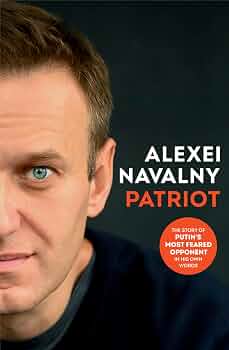
“But life works in such a way that social progress and a better future can only be achieved if a certain number of people are willing to pay the price for their right to have their own beliefs. The more of them there are, the less everyone has to pay. And the day will come when speaking the truth and advocating for justice will be commonplace and not at all dangerous in Russia.” (back cover) Unfortunately, that day will never come for Alexei Navalny, for he has paid the full price of his life.
Navalny was born in 1976 near Moscow. He was a bit of a scrawny city kid, and during the school summer break, he was sent to his father’s extended family in a village in northern Ukraine. He returned from a summer of village life well fed and a bit bigger, and the cycle repeated itself the next year. The spring before he turned 10, the Chernobyl explosion spread radiation across the region, and the village where his father was from was evacuated. Navalny was 15 when Yeltsin stood on the tanks. He was a Soviet kid, growing up in a Russia that knew both promise and crisis. He was too young to be a kitchen dissident and samizdat reader, to have the astonishing and occasionally bloody-minded bravery of an Anna Politkovskaya. He was too old to be reflexively cowed by the system that Putin built. He finished a law degree in 1998 and further training in public finance in 2001.
He has some stories of what Russian business was like in the early 2000s. One place he worked took the whole company to Turkey each year for a week, for morale building. It became a tradition, and then a legend. Navalny arrived at the business just as the bosses were trying to cut back. On the whole, the stories in Once Upon a Russia are better and wilder. As Navalny presents himself in Patriot, wild is not exactly his style. “It may sound corny, but it’s true: I wanted my efforts to make the world a better place.” Accordingly, he gradually soured on business. “My company, building offices in Moscow, offered no such opportunities. I shuddered at the thought that my whole life might be spent helping certain people make an extra couple of million dollars.” (both p. 180)
There was not a single moment that pulled him into activism and campaigning for a Russia that respected justice; there was just a sense of fairness, and that he could do something about making that normality. Navalny sums up his view while recounting his early campaigns with the Yeltsin-era reformist party Yabloko. “I went into politics to fight against people who are wrecking my country, are incapable of improving our lives, and act solely in their own interests.” (p. 180) He only has as many illusions about Russia as he has to have. He knows that the people who hold power are corrupt, and violent. He often said that the most dangerous work he did was in contract disputes in Moscow property and construction, because a common way of settling disputes in that sector was with a crowbar to the head.
Navalny consistently found ways to annoy the system that Putin was building. He was very good at bypassing major media and getting his messages to citizens across Russia. Most of the time, he stayed a step ahead of officials curbing access. He was also adept at turning bureaucratic setbacks into wins in public opinion. When election officials barred him from running for this or that office, or from registering an organization as a political party, Navalny showed that the state was afraid of an individual. Corruption was a consistent theme, and one that found support throughout the population. Why were their leaders building villas? How did they get the money for expensive watches, for apartments abroad and other signs of great wealth? Why did these public servants keep serving themselves to heaping helpings of taxpayer money?
The Putin system fought back with criminal charges, keeping Navalny tied up in court cases and, eventually, jail. These all had the useful side effect — from Putin’s point of view — of rendering him ineligible for political office. From at least 2012, escalation was the name of the game. Navalny was in and out of jails. Russia went after his brother, too, convicting him of financial crimes and sentencing him to three years of confinement. Oleg Navalny served his time, and implored Alexei not to stop because then his sacrifice would have been in vain.
In August 2020, Alexei Navalny was poisoned while he was in Tomsk. He fell ill during a flight from there to Moscow, and the plane made an emergency landing in Omsk. He barely survived. Under intense pressure from European governments and Germany in particular, the Russian government allowed Navalny to be flown to Berlin on an official German plane, for treatment at the Charité hospital. German authorities announced that he had been poisoned with Novichok, a nerve agent that is not generally available to non-state actors, and which has been used against several people the Russian state regards as enemies.
Navalny was in a coma for three weeks, and spent months in Berlin regaining his health. In this time, he wrote much of Patriot, which opens with his harrowing description of what it’s like to be dying from a nerve poison. Even while he was still in the hospital, Navalny made it clear that he intended to return to Russia. I remember thinking at the time that that was a fatal choice; Navalny must surely have known what he was choosing. In January 2021, he flew back to Russia and was immediately arrested. Thousands of people protested in major Russian cities, but they did not move the Russian government in the least. The last 200 pages of Patriot are his prison diary. Prison authorities denied him medical care; they shuffled him from place to place and kept his whereabouts hidden from Navalny’s family and lawyers. They found pretexts to keep Navalny in Russia’s harshest prisons in the country’s far north. This was a game of cat and mouse that was only ever going to have one outcome. In February 2024 — three years after Navalny’s arrest and two years after Russia’s full-scale attack on Ukraine — Navalny died. In February 2026, five European governments made a joint statement that Navalny’s death was the result of a further neurotoxin poisoning.
I hate Putin because he has stolen the last twenty years from Russia. These could have been incredible years, the sort of period that we’ve never had in our history. We had no enemies. We had peace on all our borders. The price of oil, gas, and our other natural resources was incredibly high. We earned huge amounts from our exports. Putin could have used these years to turn Russia into a prosperous country. All of could have lived better.
Instead, twenty million people live below the poverty line. Part of the money Putin and his cronies simply stole; part of it was squandered. They did nothing good for our country, and that is their worst crime against our children and the country’s future. I’m afraid that we’ll never again have such a well-fed, peaceful, and happy period, and I cannot but feel regret for this and hatred for those who stile from us the possibility of enjoying it. (pp. 274–75)
In his telling, Navalny never appears to have seriously considered not returning to Russia. He had his country; he had his beliefs; he had his life. But the system in his country said to him: Choose two.

 Al Singh
 Doug Merrill
 Doreen Sheridan
 Emily Lauer
 John Pitzel
 Lars N. Goldschlager
 Laura Eilers
 Professor X
 Robert Maedgen
 Sylvere Ap Leanan
 The Shire