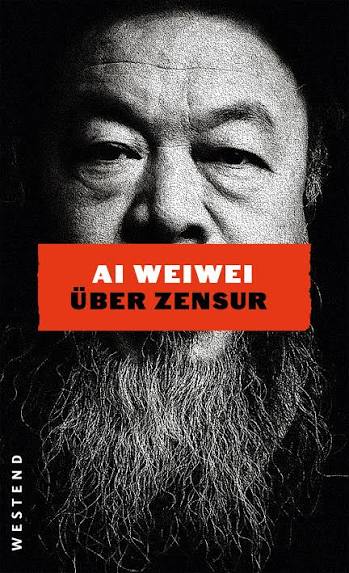
The title translates as On Censorship, and over the course of his life, Chinese artist Ai Weiwei has encountered it far more than most people. (The book was originally published in English; I received this edition as a birthday present. It was translated into German by Luca Groß, and it reads both smoothly and clearly.) His father was the poet Ai Qing, and thanks to the censorship of the Chinese state and the Chinese Communist Party, the Ai family was exiled from Beijing to northeastern China in 1958, and then further to Xinjiang in 1959. The family did not return to Beijing until 1976, when the younger Ai was 19. By 1978, he was part of an avant-garde art group, and in 1981 he was one of the earliest reform-era Chinese students in the United States. A chance encounter led to a friendship with Allen Ginsburg, and a living link to America’s beatniks and counterculture history.
He has worked in a wide variety of media, and he has also been a civic activist. He drew particular ire from Chinese authorities when he conducted an independent investigation into why so many buildings, especially schools, collapsed following the Sichuan earthquake of 2008. Local and national authorities wanted to censor reports of corruption; they also wanted to prevent an open accounting of how many children died in the quake’s aftermath. A police beating led to a cerebral hemorrhage, which was treatable because he was in Munich when it occurred. In 2010, local authorities in Shanghai slated his studio for demolition, and placed him under house arrest. In 2011, he was arrested on tax charges; the Chinese state confiscated his passport. In 2015, he was allowed to leave China and he settled in Germany until 2019. He declared Germany a closed society and decamped for England. He now divides his time between England, where his children are in school, and Portugal.
Censorship and control, and his reactions against them, have shaped his life and art. The best parts of this brief book are where he relates his own experiences as a way of illustrating the harm that censorship imposes on people’s lives. The book itself comprises about a score short essays, from the initial definitions of “On Censorship” and “What is Censorship?” to more oblique considerations in “Surveillance” and “Understanding the Unknown.” He offers more detailed ideas in “Censorship and Privacy” or “Censorship and Education.” For Ai, censorship is any control or attempted control of a person’s thoughts and expression by an institution with the power to try to enforce such control. Self-censorship is particularly important, because the authorities do not have the capacity to be everywhere, so they rely on people to censor themselves.
On Censorship is a good introduction to the topic. It covers the basics, and its personal importance to Ai gives his writing urgency. Unfortunately, I was a bit outside the intended audience. In the late 1980s and early to mid-1990s, I read a lot of Central European dissidents, and they engaged with the ideas of censorship and how to respond to it in great detail, so apart from his personal experiences very little of what Ai had to say was new to me. Havel, Konrad, Michnik, Milosz, Solzhenitsyn, so many more, sometimes in essays, sometimes in novels or plays. Then the changes came, and they engaged with the different challenges that a free and capitalist society posed, and they wrote about those as well. On censorship, I would say that Ai offers a decent starting place, but not a stopping place.
Unsurprisingly, he’s also completely convinced of his correctness, even when he lands on views that I think range from questionable to bonkers. He’s had to hold fast to his ideas in the face of monstrous pressure from the government of the world’s most populous state, so I’m not surprised that he has some iconoclastic views. He is a long-time supporter of Julian Assange, for example. On pages 14 and 16 of the German edition, he rails against “wokeness” and “cancel culture.” This strikes me as either an embarrassing mis-identification of who really holds power, or having had a personal encounter of some sort and then refusing to consider that there might be things that he has missed. I have misplaced the citation, but there is another place where he says that a newspaper refusing to print an article is censorship. When you’re Ai Weiwei, it is entirely possible that the long arm of Chinese influence is reaching out and preventing publication, but as a general statement, that’s nonsense. There is such a thing as editorial judgement, and it gets exercised every day. Not printing every cockamamie thing that comes in over the transom is essential to a responsible publication. I am sure that Ai has had the term “responsible” used against him, and I am equally sure that it has been misused against him. But this book doesn’t go deep enough to engage in that sort of discussion, so while it’s a good introduction, a quick read, and an interesting set of perspectives, it’s also distinctly limited. Start here, if the topic is new, but definitely don’t finish here.

 Al Singh
 Doug Merrill
 Doreen Sheridan
 Emily Lauer
 John Pitzel
 Lars N. Goldschlager
 Laura Eilers
 Professor X
 Robert Maedgen
 Sylvere Ap Leanan
 The Shire