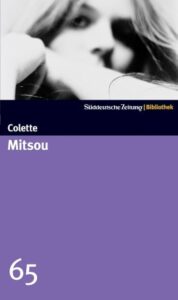
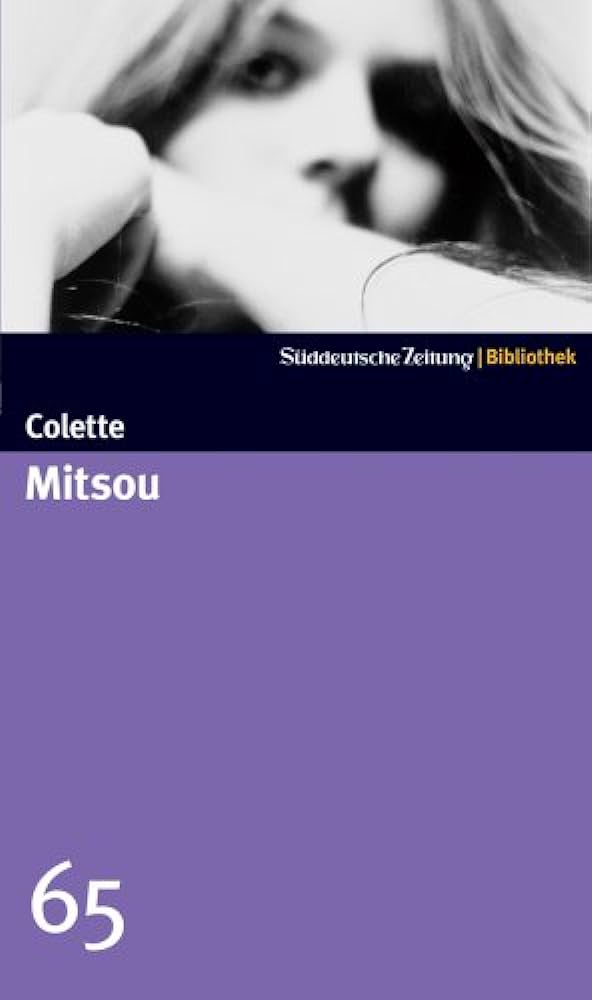
A funny thing happens when you hide a lieutenant, or indeed two, in your wardrobe. Mitsou is a performer in a Paris revue during the Great War, and the novella that bears her name opens backstage between acts, with the old stage manager trying to keep the young performers out of too much mischief and the show ticking along. One of the performers, Mitsou’s friend Petite Chose (“Little Thing”), has invited two attractive lieutenants — one in blue and one in khaki — backstage with her, but is worried about getting caught. So she persuades Mitsou to let them hide in her wardrobe. The two lieutenants barely escape the manager’s attention when Mitsou’s boyfriend, an elegant older man, appears and sees them in dashing uniforms plus Mitsou rather deshabille. Mitsou shoos them out just as Petite Chose is returning, and there’s a great comedic scene as the elegant man veers between jealousy and exasperation, while Petite Chose waxes enthusiastic about almost everything male.
Petite Chose, from the corridor: Are you there, Mitsou?
Mitsou, opening the door, sternly: Yes, you come in here!
PC, out of breath: You sent them away? At least I still caught them, they just went downstairs.
M: First apologize to my boyfriend! He’s just had quite a shock! Just imagine: he comes in and finds two soldiers in my wardrobe…
PC, in her usual flattering manner, snuggling up closely to the elegant man: Really? I’m so sorry! You can’t be mad at me — and you can’t be mad at Mitsou either. They were just so charming! Did you see them, Monsieur? Especially the blue one. He has eyes..
Elegant Man, jealous: What kind of eyes?
PC, passionately: Fiery eyes! And then his mouth! Don’t you think so, Monsieur? Mitsou, did you see his mouth? And his nostrils? Cute little nostrils that quaver when he takes a deep breath … Anyway, if you think about it, the one in khaki is just as cute. He has a wonderful complexion. Did you notice that Monsieur?
EM, drily: I must admit that I did not give them as much attention as you have.
PC, enthusiastically: Oh! I don’t miss something like that so easily! Monsieur, Monsieur, you will miss the ballet of the frantic Kabylles!
EM: I have already seen it.
PC, entirely a lady of the world: So you will remain with us. What a party!
EM: No, because I have to get back to my guests, two flour exporters, I left them back in the foyer.
PC: Two flour exporters? Oh! Send them to me! Are they good looking?
EM: The one is my uncle, the other his brother-in-law.
PC [as if she had just swallowed something bitter]: You can’t have everything.
(pp. 16–17, my translation of the German, which was translated from the French by Alexandra Auer)
The novella is written partly in the style of a play, as the quotation above shows, interspersed with short descriptions and asides. Two days after the misadventure backstage, Mitsou receives a package of small presents and a letter from the blue lieutenant. From there, Colette adds to the literary mix the letters that pass back and forth between Mitsou and the blue lieutenant. The letters show Mitsou reflecting on life and her position, alternately enticing the blue lieutenant and reminding him of their separate worlds. The chance meeting appears to be developing into something more, but do the young people even know themselves well enough to say?
Continue reading
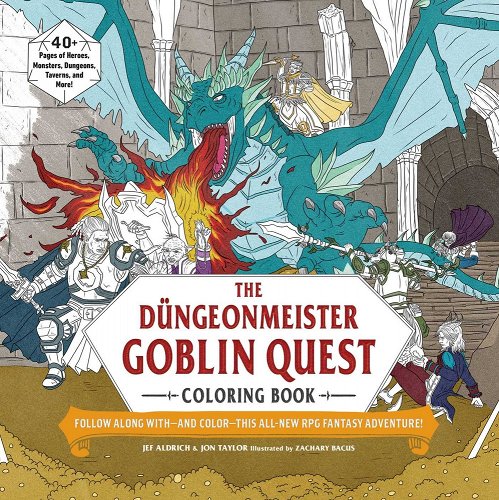 So this is something of a departure from your usual book of role-playing adventure. Most modules/campaign books are just stuffed with stats and info to help the Dungeon Master (or Dungeon Meister, in this case. We’ll just use the standard DM from here on in to reference that) lead their party on a grand tale of derring-do. This adventure-coloring-book is much lighter on detail but gives players way more agency in randomly determining what happens next in the story — if that isn’t a contradiction in terms — often by choosing what to color.


 Al Singh
 Doug Merrill
 Doreen Sheridan
 Emily Lauer
 John Pitzel
 Lars N. Goldschlager
 Laura Eilers
 Professor X
 Robert Maedgen
 Sylvere Ap Leanan
 The Shire