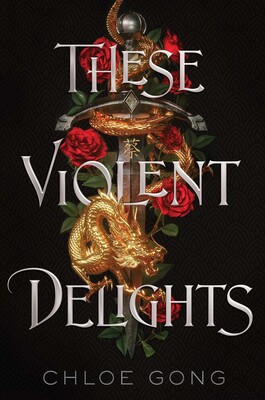
So there are some really good bits in Chloe Gong’s retelling of Romeo And Juliet, set in 1920s Shanghai and featuring the scions of two rival gang families needing to team up to defeat a supernatural threat to the city. First and foremost is the lived-in character of Juliette Cai, heir to the Scarlet Gang, whose position is threatened by her brash and, more importantly to some, male cousin Tyler. Repeatedly sent away to America for her education, Juliette adopts a Westernized persona as her signature pose, even as she bitterly resents the Western European interests that seek always to undermine local rule.
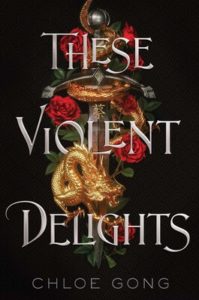 Her nemesis/true love is Roma Montagov (which is a totally nonsense name,) heir to the White Flowers, a gang descended of Russian refugees who fled the Bolsheviks and assimilated to Chinese life. I honestly loved how the White Flowers were considered native Shanghainese compared to the British and French, primarily because they weren’t there to colonize but to survive, and understand that that means respecting and absorbing local traditions and mores. Unfortunately, Roma is wildly underbaked as a character compared to Juliette, or even to her maternal cousin Kathleen Lang. Honestly, if this book had been about Juliette and Kathleen running around having adventures and defeating bad guys, as well as grappling with what it means to be a cis woman and a trans woman respectively in a patriarchal society, I’d have loved it a lot more, but I guess you can’t have an R&J retelling without Romeo. So there Roma is, and he’s… fine. He’s a pacifist, a cinnamon roll who has to be tough in order to preserve his place as heir to the White Flower leadership. I just found it silly towards the end that he didn’t quit when faced with the quandary that originally divided him from Juliette, but teenagers are a lot more tied to their parents than they want to admit.
And that’s honestly the main trouble with this book, that it’s about teenagers, none of whom are too bright, running around being violent. Whereas the original play was teenagers being melodramatic and self-destructive, These Violent Delights has them dial down the drama — it honestly is far more sensible about the romance than its inspiration — but turns the violence outward and amps it up. Which is fine, if you’re into having protagonists that aren’t particularly clever, in a plot that doesn’t particularly make sense, with, barring Kathleen, awkwardly written supporting characters who often serve more as plot devices than actual people, running around killing others with little to no consequence. The occasional paraphrasing of Shakespeare is neat, but doesn’t make up for the atrocious grammar that I’m hoping gets edited more stringently in the finalized version of the book (I read an ARC, natch.) While I can forgive the overuse of the verb surge, I’m pretty sure Ms Gong has never broiled anything in her life, given the way she constantly uses the word as a cross between “boil” and “roil” when it is like neither of those things. I get wanting to expand the limits of language, but words have meanings. Don’t even get me started on the use of exhale and inhale as nouns, in just another egregious example that seems to be endemic to the YA genre recently. Ffs, editors, do your jobs.
Continue reading
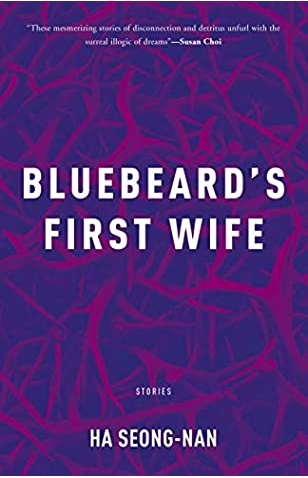 I have a bad habit of not remembering why I picked up certain volumes, not helped by the often considerable lag time between me deciding I want to read a book and me actually getting the opportunity to read it. So I vaguely recall placing a library hold on Bluebeard’s First Wife by Ha Seong-nan because I was told it was a collection of horror stories set in contemporary South Korea. And it’s not. It’s actually better.

 Al Singh
 Doug Merrill
 Doreen Sheridan
 Emily Lauer
 John Pitzel
 Lars N. Goldschlager
 Laura Eilers
 Professor X
 Robert Maedgen
 Sylvere Ap Leanan
 The Shire