Like the protagonist of Neuromancer, William Gibson is an artiste of the slightly funny deal. In The Peripheral the first slightly funny deal is between some people in England who hire some other folks in a small-town part of Appalachia in the US. The English contingent wants the people across the pond to fly a drone, ostensibly in a game, and keep other paparazzi drones away from a window high up on a London tower. They’ve contracted Burton, a partly disabled veteran of an unspecified American war, to do the remote flying. It’s close enough to what he did during wartime to take advantage of the skills that remain even after the government took back the haptic enhancements they had given him. But Burton has things to do besides swatting drones in a game, so he lets his sister Flynne take a shift or two and thinks his employers will be none the wiser. She’s at least as good with the drone as he is, and it’s all done remotely, what can go wrong?
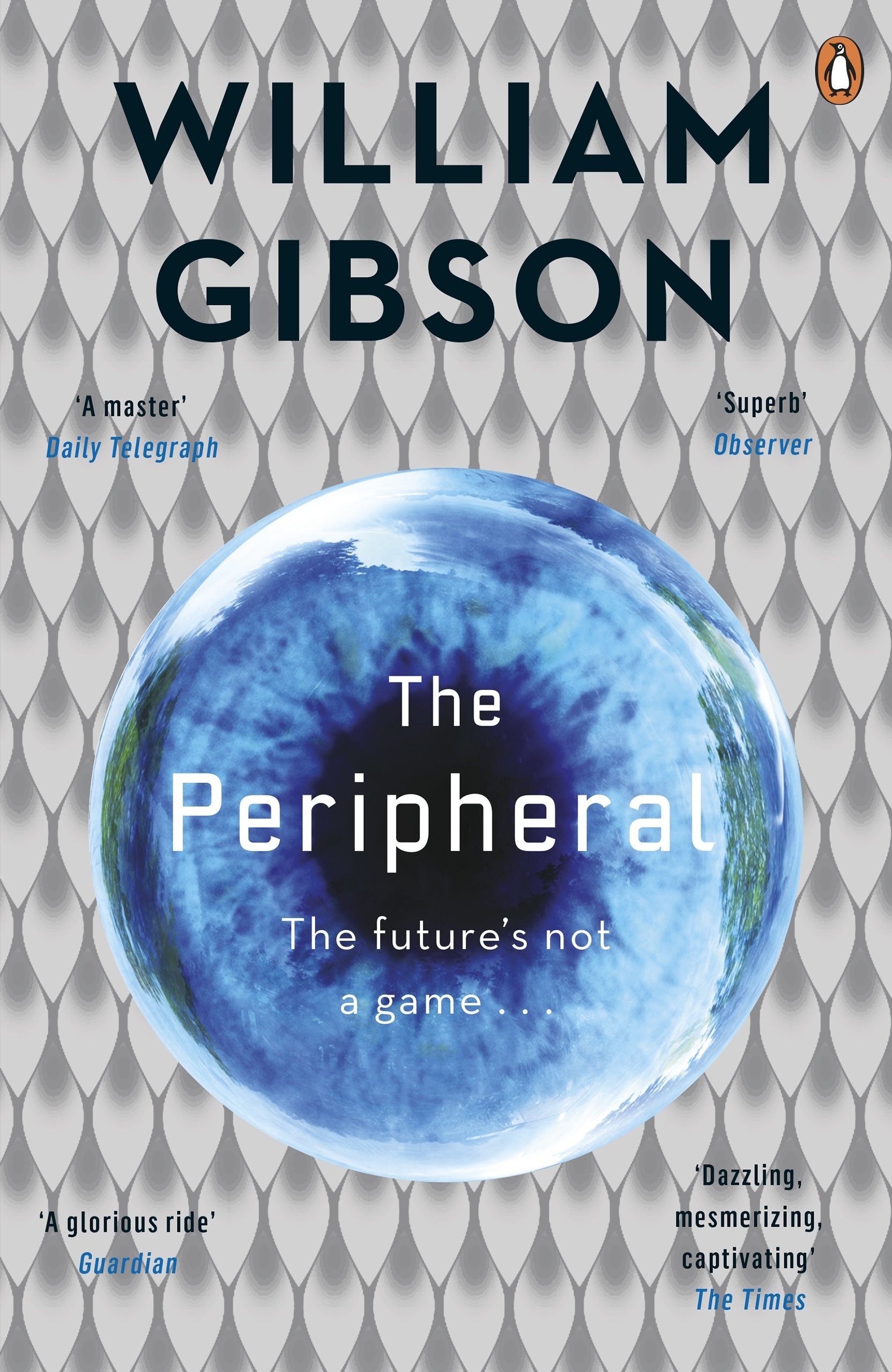
Meanwhile, Wilf Netherton is a publicist with a problem. Daedra West, a performance artist who is his current client and not incidentally a former lover, is about to cause an incident by parafoiling into a mid-ocean meeting wearing nothing but a lot of brand-new tattoos. That will upset the sponsors who include puritanical Saudis. That reaction is likely to be mild compared with what her counterparts at the meeting might do: eat her right up, as they have done to more than one person who recently attempted contact. That won’t be the worst of it, says Rainey, Wilf’s partner on the project. “She’s a death cookie, Wilf, for the next week or so. Anyone so much as steals a kiss goes into anaphylactic shock. Something with her thumbnails, too, but we’re less clear on that.” (p. 6) What can go right?
The opening chapters are unforgiving, alternating between the two settings and giving readers little in the way of description and a lot in the way of terms particular to each. Gibson shows what his characters experience and has them talk like regular people of the worlds that they inhabit who know that everyone they talk with shares the same context. What gradually emerges (although the text on the cover spells much of this out) is that Burton and Flynne are in the near future, living in a poor county in the hills where much of the economy runs on drug manufacturing, while Wilf and Daedra are about seventy years further into the future on the other side of interlocking disasters — pandemics (The Peripheral was published in 2014), climate crises, social breakdown — that are collectively called “the jackpot.” Those disasters kill a large share of humanity, but the survivors have mastered advanced technologies such as nanotech assembly, carbon sequestration, personalized medicine, full-brain telepresence, and more.



 Al Singh
 Doug Merrill
 Doreen Sheridan
 Emily Lauer
 John Pitzel
 Lars N. Goldschlager
 Laura Eilers
 Professor X
 Robert Maedgen
 Sylvere Ap Leanan
 The Shire