Hello, readers! We have a spooky season treat for you today, as Christa Carmen joins us to talk about her latest book, How To Fake A Haunting, and the Rhode Island legends that have inspired her writing.
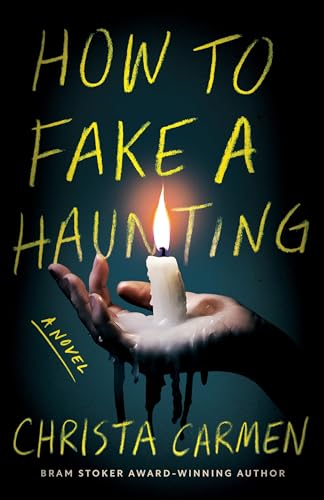 But first, a little bit about the novel. Lainey Taylor wants out of her marriage to her alcoholic, erratic husband Callum. She’s convinced that it’s only a matter of time before he puts her life and the life of their daughter Beatrix in danger. Unfortunately, he has no interest in ending the marriage and giving her the full custody that she wants. He’d rather die first, as he’s more than happy to remind her.
Since Lainey isn’t the murderous type, she and her friend Adelaide hatch another plan to take advantage of Callum’s increasing drink-induced hallucinations. They’re going to stage a haunting. Nothing too wild: just some odd noises, some weird smells, a few dead flies by the windowsill. If she can drive him out of their home, maybe she’ll be able to drive him out of her life for good.
But what if faking a haunting means inviting a real haunting into their lives? As everything goes horribly awry, Lainey will have to join forces with Callum to put an end to something far greater and more terrible than their own marital woes, if either if them is to have a chance of surviving.
Ms Carmen talks a little about her inspiration for this book, as well as the ghost stories of her Rhode Island home, in the fascinating essay below:
~~~~~~~
In the late 1800s, in Foster, Rhode Island, a woman named Dolly Cole is reported to have lived in the woods near the Hopkins Mill. In all of the stories about Dolly, there is no man mentioned, no husband, no father to Dolly’s little girl, so it should come as no surprise that Dolly’s reputation for being a little too wise, a little too skilled in the realm of natural remedies made her a target for suspicion, and eventually, outright fear. Before long, the villagers had plotted to burn Dolly in her home in order to rid themselves of a witch. As the hysteria grew, along with the flames, Dolly emerged from the woods, having gone to the river for a bucket of water. She returned just in time to see her house become so consumed by the fire that rescuing her daughter from inside it was an impossibility.
There are many different versions of Dolly’s legend, but in the one most oft-repeated, Dolly returned to the river in order to curse those who’d killed her daughter, only to be overtaken by the villagers and drowned in the black water that powered the nearby mill. Her ghost has wandered the woods around the mill ever since, a vengeful figure carrying a bucket of water, tortured by her inability to save her beloved child.
Around that same time, twenty-five miles south, Mercy Brown was fending off equally harmful but slightly different suspicions from the residents of Exeter. Nine years earlier, in 1883, Mercy‘s mother, Mother Eliza, and Mercy’s older sister, Mary Olive, perished from consumption. Now, in 1891, Mercy and her brother, Edmund, were exhibiting similar symptoms of the wasting disease. Mercy succumbed quickly, and afterward, there were whispered rumors of “offending corpses,” undead specters that could rise from the graves to drain the life force of the living, a superstition believed to have been passed down from Hessian mercenaries in the Revolutionary War. Mercy died on January 17, 1892, and the rumors turned to demands for action. While Edmond continued to waste away, the villagers appealed to George Brown to have his wife and two daughters exhumed in order to determine which of them might be responsible for the ongoing illnesses and deaths. George didn’t believe in the superstition himself but felt he had no choice but to relent, asking Dr. Harold Metcalf to preside over the exhumation. Mercy, who’d been interred above ground since her death three months prior, had retained blood in her heart and lungs. She was subsequently deemed the offending corpse, and her organs were burned on a nearby pyre. The ashes were mixed with water and given to Edmund to drink, but he died two months later. Rumors of Mercy’s vampirism have persisted ever since, to the point where Exeter Police have to station themselves outside the Chestnut Hill Baptist cemetery every October 31st to discourage impromptu séances and Halloween hijinks. Her tombstone is bolted to the ground to keep legend trippers from making off with it (as one did in 1996… it was mysteriously returned several days after it was stolen).
I’ve written about both of these Rhode Island legends, across two different forms. Dolly Cole was the inspiration for my short story, “The Circle” (included in the Shirley Jackson Award-, Ditmar-, and Australasian Shadows Award-nominated anthology, Monsters in the Mills: More Tales of Horror from the Ocean State). In my story, Dolly’s decision to remain in Foster despite the community’s prejudice against her ripples across time and into the present, when another woman, Calista, meets a similar fate at the hands of a team of ghost hunters intent on exposing what they believe is the truth through Calista’s impressionable daughter. With regards to the legend of Mercy Brown, I penned a novel with which I obtained my literary agent (though at present, it remains unpublished), delving into the details of Mercy’s story beyond those covered in her Wikipedia entry and trying to bring humanity to a young woman whose life was plagued by hardship and tragedy, but is remembered today as… a vampire. Both of these women’s legacies persist, for better or for worse, through ghost stories and folklore, hauntings and legends, fact and fiction.
Before I moved back to Rhode Island — and began writing in earnest — in 2013, I worked at a substance abuse treatment facility in Massachusetts, specifically, a methadone clinic. During that time, I was consistently struck by the idea that if a patient began methadone treatment, there existed the potential for tremendous repercussions down the line. Despite it being a very appropriate treatment and effective harm reduction strategy, using methadone to recover from opioid addiction was a decision that could echo throughout one’s life. In many ways, methadone is a treatment that can be lifesaving in the beginning and like liquid handcuffs by the end. Methadone patients can build outrageously successful lives in recovery, then discover, in trying to get off the medication, that those lives have been built on a foundation of cards. As their mental health counselor, watching those patients grapple with the consequences of a decision to get on this treatment two, five, ten years prior felt like witnessing a fragmentation of their very selves, like they were at this specific junction because of a single medication, a single decision, and they would be at an entirely different junction if not for that single decision made in desperation, in the space of a single shaky breath. Rarely can we pinpoint the moment in which the Butterfly Effect is set in motion, but in these instances, I felt like I was looking back along a very clear path, and seeing in startling clarity, the shuddering of the monarch’s wings.
Another reason why I’m fascinated by Dolly’s and Mercy’s stories is because I can’t help but wonder at what moment they crossed the threshold between actions that would have kept them a mystery to us here in the present, and actions or decisions—likely reactive ones—that catapulted them forward in time, destined, for better or worse, to be remembered indefinitely for who they were… or who they’ve been perceived to be. Exploring Mercy and Dolly’s histories felt like opening a Pandora’s Box of existential questions: How do any of our decisions in the present affect our future selves? Can our present selves be haunting our future selves even now, and we’re just not aware of it? How much do the ghosts of our past selves infringe on the present? Are we one person at all, or an amalgamation of all the selves we’ve ever been… and ever will be? Do we control our own fate, or might that be written—or rewritten—at some point in the future based on circumstances beyond our control?
My experience of working at that clinic, and of my own journey into and out of substance abuse, was also very much a catalyst for my new novel, How to Fake a Haunting. Main character Lainey Taylor isn’t in any sort of mental health treatment or recovery, but she does believe, unequivocally, that she is the best person to care for her daughter, the one who’d help her daughter forge the brightest future, only to discover that a single decision could set things on a path where that might not be the case. Again, I played with the idea of exploring choices and analyzing how those choices echo throughout the next two, five, ten years of one’s life. Terrifying? Maybe. But also eye-opening and riveting and enlightening. That one moment with the potential to change the course of a life informed how I wrote Lainey, how I wrote Dolly and Mercy, and how I’ve written numerous other characters throughout my fiction (namely, Alice “Allie” Stevens in “Through the Looking Glass and Straight into Hell,” from Orphans of Bliss: Tales of Addiction Horror). It’s truth versus legend, plan versus circumstance, autonomy versus loss of control of one’s personal narrative. If nothing else, I hope readers will consider the idea that a haunting, a story, a life, might not be linear at all, but circular, or maybe an infinite reflection, parallel mirrors producing diminishing reflections that go on forever, the source of which we may never truly know.
But the source of which I’ll continue to search for throughout my writing and across Rhode Island’s rich folkloric traditions, complex histories persisting throughout the centuries like a wronged mother’s curse or a stone slab over a crypt.
~~~~~~~
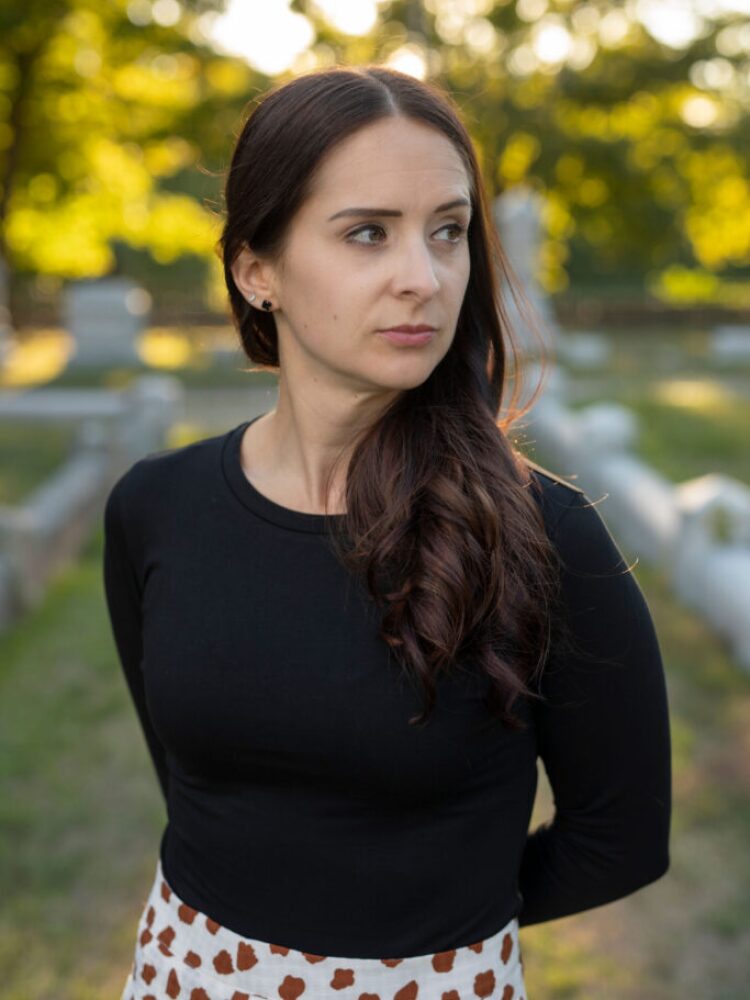 Christa Carmen lives in Rhode Island. She is the Bram Stoker Award-winning and two-time Shirley Jackson Award-nominated author of The Daughters of Block Island, Beneath the Poet’s House, and How to Fake a Haunting, as well as the Indie Horror Book Award-winning Something Borrowed, Something Blood-Soaked, the Bram Stoker Award-nominated “Through the Looking Glass and Straight into Hell” (Orphans of Bliss: Tales of Addiction Horror), and co-editor of the Aurealis Award-nominated We Are Providence and the Australiasian Shadow Award-nominated Monsters in the Mills. She has a BA from the University of Pennsylvania, an MA from Boston College, and an MFA from the University of Southern Maine.
When she’s not writing, she keeps chickens; uses a Ouija board to ghost-hug her dear, departed beagle; and sets out on adventures with her husband, daughter, and bloodhound–golden retriever mix. Most of her work comes from gazing upon the ghosts of the past or else into the dark corners of nature, those places where whorls of bark become owl eyes, and deer step through tunnels of hanging leaves and creeping briars only to disappear.
~~~~~~~
How To Fake A Haunting by Christa Carmen was published October 7 2025 by Thomas & Mercer and is available from all good booksellers, including

 Al Singh
 Doug Merrill
 Doreen Sheridan
 Emily Lauer
 John Pitzel
 Lars N. Goldschlager
 Laura Eilers
 Professor X
 Robert Maedgen
 Sylvere Ap Leanan
 The Shire