For reasons not detailed within the novel, the planet Athos is settled exclusively by men. It’s a backwater, isolated by choice and religious conviction. Converts are few, visitors prohibited, and travel off-planet essentially nil. The rest of spacefaring humanity seems to regard them as quaint but harmless oddballs.
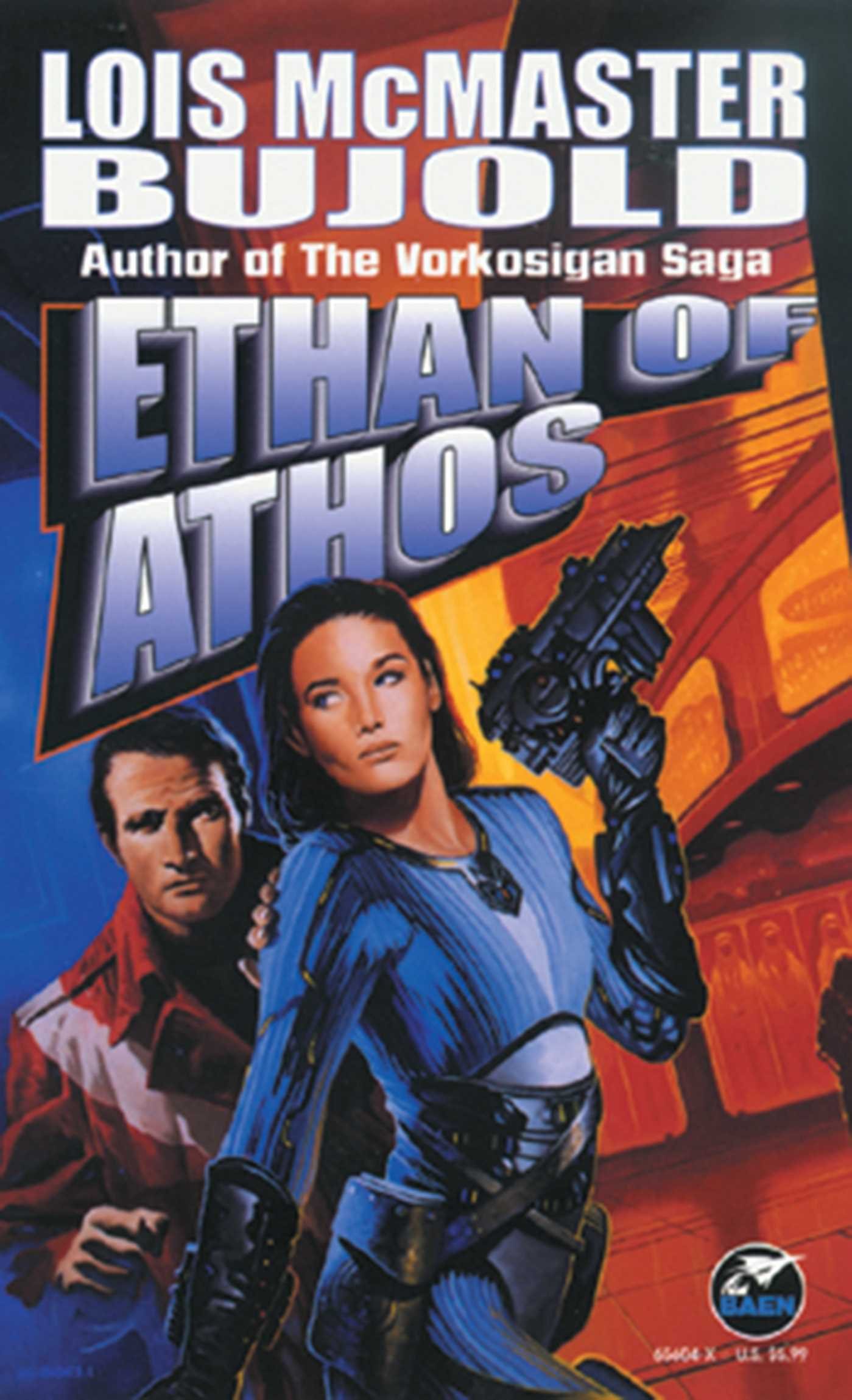
The men of Athos have mastered the technology of artificial wombs, and of course they have sufficient genetic technology to only create male embryos, but they are still dependent on cultures of ovarian cells. In the two hundred or so years since Athos was settled, these cultures have started to degrade. Scientists on Athos determined that the rate of decay is increasing and will reach a crisis in the near future. As the novel opens, they have bought replacement lines from one of interstellar society’s centers of genetic expertise. Unfortunately, something has gone wrong along the way, and the delivery that reaches Athos is cellular junk.
Athos has no choice but to send an emissary into the outside worlds. They choose Dr. Ethan Urquhart, chief of biology at one of the planet’s reproductive centers. He’s smart, and resourceful by local standards, but isolation from half of humanity has left him almost comically unprepared for a mission that will turn out to be much more than some commercial acquisition. Athosian society comes across as Calvin’s “Girls Are Icky” Club writ large, and its supposedly wise councils like a bunch of bickering old maids.
[Ethan] found himself looking suddenly, on screen, at two of the strangest faces he had ever seen.
Beardless, like men without sons, or boys, but devoid of a boy’s bloom of youth. Pale soft faces, thin-boned, yet lined and time-scored; the engineer’s hair was nearly white. The other was thick-bodied, lumpy in a pale blue lab smock.
Ethan trembled, waiting for the insanity to strike him from their level, medusan gazes. Nothing happened. After a moment, he unclutched the desk edge. Perhaps the madness that possessed galactic men, slaves to these creatures, was something only transmitted in the flesh. Some incalculable telepathic aura? Bravely, he raised his eyes again to the figures in the screen.
So. That was a woman—two women in fact. He sought his own reaction; to his immense relief, he seemed to be profoundly unaffected. Indifference, even mild revulsion. The Sink of Sin did not appear to be draining his soul to perdition on sight, always presuming he had a soul. (p. 14)
Bujold is having one on about male supremacists, a laugh at the religiously driven misogyny that tends toward the cruel and the vile rather than toward the harmlessly dotty. Anyway, Ethan of Athos is a novel of intrigue, action and adventure rather than of theology and sociology, so Bujold does not dwell on these points. Instead, she sends Ethan off to Kline Station, a sprawling artificial habitat at a nexus of interstellar travel routes. Then, through bumbling on Ethan’s part she places him in the capable hands of Elli Quinn, an officer in the Dendarii Mercenary Fleet, a native of Kline Station, and the link to the larger Vorkosigan Saga.
At first, Quinn is willing to help him to uphold Kline’s reputation for aiding travelers, but they soon discover links between Ethan’s mission and her own undercover reasons for visiting Kline. Sending genetic junk to Athos wasn’t just a mistake or greedy maliciousness, but a deliberate act of sabotage. Ethan and Quinn have to race to find out which of several possible suspect factions cares so much about Athos’ genetic material before those factions can eliminate the Athosian emissary with extreme prejudice.
The action and reversals come fast and furious, and the book’s good fun to read. Bujold brings it all home in fewer than 250 pages, a size nearly lost in contemporary science fiction but just right for an afternoon of reading. Keep the popcorn handy, sit back, watch the heroes overcome the odds and grow a bit in the process.




 Al Singh
 Doug Merrill
 Doreen Sheridan
 Emily Lauer
 John Pitzel
 Lars N. Goldschlager
 Laura Eilers
 Professor X
 Robert Maedgen
 Sylvere Ap Leanan
 The Shire