After tangling things forwards and backwards in A Trail Through Time, Jodi Taylor offers more straightforward adventures for the historians of St Mary’s in No Time Like the Past. Which is to say, there are calamities, dangers expected and otherwise, narrow escapes, and scuffles with university bureaucracy. I would say that Dr Madeleine Maxwell, first-person narrator of the series, handles it all with aplomb, but the truth is that she is the cause of several of the calamities, she gets badly wounded in the middle of the book, and she nearly derails Western civilization towards the end by thonking the wrong person at Thermopylae.
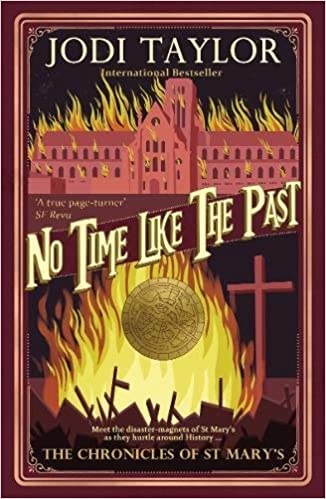
Along the way, they try to rescue the budget by salvaging items from St Paul’s during the Great Fire of London and nearly burn up several historians for their trouble. That’s to say nothing of the summer festival of St Mary’s, where their boat is to race against the one from Thirsk University, competing by hook and by crook. Uninvited guests arrive, and several things blow up, only few of which were planned that way.
The visit to Botticelli makes up for a lot.
There is a wonderfully reflective moment between Max and Dr Bairstow, the director of St Mary’s: “I still remember your first day here. The day we met. You stumped into my office with, as I believe I remarked to Mrs Partridge afterwards, an armful of qualifications and a bucketful of attitude and nothing has ever been quite the same since.” (p. 365)
No Time Like the Past feels like a bit of a breather in the overall St Mary’s series. While there is at least one major development among the continuing characters, most of the book relates episodic adventures of the historians going back in time to observe something, getting tangled in contemporary events, and trying to sort things before History does the sorting for them — something that is generally fatal to historians outside their usual time. Some of the continuing villains do show up to cause trouble, but for most of this book the historians are quite capable of causing it for themselves. When I picked this up, I wanted to take a break from heavier reading, and it was just the thing.
The fifth book in a slightly convoluted series about time travel is probably not the best place to start, and the first four are plenty of fun, too.


 Al Singh
 Doug Merrill
 Doreen Sheridan
 Emily Lauer
 John Pitzel
 Lars N. Goldschlager
 Laura Eilers
 Professor X
 Robert Maedgen
 Sylvere Ap Leanan
 The Shire