Due to my absolutely bonkers (and entirely self-inflicted) work schedule over at CriminalElement.com, I feel like I’ve had to dial back a lot on my professional obligations w/r/t books over here, but you’d best believe that when the chance to join the book tour for J. L. Worrad’s latest book came up, I jumped on it! Pennyblade was one of my favorite books of last year (note to self: go nominate it for a Hugo once the Chengdu website starts working) and I was super ready to read more set in that universe.
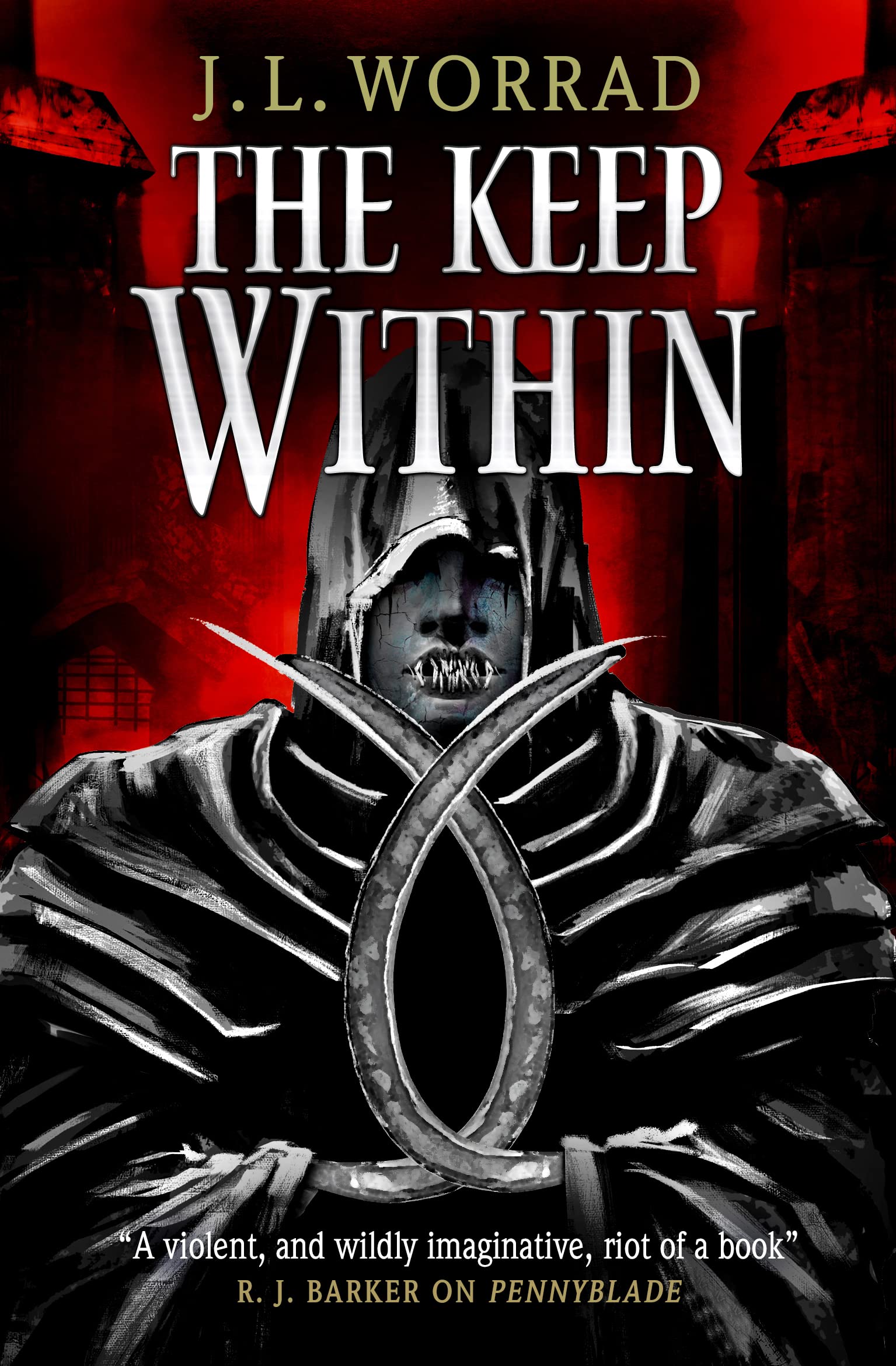 So, the bad: Kyra isn’t in this book. As far as I can tell, no one from Pennyblade appears in The Keep Within (except for maybe the gross country priest?) but I am also notoriously bad with names and details.
But the good? Oh, there is so much good!
The world depicted in TKW is the same as Pennyblade’s, tho I couldn’t tell you how far from that era it may or may not be. My grasp of real world history also tends to be shaky, but TKW feels very Tudor, if not outright Elizabethan. One of our four viewpoint characters is Sir Harrance “Harry” Larksdale, one of the reigning King Ean’s many bastard siblings. Unlike his brothers, he’s never taken to the study of the blade, preferring instead the stage. As the proprietor of The Wreath, the foremost theater in Becken, he’s a known dandy who’s given free access to the royal seat of Becken Keep, where the king and his court reside.
In the keep, the king’s First-Queen, Carmotta Il’Lunadella, is scheming. She knows that the heavily pregnant Third-Queen Emmabelle is plotting against her, but isn’t quite sure how. Chafing at the bonds that constrain her due to her sex, Carmotta plans out her intrigues even as rumors of coup swirl throughout the court.





 Al Singh
 Doug Merrill
 Doreen Sheridan
 Emily Lauer
 John Pitzel
 Lars N. Goldschlager
 Laura Eilers
 Professor X
 Robert Maedgen
 Sylvere Ap Leanan
 The Shire