What would Jazz Age America be like if it had a large and powerful Native American state in the Midwest, with its capital a thriving city called Cahokia, descendant of the largest Indigenous settlement north of Mexico? In 1922, the great Mound is still the symbolic center of the city, as it has been for nearly a thousand years. Next to it, though, is the Catholic cathedral, reflecting the alliance the future Cahokians made with the Jesuits before they made the long trek up from Mexico and settled in the Mississippi valley, displacing and mingling with the other nations who were there. The city has a radio station on a nearby bluff, an Algonkian hotel, Union Station on Grant Square, F. Xavier University, densely built traditional housing in the area immediately surrounding the ceremonial Plaza by the Mound, Germantown off to the west where many recent white immigrants live, and three modern skyscrapers just behind the Mound. They’re headquarters of the three trusts — Water, Land, Power — that undergird Cahokia’s prosperity and bring their tradition of collective ownership into the twentieth century.
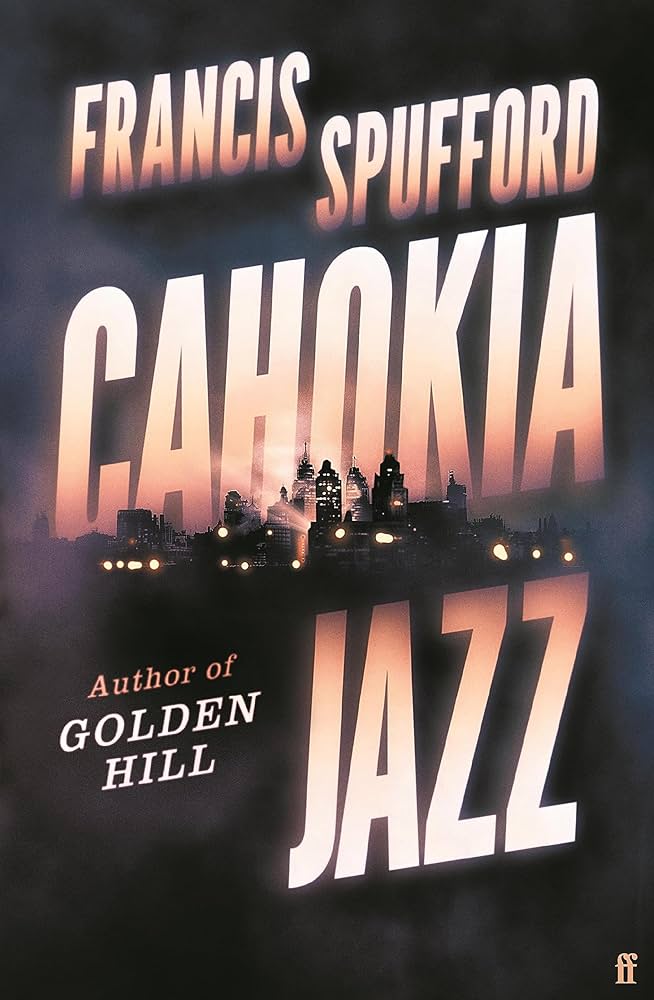
Cahokia Jazz begins atop the Land Trust amid a light pre-dawn snowfall, detectives Phin Drummond and Joe Barrow summoned by a patrolman who had been alerted by one of the building’s overnight cleaning staff. “With the building dark beneath it, the skylight on the roof of the Land Trust was a pyramid of pure black. Down the smooth black of the glass, something sticky had run, black on black, all the way down into the crust of soft spring snow at Barrow’s feet, where it puddled in sunken loops and pools like molasses. On top, a contorted mass was somehow pinned or perched. … The whole scene on the roof was a clot of shadows, and the wind was full of wet flakes.” (p. 3) Clotted indeed, for the substance that has run down the glass is blood, and the contorted mass is the body of a man who has been murdered — ritually, by all appearances — at a site that’s both inaccessible and symbolically important to the city. To make matters worse, someone has written a Cahokia gang’s slogan in blood on his forehead. “‘But they write it on walls, not on bodies,’ [said Barrow]. ‘Till now,’ said Drummond.” (p. 9)



 Al Singh
 Doug Merrill
 Doreen Sheridan
 Emily Lauer
 John Pitzel
 Lars N. Goldschlager
 Laura Eilers
 Professor X
 Robert Maedgen
 Sylvere Ap Leanan
 The Shire