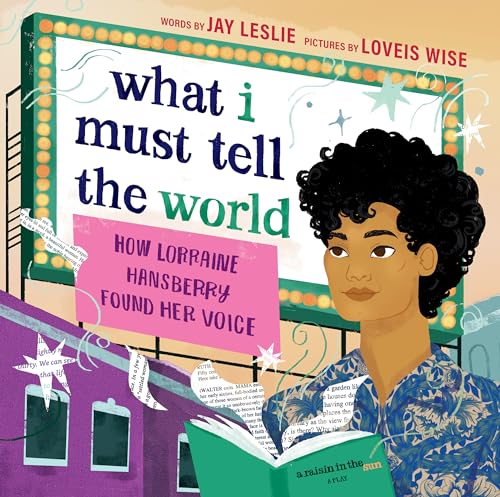
 subtitled How Lorraine Hansberry Found Her Voice
Oh, y’all, I don’t even know why I’m crying. No, actually, I suspect I do: I am shamed, and for once not in a bad way, and challenged by the courage it took for playwright Lorraine Hansberry to follow her dreams and live honestly in an era potentially even more hostile to her than the one I live in now is to me. Every life is different ofc but her valor stands out through time, reminding me — and potentially many other readers — that courage takes work, and that even just using your voice to champion the oppressed is already an important step in reshaping the world to be a better, more just place for everyone in it. It’s definitely continuing a personal trend that I recently discussed in my weekly newsletter, where I was Writing About Writing. Who do we write for, I asked, and why is it important, even when the days seem darkest? If you too need further reason to keep making art, this amazing children’s book will likely help shore you up immeasurably.
Ms Hansberry grew up the daughter of a family that decided to challenge segregation by moving from their Black Chicago neighborhood of Bronzeville to the white neighborhood of Woodlawn. Despite enduring horrifying racism, the Hansberrys persisted in proving that they belonged, even going to court to defend their right to live there. In 1940, the Supreme Court ruled in their favor in the landmark case Hansberry v Lee. As her father Carl Hansberry told all his children:









 Al Singh
 Doug Merrill
 Doreen Sheridan
 Emily Lauer
 John Pitzel
 Lars N. Goldschlager
 Laura Eilers
 Professor X
 Robert Maedgen
 Sylvere Ap Leanan
 The Shire