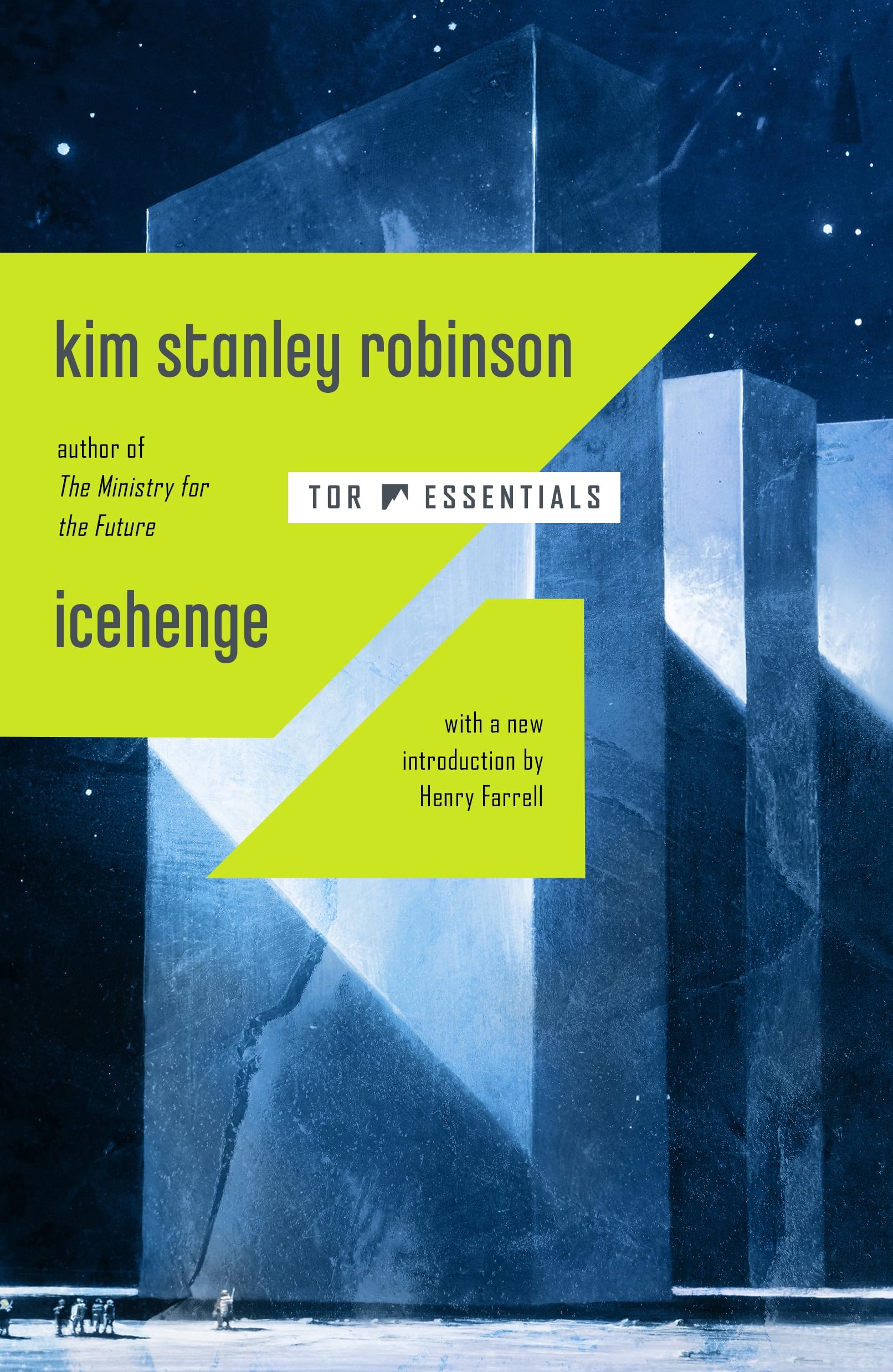
By the year 2248, when Icehenge begins, humanity has long-established settlements on Mars though terraforming is far from complete. Spaceships ply the middle planets, and asteroid mining has been an industry long enough for people to have grown up in it. One of the key differences that has made long-term projects such as terraforming viable is a set of treatments, developed in the early twenty-first century, that stop aging in adulthood. People in the era of Icehenge expect to live on the order of a thousand years, though obviously nobody has managed that much yet. Robinson tells his tales of this epoch through three interlinked first-person novellas, one set in 2248, one in 2547 and one in 2610.
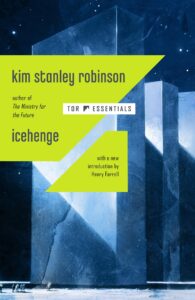
Emma Weil’s story starts on the interplanetary vessel Rust Eagle, and in the very first sentence she lets readers know that the journey will be interrupted by a mutiny. She is an ecological systems engineer, one of the best in the business, keeping spaceships’ life support systems in balance on long voyages as humans and the life forms that support them breathe in and out, eat and excrete, using and returning to the onboard environment oxygen and carbon dioxide and many other trace items that are nonetheless vital. The closer a ship can get to becoming a closed system the lower its running costs, an important consideration in the economics that Robinson has set up in the book.
Looking nearly three hundred years into the future — Icehenge was published in 1984 — Robinson considered that Earth would still be dominated by the United States and the Soviet Union, but that they would work together through the Mars Development Committee to keep the Red Planet under their two thumbs. He doesn’t dwell on Earth, which is just as well given that the Soviet Union had less than a decade left to run, but posits that conditions on Mars would lend themselves to bureaucratic dominance and very little freedom, even deep into the terraforming process. In Emma’s time, people can move around in domed cities but outside the domes they still need life support of some sort, whether vehicles or suits. The Committee’s technocrats extend their control over the material conditions of colonists’ lives into thorough control of their lives in general.
Naturally, not everyone is willing to follow the Committee’s strictures. Some of them wind up in jail, orbiting Mars. Emma’s father is in that jail. Others have hatched a long-running plan; that’s the mutiny that Emma mentions in the first sentence of her account. Of course it only looks like a long plan to readers. To characters with a lifespan plausibly measured in centuries, spending a few decades putting certain things into motion is a modest investment, especially if the payoff is freedom or something even more audacious.
Continue reading

 We have a fun excerpt for you this week, readers, as we dive into a comic take on your usual Scandinoir crime thriller. Translated from the Finnish by David Hackston, this darkly funny novel is the perfect balance of thrills, twists and laughter.


 Al Singh
 Doug Merrill
 Doreen Sheridan
 Emily Lauer
 John Pitzel
 Lars N. Goldschlager
 Laura Eilers
 Professor X
 Robert Maedgen
 Sylvere Ap Leanan
 The Shire