Ninefox Gambit (The Machineries of Empire, #1) by Yoon Ha Lee

Whoo, jeez, this was one hell of a read!
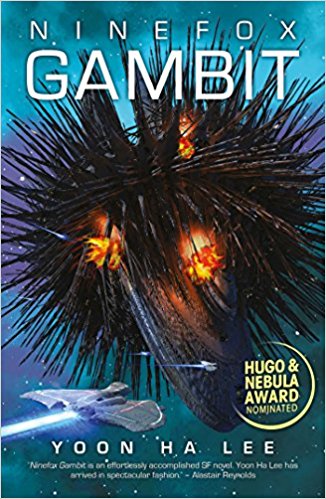
So you know that bromide, that any scientific technology, advanced enough, is indistinguishable from magic? To a very large extent, one can apply that to science fiction, where if we follow theoretical math and physics to their natural conclusions, the results are indistinguishable from fantasy. Because, y’all, this book works on the tenet that mathematical harmonics are codeable not only into weapons and defense systems, but also into genetics and physical behavior modification. The basis is the “calendar” or the overarching numerical system upon which the Hexarchate, the galactic empire that our heroes serve, hangs its technology, propped up by its citizens’ belief (which is another fascinating deep dive into the intersection between quantum mechanics and human philosophy.) There’s some crazy theoretical math made practical here, and if you’re not familiar enough with or willing enough to concede that these are a plausible, if speculative, use of the concepts, then you’re gonna have a bad time. But if you’re okay with accepting that there’s a future where pure math can be bent into applied, then ooh boy, are you in for a treat with Ninefox Gambit!

I just realized that the entire preceding paragraph makes this book sound like total nerd wankery, but I promise you, it’s a terrific space opera that just happens to use some crazy ass tech as its basis (insert comparison of Yoon Ha Lee to the Hexarchate here, lol.) There’s this Captain, Kel Cheris, who is selected to lead the assault on an important fortress that has sunk into calendrical heresies. To this end, she has been given the weapon that is the shade of the legendary general Shuos Jedao, who was executed and kept in a sort of limbo to be brought back whenever the Kel Command saw fit. Jedao never lost a battle, not even the one where, two hundred years before this, he massacred not only an enemy base but also all of his own troops before being captured and condemned to undeath. Now, he is the greatest weapon the Hexarchate has against a heresy that threatens the entire empire. But is he really working with Cheris or does he have plans of his own?

Mr Lee writes like a man swiftly navigating a tangled, thorny tightrope. It’s a bravura performance that relies on the reader being smart enough to follow along as he plunges you into action and betrayal and scenes from lives and times in chaos. It’s a book that at once praises and despairs of military discipline and loyalty, even as it presents a refreshing view of gender and sexuality, devoid of stifling cultural baggage. Plus, it’s clearly rooted in an East Asian mythos, making for a gloriously original sort of sff. And it has sequels! I’ve already placed a hold on Raven Strategem from my local library and am very excited for the release of the final book in the trilogy this summer. Heady stuff for anyone into theoretical math and philosophy, but especially for anyone who loves a smart space opera.

Also, servitors sound cute as hell and while I’ve never given a darn about a droid, I totally want a servitor.

(Doug’s review is here.)
Permanent link to this article: https://www.thefrumiousconsortium.net/2018/02/07/ninefox-gambit-the-machineries-of-empire-1-by-yoon-ha-lee/

A Hat Full of Sky by Terry Pratchett

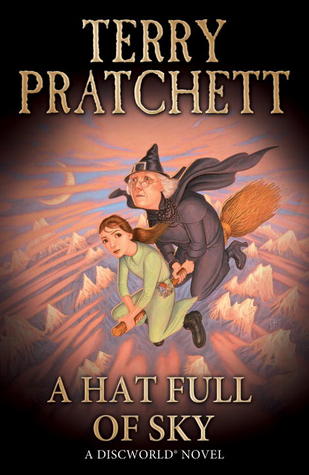
The second Tiffany Aching book, A Hat Full of Sky, picks up right where the first one left off. The Lancre witches have arranged for Tiffany to learn from a witch, in something like an apprenticeship. This matches with traditions in the Chalk, Tiffany’s home region, in which girls often went “into service.” Pratchett explains, “Traditionally, you started by helping an old lady who lived by herself; she wouldn’t be able to pay much, but since this was your first job you probably weren’t worth much either.” (p. 14) There’s a pointed message for any young adult readers!

Early on, Pratchett lines up elements that will be important later. Tiffany casually steps outside of herself to get a better look at herself than her farm’s meager mirror can provide. Just before Tiffany leaves to go into service the local Baron’s son, who is “a lot less of a twit than he had been” (p. 25) according to Tiffany, gives her a present to remember him and her homeland by. When she arrives at the new witch’s cottage, she sees a circus poster that, among other things, encouraged visitors to “See the egress!!” Pratchett slips a discussion of wishes into Tiffany’s musings on the Nac Mac Feegle, the formidable pictsies who have taken a liking to her, and even made her their chief for a brief while. The new chief, a proper Feegle kelda, makes her distrust of Tiffany plain early on, thus ensuring that she will be on her own — at least for a while – when unfortunate things start to happen. Which of course they do, or there wouldn’t be much of a story.

In A Hat Full of Sky, Pratchett introduces a new magical entity, called a Hiver. Even the Nac Mac Feegle are afraid of them. They are like bodiless parasites, taking over living beings and eventually consuming them. But a Hiver remembers everyone it has been, meaning that previous victims continue to exist, after a fashion.

About the first third of the book ambles along, showing Tiffany’s leave-taking, and how she settles into her new home and role. Miss Level, her mentor, has a secret that Tiffany soon figures out. It had made Miss Level unwelcome where she came from.

Continue reading

Permanent link to this article: https://www.thefrumiousconsortium.net/2018/02/06/a-hat-full-of-sky-by-terry-pratchett/

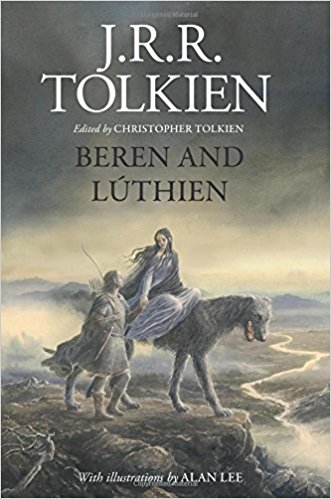
Beren and Luthien by J.R.R. Tolkien

Beren and Lúthien mainly reminded me of why I never finished The Silmarillion. There is a paragraph late in the book that explains as well as any. Editor Christopher Tolkien is describing a misunderstanding that arose between his father and his father’s publisher after the apparently unexpected success of The Hobbit. Tolkien had sent the publisher several possible manuscripts for his second publication. What with one thing and another, they did not find a reader who knew what to do with the materials Tolkien had sent, and the publisher pressed for something else.

Many years later my father wrote in a letter (16 July 1964): ‘I offered them the legends of the Elder Days, but their readers turned that down. They wanted a sequel. But I wanted heroic legends and high romance. The result was The Lord of the Rings.’ (p. 222)

And thank God for that.

It’s not that Beren and Lúthien is a bad tale, it’s just that the prose versions in the book are in an ancient register that is so distancing as to render the story nearly bloodless, while the poetic versions are narrative poetry, using mostly modern English in an Anglo-Saxon verse form to tell a high romance from the distant past of an invented world. If this weren’t Tolkien, I never would have finished, and I dare say if it had been published in the 1930s or 1940s before The Lord of the Rings it would have sunk like a stone, leaving The Hobbit as a curious one-off by an obscure Oxford professor with a knack for invented languages.

The foregoing is a bit unfair to Beren and Lúthien, which is interesting for a number of reasons. It’s interesting to see how the story changed over the decades that Tolkien worked on it, to consider what he kept, what he left out in subsequent versions, how this great love story was increasingly tied to the other legends of the First Age that he was developing over the same years. Some things never changed: Beren’s outsider background, Lúthien’s love for him over paternal objection, the quest for a Silmaril, her rescue of him, their joint return to peril, his loss of a hand, the hunt for the great wolf, her retrieval of him from beyond the veil of death. Other elements vary more. In an early, prose version, Beren is held in thrall to the lord of the cats, whereas in later versions he is captive to an early version of Sauron. Early on, Beren is also an Elf; later, he is mortal. Their fates after Beren returns from the dead also vary. Sometimes they live long lives among their peoples, sometimes they wander long but alone together, sometimes they fade quickly from the world.

Continue reading

Permanent link to this article: https://www.thefrumiousconsortium.net/2018/02/04/beren-and-luthien-by-j-r-r-tolkien/

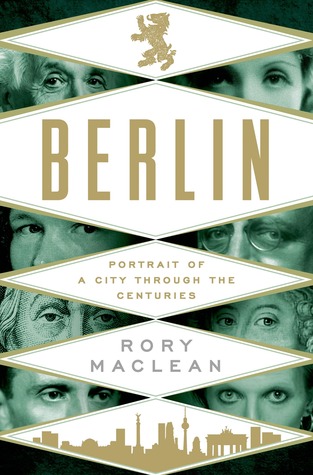
Berlin by Rory MacLean

Rory MacLean gave his book on Berlin the subtitle “Imagine a City.” His American publishers changed this to “Portrait of a City Through the Centuries,” which is odd because it loses the ties to MacLean’s prologue “Imagine” and epilogue “Imagine Berlin.” Further, the book is not a portrait but rather a collection of almost two dozen portraits of particular people (most of them real) who stand as exemplars of particular periods in Berlin’s history.

Before commencing with his portraits, MacLean ventures a few words on the city’s meaning:

Berlin is all about volatility. Its identity is based not on stability but on change, as wrote historian Alexandra Richie. No other city has repeatedly been so powerful, and fallen so low. No other capital has been so hated, so feared, so loved. No other place has been so twisted and torn across five centuries of conflict, from religious wars to Cold War, at the hub of Europe’s ideological struggle. (pp. 1–2)

Moscow would like a word. As perhaps would Rome and Tokyo, and in terms of being twisted and torn across five centuries of European struggles, certainly many cities in the continent’s central and eastern regions could give Berlin a run for the title. At any rate, MacLean has not written a comparative treatise, and the book is much better when it is particular than when it is general.

MacLean also has a personal stake. He appears in later chapters involving Marlene Dietrich and David Bowie. His engagement with Berlin started earlier, as “a teenage traveller ‘doing’ Europe.” He continues:

During a happy, footloose summer I climbed the Eiffel Tower, tripped down the Spanish Steps and felt the earth move under the stars on an Aegean beach. Then on the last week of the holiday I saw the Wall. The sight of the heinous barrier shook me to my core. At the heart of the Continent were watchtowers, barbed wire and border guards instructed to shoot fellow citizens who wanted to live under a different government. …
Throughout that week I was drawn again and again to the Wall. I stood for hours on the wooden observation platform at the end of a bizarre cul-de-sac overlooking vanished Potsdamer Platz. I stared in silence across the death strip, stunned that a clash of ideas could be set in cement at the centre of a city. (pp. 2–3)

Continue reading

Permanent link to this article: https://www.thefrumiousconsortium.net/2018/02/03/berlin-by-rory-maclean/

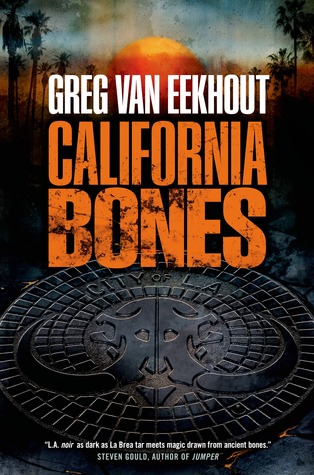
California Bones by Greg van Eekhout

This was fun. It wasn’t deep, but it was fun. California Bones is set in an alternative present in which magic of various kinds works, and California is split into two independent polities — inexplicably not nicknamed Lo Cal and No Cal, although it is implied that southern California is colloquially known as the magic kingdom. The magic most prominent in the book is osteomancy, an arcane discipline in which the essence of magical or semi-magical creatures that were or are real in this world — gryphons, sphinx, kraken, cerebrus wolves, mammoth, saber-tooth tigers, and many more — can be appropriated by magicians who consume their remains. In most cases, they cook down the bones, but flesh will do the trick, too, if available. More darkly, the same principle holds true for other magicians, and the more powerful they are, the more puissance passes on to whomever eats them up.

The story follows Daniel Blackland, the son of a powerful magician who rose high in the service of southern California’s absolute ruler, the Hierarch, and then fell out of grace and was consumed in one of the Hierarch’s periodic purges. Daniel managed to escape, and grew up under the protection of a boss in local organized crime. About halfway through California Bones, Daniel learns that he only survived at all because the Hierarch thought he had been killed by border guards when his mother crossed into her native northern California. The crime lord is named Otis, which may be a reference to Otis Chandler; van Eekhout populates his southern California with a few other notable names from our history.

Under Otis’ tutelage and using the osteomantic abilities his father taught him, Daniel grows into a skilled thief and assembles a loyal crew that is capable of complex heists. When the main story starts, Daniel has left Otis’ employ and barely scraping by, lifting small bits of magical ingredients from the marketplace and staying half a step ahead of anyone who might betray his family history.

Then one day Otis’ thugs pick Daniel up and bring him in as the boss convinces him to take on a big job: a theft from the Hierarch’s own hidden reserve of magical items. Otis wants some basilisk parts that will fetch a fortune. Daniel, Otis says, should take the sword that his father was working on when the Hierarch captured him. Not only is it a potent weapon, more potent in Daniel’s hands, but there is enough of his essence in it that if the Hierarch chose to examine it, he could discover that Daniel is not as dead as he thinks. It’s a lure and a warning.

The rest is a good, solid heist story. Daniel re-gathers the surviving members of his old team, despite some misgivings because of how their last job ended. Van Eekhout also shows how the Hierarch’s world looks from the inside, with several chapters following someone within the security services who has figured out that Daniel is still alive. It’s akin to someone in Stalin’s Soviet Union finding out that there really is a Trotskyist plot to overthrow the ruler: dangerous to know, more dangerous to tell anyone who might do something about it, possibly more dangerous still not to tell anyone.

The setting is a vividly changed Los Angeles. A different path of development means that canals have replaced freeways in the city’s building, so that it’s much like large-scale Venice on the Pacific. The La Brea Tar Pits were one of the great sources of magical bones that powered southern California’s independence and economy. Griffith Observatory is the setting for a glamorous party, and Disney plays an important role too.

The pace is brisk, and van Eekhout puts in enough obstacles and reversals to keep the excitement high and the page turning compulsive. I tore through California Bones in about a day and a half.

There are two more books in the set, Pacific Fire and Dragon Coast, and I look forward to finding out what else is happening in this darkly sorcerous California.

Permanent link to this article: https://www.thefrumiousconsortium.net/2018/02/02/california-bones-by-greg-van-eekhout/

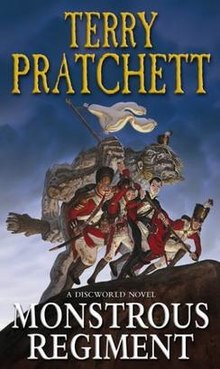
Monstrous Regiment by Terry Pratchett

One of the things I like about middle and later Discworld novels is Terry Pratchett’s willingness to start a farce and then just keep going with it, well past the point where a more cautious or less experienced author would have reined in his plot and characters. I noted this in particular in The Fifth Elephant, when Pratchett gives considerable authority to a character who is utterly unsuited for it and he just keeps going, letting the character dig himself ever deeper in as the absurdities multiply.

Monstrous Regiment offers an extended send-up of military life, and it starts with an element that is not obviously part of a farce: a teenage girl cuts her hair, dresses up like a boy, and joins the army to get out of her no-horse village. Polly, who decides to call herself Oliver in the army, comes from Borogravia, a small country with a militant reputation, an eccentric god, a Duchess who hasn’t been seen in decades, and a host of enemies surrounding it.

The war is not going well, despite official proclamations, as evidenced by the veterans that Polly’s regiment sees streaming back from the front missing various major body parts and telling them in no uncertain terms to turn around. The very abbreviated course of training is another indicator, as is the army’s sudden willingness to sign up not just Polly but also a troll, an Igor, and a vampire. There’s good-natured fun had about the essential cluelessness of all officers (“Who’s looking after the rupert? [asked the corporal]. … The corporal sighed. “The officer,” he explained. “They’re all called Rupert of Rodney or Tristram or something. They get better grub than you do.” p. 100) Crafty sergeants, corrupt quartermasters, and a bullying noncom who’s also a political informer all play their appointed roles.

Continue reading

Permanent link to this article: https://www.thefrumiousconsortium.net/2018/01/30/monstrous-regiment-by-terry-pratchett/

Time Shards (Time Shards #1) by Dana Fredsti and David Fitzgerald

Wrapping up the newest available seasons of Flash and Legends Of Tomorrow on Netflix (LoT has gotten significantly better in this second season despite still having zero regard for science and physics, whereas Flash in the Savitar season is godawful,) I’m a little leery of time-travel shenanigans right now. But like Fox Mulder, I want to believe! Fortunately for me, Time Shards came along at the perfect moment to prevent me from giving up on the genre altogether.

Told from the point of view mainly of Amber, a modern young woman from California who was cosplaying as The Guild’s Codex in England when catastrophe struck, Time Shards follows a band of explorers as they fight for survival in a world fractured by chronology. Any given step can take you from modern day to prehistoric times or any point in between. I really liked how much space was given to said prehistoric times, given what a huge portion they make of Earth’s history in comparison to humanity’s brief sojourn. I also really liked how well-researched everything felt, from the history to the science: when the guy who maybe possibly caused all this explains what he’s done and what the consequences still might be, I totally went with it. I’m not the kind of person who demands absolute scientific accuracy and realism in my fiction, but I do have some standards, and Time Shards delivers.

Oddly, the only thing I somewhat disliked was Amber, and it was less to do with the character, who is essentially inoffensive, than with the way the character is written. I much, much preferred Nell and Alex, as far as the female characters went, for being resourceful and capable. I think it has to do with how the writers clearly expect me to like Amber more than she’s shown herself worthy of being liked. I keep being told she’s awesome, but I’m not really seeing it: she feels like a supporting character, at best, and not like the heroine. Hopefully, that’s something that gets sorted out in the next two books of the trilogy, as I’m really quite excited to see where this goes next!

FYI, Titan Press sent this to me for review.

Permanent link to this article: https://www.thefrumiousconsortium.net/2018/01/28/time-shards-time-shards-1-by-dana-fredsti-and-david-fitzgerald/

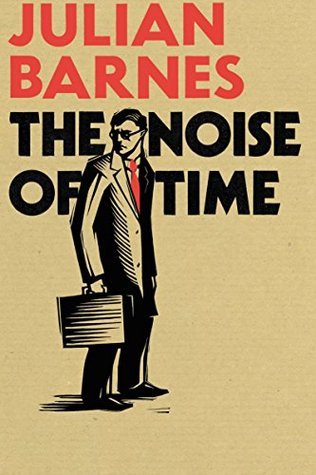
The Noise of Time by Julian Barnes

Not all terrific books about Russian topics have to be gigantic. In The Noise of Time, Julian Barnes sketches the life of Dmitri Shostakovich in fewer than 200 pages, drawing mainly on three periods in the composer’s life while using those to look back on other times. In the first, it is 1937, the height of Stalin’s purges. Shostakovich’s patron, a marshal of the Soviet Union, has fallen into disgrace and been shot. Pravda publishes a major article criticizing his music. Shostakovich thinks it is only a matter of time before he is taken in by the secret police, and he takes to spending each night by the lift in his apartment building, suitcase already in hand.

Barnes captures the terror of waiting, of knowing the ominous signs and being sure that a car will come in the depth of night but not knowing which night. He also captures the menace of a Conversation with Power, and shows how people brought in were not only expected to confess, but to implicate many others, thus helping the police fulfill their planned production of enemies of the people.

He escapes being shot, of course; as soon as Barnes gives his protagonist’s full name, a reader knows he will not be killed in the purges. But that article in Pravda echoes through his life. Shostakovich never writes another opera. Critics interpret his next symphony as a Soviet composer responding to justified criticism, and he quite consciously lets the interpretation stand.

He allowed them to stand because they protected his music. Let Power have the words, because words cannot stain music. Music escapes from words: that is its purpose, and its majesty.
The phrase also permitted those with asses’ ears to hear in his symphony what they wanted to hear. They missed the screeching irony of the final movement, that mockery of triumph. They heard only triumph itself, some loyal endorsement of Soviet music, Soviet musicology, of life under the sun of Stalin’s constitution. He had ended the symphony fortissimo and in the major. What if he had ended it pianissimo and in the minor? On such things might a life — might several lives — turn. (pp. 57–58)

Shostakovich is not shot, but he is in disfavor, and nobody wants to run the risk of playing his music. Barnes shows the kind of limbo a person could fall into in Soviet times, even, or especially, someone as high up in society as Shostakovich. The second and third sections of the book follow other, less immediately deadly, perils. In the second, Shostakovich is asked to join a delegation of Soviet representatives to an international peace conference in New York. He demurs, hoping to retain some personal integrity and not to have to parade himself before the world. Power is not so easily deferred. It insists. When Shostakovich plays his final trump, saying that his music is played and admired in the West but is prohibited at home and how should he respond when asked about it, Power replies that it had never given such an order, that there had been a mistake and that there will be a reprimand. And so his music returned to Soviet concert halls. And he went to the West, and duly recited what Power required him to say.

While the relationship between art and politics, not just in dictatorships, forms a major theme of The Noise of Time, Barnes examines much more of Shostakovich’s life in this slender volume. The relationship between family and work, where and how he found love, and how all the people involved lived with those developments — all of these are shown in the short movements, sometimes just a sentence or three, seldom more than a page and a half, that comprise the book.

This is a mature writer’s work, looking back on life as a whole, with all of its contradictions, complications, and compromises. It’s very different from The Porcupine, Barnes’ other book that looks at the legacy of Communism. That one revolves around the post-1989 trial of a newly deposed General Secretary, an unrepentant son of a bitch who tells everyone involved how worthless he thinks liberalism and the rule of law are; he takes great pleasure in reminding his opponents of their, or their parents’, compromises under the previous regime. The Noise of Time looks at those compromises from the inside, in the person of an undeniably great artist, how people get along in both their public and private lives. Shostakovich is well aware of his shortcomings, and peculiarities; Barnes portrays both with unsentimental sympathy. This is a terrific book about life, and Soviet life, and how much of it comes full circle in the end.

Permanent link to this article: https://www.thefrumiousconsortium.net/2018/01/26/the-noise-of-time-by-julian-barnes/

An Excess Male by Maggie Shen King

4.5 stars

It feels a bit mean to criticize such a thoughtful book, but I did have very long stretches of not understanding how Wei Guo could possibly be as awesome as he is given his surroundings and upbringing. Then I remind myself that he’s 44 years old and has spent that time learning how to manage people well in both personal and group settings, and it makes a lot more sense. Wei Guo is such a terrific guy, and you can see why every member of May Ling’s family (herself, her two husbands who happen to be brothers, and their son) falls in love with him. They all live in a future China where the One Child policy has led to a huge imbalance in the gender ratio. The Chinese government, instead of realizing that they should probably stop legislating families, doubles down and applies social management techniques that are a far, far cry from Wei Guo’s. Women are allowed to marry more than one man, often being sold by their parents to the highest bidder, but each man is allowed only one child. Women are almost entirely out of the workforce, as their primary role is to bear children and keep house for their husbands. Men with homosexual tendencies are labelled Willfully Sterile and denied basic human rights, as are men on the autism spectrum, here labelled Lost Boys. The rich and powerful, of course, get away with anything. It is a supremely messed up world with deeply unhappy people, drawn in such a way as to feel both realistic and perfectly plausible.

Maggie Shen King has written a tour de force of speculative fiction, extrapolating much like Margaret Atwood did with The Handmaid’s Tale, to deliver a book that is both exceedingly humane and subversive. She writes with deepest sympathy for her main characters, and it’s refreshing to read of heroes who include a gay man, an autistic man (who was easily my favorite viewpoint character, as annoying as the others might have found him in their own chapters,) and a frazzled mom. Above all, An Excess Male is a scathing critique of authoritarianism and government overreach in the lives of its citizens. I’m hoping Ms King writes a sequel or two to further explore this future world, and because I want a happy ending for *name redacted but you’ll know who I mean when you read it*, damn it!

Permanent link to this article: https://www.thefrumiousconsortium.net/2018/01/26/an-excess-male-by-maggie-shen-king/

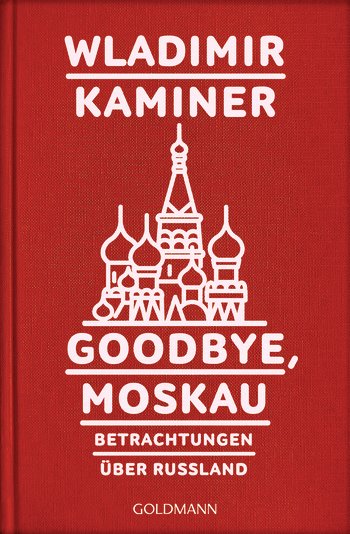
Goodbye, Moskau by Wladimir Kaminer

Wladimir Kaminer left Moscow for Berlin in 1990, and since then he has lived and chronicled the life of a Russian in the German capital. In roughly two dozen books, beginning with Russendisko (Russian Disco, first published in 2000), he explores with droll humor what it’s like to make a new life in a changing country. Kaminer’s books vary their emphasis, but almost all of them are collections of short-ish stories that depict the comic interactions of his Russian and Soviet past, his partly German present, and all of the contradictions that arise from those elements.

Goodbye, Moskau bears the subtitle “Observations About Russia.” He takes a quotation from Gogol as his epigraph, “Oh, Russia, where are you rushing? Give me an answer!” Russia’s invasion and annexation of the Crimea in 2014 looms large over the book. Kaminer grew up in the Soviet Union, so he knows very well how the state can be cruel and foolish at one and the same time. But his childhood and youth were the waning years of the USSR, and in his earlier books, there is a greater sense of the old system’s absurdities, that it could stumble around like a blind fool, that it could be a nuisance or inconvenience, but that it wasn’t particularly malevolent.

In “Crimea,” the book’s second story, and old friend of Kaminer who always wondered what the Crimean beaches would be like if they weren’t jam packed with visitors decides to go and see what it’s like after the annexation. The friend still has a Russian passport, so travel to the peninsula won’t present a problem. “Two weeks later, however, Sergei came back, tanned and well rested.”
Continue reading

Permanent link to this article: https://www.thefrumiousconsortium.net/2018/01/24/goodbye-moskau-by-wladimir-kaminer/