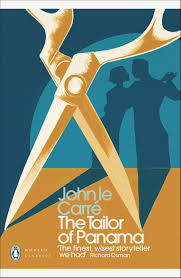
The Tailor of Panama is Harry Pendel, half of the Savile Row partnership of Pendel & Braithwaite, relocated to Panama City some years back. A large portrait of the late Arthur Braithwaite — shipped over from England at his widow’s insistence and damn the expense — presides over the premises just off the prestigious Via España. The prestige of English hand-tailoring has translated into a tidy business for Pendel. He has fitted more than one president, quite a number of ministers, practically all of Panama’s business elite, and wealthy men of discerning taste from around the region. He has not held himself above creating uniforms for men new to their high ranks, and he is far too worldly to inquire about how they attained those ranks, or indeed how legitimate their governments might be. Credit available to the right customers, but cash very much preferred.
The book was published in 1996 and is set a vague but not too large number of years following the first Bush administration’s forceful ouster of Panama’s notorious ruler Manuel Noriega in 1989. Corruption is assumed of anyone with money. The deadly violence of the drug trade is also assumed, but stays in the background in this novel. By all appearances, Pendel has created a jolly island of English probity and taste in the tropics. The men who come to his shop enjoy the whisky more than the good fitting, and there are regulars who stop by to be seen and to catch up on the latest gossip, in between business, golfing, maintenance of at least one mistress, and the other accoutrements of being rich and Panamanian. Pendel hears a lot in unguarded moments, whether that is during fittings or when his clients are relaxing in the club-like atmosphere of Pendel & Braithwaite.
Pendel himself is a devoted family man; one of the novel’s first scenes shows him taking his two children to their school. His wife, Louisa, is a daughter of one of the Canal’s leading engineers and grew up when the Canal Zone emphasized the practical colonial status of the country that surrounded the Canal. She works for a Panamanian politico-businessman, and she’s a part of the city’s network of socially elite women, parallel to the men’s networks and just as riven by affairs and personal scores. At times Pendel cannot believe his luck; at others, he cannot meet Louisa’s complex and contradictory psychological demands. Le Carré only partly explores this relationship, which is probably just as well because I do not think it would hold up to protracted investigation.
The plot begins with the arrival of one Andrew Osnard, a new intelligence agent posted to the somewhat sleepy British Embassy. Only Osnard turns up a week early to begin his activities with the Embassy none the wiser. He lights on Pendel’s shop not as an island of Englishness but as an entry point to Panamanian society. Just as the shop is slightly off the Via España, something is slightly off about Harry Pendel. Quite a bit, in fact. There was no Arthur Braithwaite, no original shop on Savile Row, no widow shipping the portrait. Pendel’s skills are real, but they were learned at an institution where he spent several years at Her Majesty’s pleasure, doing time for a small bit of arson that helped his Uncle Benny out of a large business problem. Harry never spilled the beans, and for that Uncle Benny set Harry up in Panama, to which he had retired, when Harry was released. Osnard knows all of this when he poses as a newly-arrived businessman in need of tropical suits, and by the end of his first visit he has recruited, not to say blackmailed, Pendel into becoming an intelligence source for queen and country.
Pendel, though, has a gift for invention. He has invented himself as an English tailor of impeccable pedigree, and not even his wife knows that his story is quite different. For his clients, he has invented himself as a sounding board, as a man of the world, as a skilled servant with style and discretion, traits which his bespoke suits can transmit to them as well. He is something different to each of the people in his circles: a good boss, a strict taskmaster, a beneficiary, a raconteur, a steady hand. All of these inventions are related, and all contain at least some truth, but they also sometimes rub up against each other in uncomfortable ways.
For Osnard, he delivers compelling information. Panama is naturally awash in intrigue, and its leading personalities have plenty of peccadilloes, which Pendel packages in just the ways that Osnard wants to hear. Le Carré wrote The Tailor of Panama before the phrase “sexing up” had entered discussions of dossiers, but that is Pendel’s stock in trade. There are, he reports, feuding factions within the government plus a silent opposition that might unite Panama’s middle classes, who are fed up with corruption, with the country’s downtrodden, who would like to be less trod upon. With the handover of the Canal from American to Panamanian control a few years away (treaties signed in the 1970s set the handover date as December 31, 1999), Japanese, French, Chinese, and possibly other foreign powers are feeling around for ways to take control of the vital chokepoint in international trade.
Osnard presses Pendel to deliver more and more information. London is very pleased, he says. Money flows, for Pendel, for his sources, possibly also for the causes they espouse. But the information has to keep coming, and Pendel should recruit more people into his network. It’s a classic intelligence squeeze; once someone is recruited, it is extremely difficult for them to extricate themselves. But who is playing whom? Does Osnard actually care that Pendel’s juicy intelligence might be too good to be true? Does London?
Le Carré leans heavily on the cynicism in the early years after the end of the Cold War. Here is a scene from Osnard’s recruitment into British intelligence:
“And you don’t feel — having skipped around the globe so much — family here, there and everywhere — dual passports — that you’re as it were too un-English for this kind of service? Too much a citizen of the world, rather than one of us?
Patriotism was a thorny subject. How would Osnard handle it? Would he react defensively? Would he be rude? Or worst of all emotional? They need not have feared. All he asked of them was a place to invest his amorality.
“England’s where I keep my toothbrush,” he replied to relieved laughter.
He was beginning to understand the game. It wasn’t what he said that mattered, but how he said it. Can the boy think on his feet? Does he ruffle easily? Does he finesse, is he scared, does he persuade? Can he think the lie and speak the truth? Can he think the lie and speak it? (p. 179)
Much later, as some things are starting to unravel:
“And you haven’t said anything to Osnard?” [asked the No. 2 in the Embassy].
“Whatever for? Fran’s an angel, he’s a shit, I’m a lecher. What would we possibly achieve?” [replied the Ambassador]. …
“So what do you intend to do?” Stormont said gruffly, fending off all the questions he refused to ask himself.
“Do, did you say, Nigel?” It was Maltby as Stormont remembered him: arid, pedantic and aloof. “Whatever about? … My dear man. We’re not being asked to do anything. We’re merely the servants of a higher cause.” (pp. 281–82)
The penultimate chapter is hilarious, if terribly improbable. It contains excerpts of press conferences as a spokesperson alternately tries to explain and diligently no-comments the events that make up the novel’s climax, and Le Carré lets his cynicism run free.
That attitude may make for fun reading, but it can also be corrosive. One of the shared assumptions of nearly all of the book’s characters is that the Panamanians would be incapable of running the Canal without ruining it. Corruption would lead to mishaps, killing the country’s golden goose while also throwing a monkey wrench into global commerce. Alternatively, the Americans would never keep their word; they could not possibly bear to give up so much leverage. Someone else would step in to take control, surely? This small country cannot handle so much responsibility, can it? In the event, the transition passed quietly and almost unnoticed by people outside of Panama. More than a quarter century of Panamanian management has passed, and operations continue as before. Between 2007 and 2016 a new, wider set of locks was built enabling larger ships to pass between Atlantic and Pacific, no tailors required.
+++
A film of The Tailor of Panama was released in 2001, with Piers Brosnan — who was between his third and fourth movies as James Bond — playing the role of the spy Osnard. The movie version got good reviews, but I have not seen it.

 Al Singh
 Doug Merrill
 Doreen Sheridan
 Emily Lauer
 John Pitzel
 Lars N. Goldschlager
 Laura Eilers
 Professor X
 Robert Maedgen
 Sylvere Ap Leanan
 The Shire