I liked Volume 2 of Lola’s Super Club a bit more than Vol 1, tho I think that’s due in large part to being more prepared for the absurdist humor of this title, which may or may not be to everyone’s taste. Overall, I think the quality of both art and gags were better here, perhaps due to the topics each of the two stories included chose to focus on.
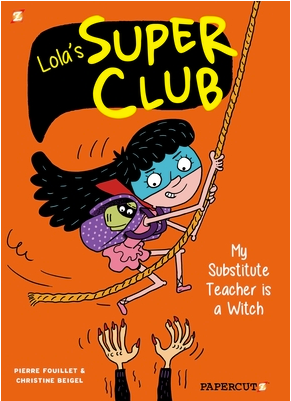 In the first story of the volume, Lola Darkhair is on her way to school in Friendly Falls, with a backpack full of the other members of her Super Club. Her classmates are excited to meet her little friends, but disaster strikes: a mean substitute teacher takes over and has extremely unrealistic expectations of the students. Odder still, she introduces a new student to the class, who happens to be her son, supervillain Max Imum. Lola, the Super Club and her classmates will have to join forces to defeat the wicked Mini Mum and her monstrous allies.
The second story, in timely fashion, revolves around the Evilympics, an event dreamed up by Mini Mum to pit the Super Club of Friendly Falls against the Villains of Fiendish Falls. In several creatively mashed up events such as Dodgeboat, Weightlifting Ping Pong, and Rhythmic Equestrian, the two teams must compete for the championship, while Mini Mum does her best to sabotage the scoring. Fortunately, Lola’s sports-loving if presently wheelchair-bound Grampy is there to help save the day.
I think my favorite part of this volume was the lesson Lola learned in villains being made not born, as you can see how Mini Mum’s behavior led her son to his life of crime. It was also nice to see Lola spend time with her grandpa, and for his disability to play a pivotal role in her team’s victory. The wittiness of the mashed up events of the Evilympics were one of the most amusing parts of this book for me, tho I could definitely have done with more of an introduction to the many of Lola’s friends who suddenly appear to help her compete. I was also not the biggest fan of the gross-out humor, and heaven save me from the preview of Astro Mouse And Light Bulb Vol I which amped that up even more. Some kids love this stuff, but I never have at any age.
 Al Singh
 Doug Merrill
 Doreen Sheridan
 Emily Lauer
 John Pitzel
 Lars N. Goldschlager
 Laura Eilers
 Professor X
 Robert Maedgen
 Sylvere Ap Leanan
 The Shire