In its 152 pages of main text, A Scandal in Königsberg gives readers a study in religious weirdness, jealousies within small-city elites, the hazards of mixing church and state, bureaucracies and their tendencies towards compromise regardless of facts, and finally the unknowability of some parts of history. Conversely, it is a testimony to what can be known in intimate detail about events nearly 200 years in the past, at least in a literate and preservation-minded society. Clark introduces the events with this brief prologue:
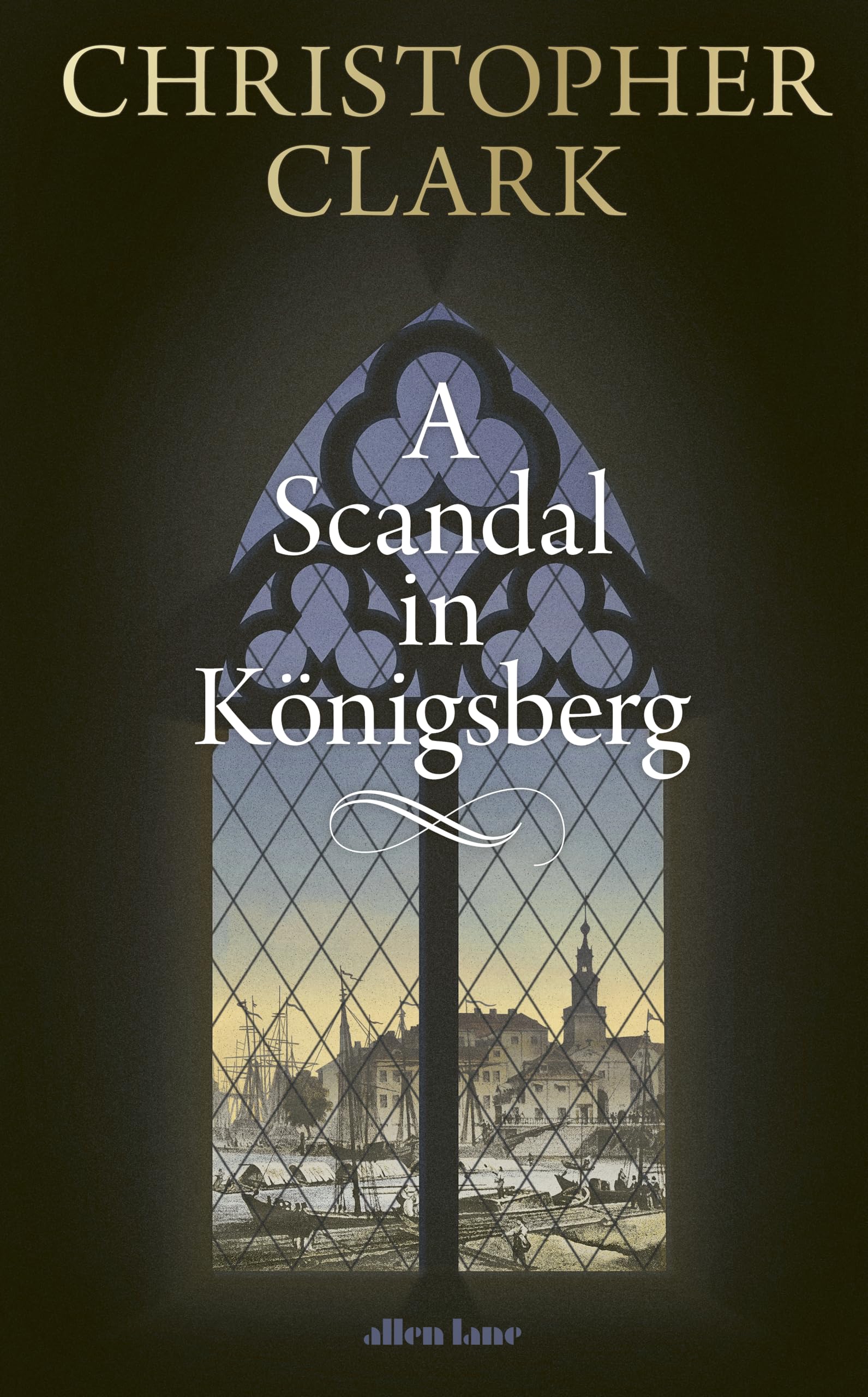
Between 1835 and 1842, scandal tightened around two clergymen in the Baltic port city of Königsberg. It destroyed their reputations, drove them out of their jobs and into prison, and banished them from public life. Their legal exoneration of the most serious charges against them came too late to reverse the damage. I have been thinking about this small vortex of turbulence ever since I happened on the relevant files in the early 1990s. The campaign of denunciations and rumour that took down the Lutheran preachers Johann Ebel and Heinrich Diestel belongs to an age before the advent of paparazzi, radio, television and digital social media, but that is precisely what endows their story with fabular power. Resemblances to present-day persons and situations, though not intended, cannot be ruled out.
Königsberg, known as Kaliningrad since it came under Soviet rule at the end of World War II, is most famous as the home of Immanuel Kant. It is also well known to mathematicians as the site of one of the founding problems of topology. The city had seven bridges that crossed three branches of the Pregel; is it possible to walk a route through the town that crosses each bridge once and only once? And if not, can this be mathematically proven? Königsberg was also the capital of Ducal Prussia, and its Hohenzollern rulers owed fealty to the Polish kings for this territory. Over the course of the 1600s, the Hohenzollern Electors of Brandenburg usurped this authority, eventually proclaiming themselves first Kings in Prussia and then Kings of Prussia.
When Napoleon broke the Prussian army, king and court were ousted from Königsberg and took refuge in Memel, today’s Klaipeda, Lithuania. Napoleon, for his part, launched the Grande Armée’s invasion of Russia from Königsberg. These world-changing events were well within living memory at the time of the scandal that Clark describes, though Königsberg itself had receded more to the status of a sleepy backwaters. As a professor at the university wrote,
… it is the city in which everything exists in a state of almost. It is almost a royal residence; dukes used to live here, electors and kings too, on occasion. It is almost an industrial city, for it has several large factories. It is almost a seaside city, because two- and three-masted ships can reach the centre of town, though the actual harbour is Pillau, seven miles away. It is almost a wealthy city because it has a number of prosperous merchants. It almost has a fortress, because a small part on the Holländer Damm is at least called a ‘fortress’ — and so on and so forth… (p. 11)
In this “city of almost,”
Johann Wilhelm Ebel, a preacher at the Old City Church, was hailed by parishioners and former school pupils wherever he walked in the streets, and everyone knew the burly preacher and division chaplain Heinrich Diestel of the Haberberg Church, who strode through town ‘like a Hussar commander.’
In the summer of 1835, a letter of complaint went from Königsberg to the Prussian Minister of Clerical, Educational and Medical Affairs. According to the letter, “A bizarre sect, influenced by the esoteric teachings of a dead eccentric, had taken root at the heart of the city’s religious life. The leader, a preacher by the name of Ebel, had encouraged his followers to engage in gross sexual impropriety. Women played a prominent role in these aberrations, many of them daughters of the province’s most prestigious families. There was talk of a pregnancy out of wedlock; two young women had apparently died of exhaustion caused by excessive arousal.” (p. 12) The report came from Theodor von Schön, President of the Province of Prussia, a post equivalent to governor.
Clark explores why von Schön might have sent such a report, and he does a deep dive into the background of Ebel. He was that rarity in state-supported clergy: a spiritual seeker. As a young man, Ebel had been intrigued by the ideas of Johann Heinrich Schönherr, a mostly self-taught religious entrepreneur who had an epiphany that he developed into an increasingly ornate and distinctly unorthodox cosmology. The 1820s and 1830s were a time of religious ferment in the Prussian provinces, and not only there. Joseph Smith had his vision of the angel Moroni in 1823; the Shakers set up their communal farm in New York in 1826. Religious innovation in the wilds of North America was one thing, in a centralizing state like Prussia where Christian clergy were in the employ of the state, it was quite another. There were royal decrees within the Ministry of Clerical, Education and Medical Affairs that officials should report on separatist and unorthodox religious activity that they became aware of. The Ministry should mind how the ministers were ministering, as it were.
Ebel was not only a genuine seeker, he was a good listener, an effective preacher, and someone attuned to the needs of his parishioners. Clark details one case where he was able to bring a young woman out of a deep spiritual crisis that had left her listless and depressed, such that her family worried that she would soon perish. The family being prominent in Königsberg and her reintegration into society so successful, Ebel soon won entrée into the city’s most genteel circles. “Good looks helped too: the young Ebel wore his hair very long, so that it fell in cascades of dark curls around his neck, and he parted it down the centre of his head, ‘like a lady.’ … He possessed a sympathy for and insight into the specific predicaments of women.” (pp- 36–37)
Clark details the fallout from the salacious charges that followed von Schön’s report. He shows how procedures that were supposed to be neutral were made to be one-sided by parties to the case. Personalities played into what might have been dry proceedings. Ebel’s co-respondent, Diestel, is combative. His responses fall just short of provoking a duel, which was still a living tradition at that time. Clark further demonstrates how officialdom was more concerned with a quiet outcome than in discovering the truth of the matter. A Scandal in Königsberg is a fascinating look at another time in place, doubly so when one considers how common the dynamics seen in the Prussian dispute are in other settings, very much including the present day.

 Al Singh
 Doug Merrill
 Doreen Sheridan
 Emily Lauer
 John Pitzel
 Lars N. Goldschlager
 Laura Eilers
 Professor X
 Robert Maedgen
 Sylvere Ap Leanan
 The Shire