Exhalation by Ted Chiang

Hey, I finally got around to reading the oldest book on my NetGalley list! This is how rich and miserable my reading backlog has been: I verily feel like King Midas on the days I don’t feel like Ado Annie.

But enough with my random allusions: how is the book, Doreen? (Forgive me, I’m a bit loopy off illness and cold meds.) I actually read it in chunks, covering the relevant stuff for their nominated Hugo year. I enjoyed Anxiety Is The Dizziness Of Freedom well enough, but was definitely not a fan of Omphalos, as my religion is all about both science and metaphor (i.e. none of this young-Earth nonsense. Literalism is death to faith, ime.) Thus the thought exercise presented here was less sympathetic than so much typical “why am I not the center of the universe?” wankery to me.

I felt similarly with What’s Expected Of Us despite it being less about faith than secular humanism. My religion believes in fate being a map of fixed points, with free will determining how we react to each and how we get from point to point. Muslim lives, unlike the lives of most pre-determinists, aren’t lockstep marches from birth to death. There’s also the important caveat of no one actually knowing what their fate will be, which is why it’s important to live your best life and not judge others’. Ted Chiang actually does an incredible job portraying how Islam deals with future science in the opening story of this collection, The Merchant And The Alchemist’s Gate, which is probably the most colorful — in the sense of evoking visceral setting detail — of the stories included here.

Continue reading

Permanent link to this article: https://www.thefrumiousconsortium.net/2022/04/05/exhalation-by-ted-chiang/

Reading Munich — München erlesen

The first great virtue of the 20-volume “München erlesen” (Selected Munich, with a bit of a pun on the German word for reading) series is the simple fact of its existence. There are not many provincial capitals that could support a literary series that runs to 20 books, let alone one with the quality of authors from Thomas Mann and Alfred Andersch to the less well known but still excellent Lena Christ and Franziska Gräfin zu Reventlow. The second is the range of periods covered by the books in the set.

München erlesen 1

I was charmed to find half a dozen books set in whole or in part in pre-WWI Munich. This was a period when the city had grown enough to have its own bohemian quarter and art movements, when the deeply rural and traditional life of most of Bavaria clashed with city and university people testing boundaries and joining Europe’s modern movements. The city naturally drew from the countryside the ambitious and discontented, and they could see both environments from an outsider’s perspective, the better to write about them for posterity. Out of these half dozen, I liked best the three written by women: The Swing (Die Schaukel) by Annette Kolb; Johanna Rumpl (Die Rumplhanni) by Lena Christ; and Herr Dame’s Notebooks (Herrn Dames Aufzeichnungen) by Franziska Gräfin zu Reventlow. The latter two could hardly describe more disparate social worlds, yet they were contemporaries and separated by very little physical distance.

Continue reading

Permanent link to this article: https://www.thefrumiousconsortium.net/2022/04/02/reading-munich-munchen-erlesen/

The Shadow Glass by Josh Winning

This homage to the kids’ dark fantasy movies and series of the 1980s is perfect for what it is, and perhaps even better than it has any business being.

Jack Corman wants nothing to do with The Shadow Glass, the cult puppet movie created by his father Bob in the 80s. TSG bombed at the box office but quickly became a fan favorite, earning Bob a constant spot on the convention scene. Without enough capital to film a sequel, however, Bob wrote and published a graphic novel focused on TSG’s setting of the land of Iri instead. A public burning of the comic by a disgruntled segment of the fandom broke Bob’s heart, tipping him over the edge into a self-destructive alcoholism that found him constantly making a fool of himself in public and, worse, lashing out at his only child.

Because of this, Jack’s once pure and shining childhood love for Iri and TSG began to wither and sour. As an adult, Jack wants only distance from the property that he believes his dad chose over him, even when a contrite Bob finally reaches out to make amends. Jack is too busy fending off creditors and unemployment to pay attention, so is stricken when Bob dies and a key to the reclusive puppeteer’s attic studio arrives in the mail as part of his inheritance.

He’s not so stricken, however, so as not to arrange for the sale of one of the actual, if not the most important of the puppets used in the filming of TSG. The movie’s hero Dune is a kettu, a fox-like creature from an honorable warrior culture. Selling Dune’s carefully preserved puppet form will clear Jack’s debts and give him some breathing room as he searches for a new job. But before he can do any of that, a series of weird events — including being accosted by an eager fan boy named Toby, an accidental concussion and the onset of a sudden storm — lead Jack to question his sanity when several of the other puppets in his dad’s studio seem to come alive, including Zavanna, the kettu who is Dune’s sister. She insists Jack assist her and her mate Brol in tracking down the four pieces of the Shadow Glass in order to protect Iri from domination by the all-consuming skalion and their greed-driven queen, Kunin Yillda.

Continue reading

Permanent link to this article: https://www.thefrumiousconsortium.net/2022/04/01/the-shadow-glass-by-josh-winning/

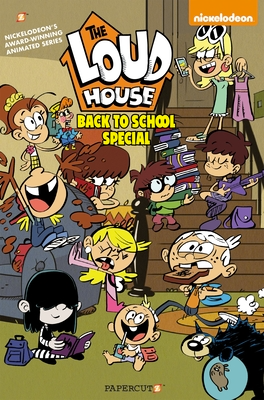
The Loud House #15: The Missing Linc by The Loud House Creative Team

Another cute if slight installment of the Loud House comics series, based on the hit Nickelodeon cartoon.

This fifteenth volume of the ongoing series is loosely based on the theme of Lost And Found, with Lincoln’s absence in the first and longest vignette sending his loving sisters on a frenzied search for him. Other of the short tales included here depict Lincoln’s classmate Zach Gurdle finding what he’s sure is a UFO part, Lola losing her stuffed unicorn, and Lynn Sr searching for his missing garden gnome.

My personal favorites of the stories focused on Lincoln’s relationship with his best friend Clyde. Their friendship is delightfully sweet and supportive, and is quite frankly #goals. The cute vignette involving Clyde’s dads building a chair together was also adorable, as was Lisa’s crashing of the Mortician’s Club book discussion. The closing story, with Lisa miscalculating a good swing push for Lana, ended on a thematically fitting high note.

The art is based very much on the cartoon, so is kinetic and bright. There are so many characters that it can be hard to differentiate between the Loud sisters especially. Fortunately, the handy guide at the beginning of the volume helps a ton.

Continue reading

Permanent link to this article: https://www.thefrumiousconsortium.net/2022/03/30/the-loud-house-15-the-missing-linc-by-the-loud-house-creative-team/

When Things Get Dark edited by Ellen Datlow

I am genuinely impressed by the way this collection invokes the spirit of Shirley Jackson. So many of the stories read as if they might have come from her pen, so seamlessly do they fit into the dark atmosphere engendered by stories such as The Haunting Of Hill House, The Lottery and We Have Always Lived In The Castle. This is a book of repressed women with unspeakable secrets; of insular communities with murderous tendencies; of finding both oppression and release in the supernatural — all hallmarks of that master of quiet, furious dread.

Despite that commonality, the eighteen stories here each stand as distinct entities. While the ones set in the past (or, as in Genevieve Valentine’s kaleidoscopic Sooner Or Later, Your Wife Will Drive Home, a number of eras) evoke more closely Ms Jackson’s mid-20th-century aesthetic, the modern tales feel like a natural carrying over of her work into the 21st century, where her themes are anything but alien. That said, perhaps my favorite story in this collection — for non-personal reasons anyway — is Tiptoe by Laird Barron, about a child of the 60s who tries to grapple with the family secrets that continue to haunt him decades later. One of the most overtly supernatural and creepy offerings here, the image of adult Greg playing the “game” will stay indelibly in my mind.

My personal personal favorite was Gemma Files’ Pear Of Anguish. Idk if it’s adolescent girls especially who are susceptible to the building of these reality-bending paracosms — or if it’s just that those of us who built them are more open about fictionalizing or even discussing them as adults than our counterparts of other genders — but I felt the strange, destructive relationship between Imogen and Una in my bones. I also really enjoyed the many stories within the story that is Kelly Link’s Skinder’s Veil, almost more than the whole itself, which I felt was somewhat let down by its ending: more’s the pity as this is the story that also completes the book.

Continue reading

Permanent link to this article: https://www.thefrumiousconsortium.net/2022/03/24/when-things-get-dark-edited-by-ellen-datlow/

Geronimo Stilton Reporter #10: Blackrat’s Treasure by Geronimo Stilton

I was actually pleasantly surprised by the clever plot twist of this volume, and definitely recommend this book for good all-ages fun.

Our title character is a workaholic reporter turned editor with way too many stories to write (and, boy, do I sympathize!) His relatives and co-workers, Benjamin, Thea and Trap, coax him out of the office in pursuit of exercise and fresh air and — more importantly to Geronimo — a story. A three-headed monster smelling of brie has been spotted down at the docks, and Geronimo wants to get to the bottom of what’s clearly a fantastic tale before he’s scooped by a rival paper.

But a bigger mystery soon presents itself while the team is down at New Mouse City’s foggy harbor. A strange, seemingly abandoned vessel is docked at one of the piers, a ship that Geronimo vaguely recognizes. He and his crew come aboard to check it out, only to be turned into a literal crew by Captain Blackrat, who casts off and press gangs them into working for him. Besides swabbing the decks and engaging in other naval exercises, Blackrat wants them to help him find a hidden treasure, no matter the peril. Will our team of heroes be able to survive the journey and discover the pirates’ loot, or will the wicked Blackrat (and his adorable companion Crabcakes) send one or more of them down to Davy Jones’ locker?

Continue reading

Permanent link to this article: https://www.thefrumiousconsortium.net/2022/03/22/geronimo-stilton-reporter-10-blackrats-treasure-by-geronimo-stilton/

A Trail Through Time by Jodi Taylor

A Trail Through Time is the fourth book about Madeleine Maxwell and St Mary’s Institute for Historical Research where the historians investigate major historical events in contemporary time — “It’s time travel, OK” — and follows closely on the events of A Second Chance. The title of this book refers to the ability of its major antagonists, the Time Police, to follow Max up and down the timeline with alarming accuracy, but it could well have also been called A Second Chance because it is all about second chances. (And is thus probably not the best place to begin reading the series.)

A Trail Through Time by Jodi Taylor

See, Max died on an assignment at the end of the third book, but History put her into one of the many alternate worlds implied by the time-travelling premise of the series’ setup. She’s back at St Mary’s, but it isn’t quite her St Mary’s; she’s still together with Leon, but he isn’t quite her Leon. They need time to get reacquainted, to adjust to a new reality. They don’t even get through breakfast.

The Time Police — though they are not yet named at that part of the book — are apparently serious enough trouble that Leon gives Max thirty seconds to grab whatever matters to her before they flee the scene in his time travel pod. They spend the first hundred or so pages desperately on the run, as each time that occurs to them to escape to provides only the briefest of respite. I had a little trouble connecting with Max and Leon through this section — it seemed to me that the two of them could be either near-strangers with memories of having loved someone very like the person now in front of them, or they could be a well-meshed pair working to save each other while hurtling through history, but not really both. On the other hand, the scene with the Nile alligators during the reign of Akhenaten was very fun.

A Trail Through Time settles down and gets better when Max and Leon pull off a trick to make it look like she has died (died again, from some points of view); the volcano on the cover is involved. They return to the Institute though he is off again almost immediately. Well, the book settles down St Mary’s style, which is to say it slows to somewhere between frantic and pell-mell. But that’s enough for librarians to provide Max with a working summary of the situation, over a well fussed-over pot of tea, of course.

Eventually, we each had a small table, a plate of crumpets, and a napkin.
Professor Rapson handed me my tea and said, without looking at me, “Should they ever find him, Leon Farrell will be charged with removing a contemporary from his own time, the sentence for which is death. Dr Peterson and Major Guthrie will be charged as accomplices. Dr Bairstow, as the person ultimately responsible for everything has, only temporarily we hope, been removed from his position as Director of St Mary’s.
“As mission controller, Dr Maxwell would have been charged as well, but she died. At this stage, we’re not sure if the colonel [from the Time Police] believes that or not. If he thinks you are Max, you’ll be shot. If he thinks you’re not Max, they might shoot you anyway. A no-win situation for you, I’m afraid. One lump or two?” (pp. 202–03)

So there is the true matter of A Trail Through Time: right at home, and not through the timeline at all. Keep Max alive, save St Mary’s, foil the Time Police, and hope for the best for Leon, wherever he has gone off to. Taylor delivers it all with heart and panache, action and hilarity, and rescues just in the nick of, well, time.

Permanent link to this article: https://www.thefrumiousconsortium.net/2022/03/21/a-trail-through-time-by-jodi-taylor/

How the Word is Passed by Clint Smith

In How the Word is Passed, Clint Smith recounts his visits to seven locations as part of what he calls in the book’s subtitle “A Reckoning with the History of Slavery Across America.” Monticello Plantation. The Whitney Plantation. Angola Prison. Blandford Cemetery. Galveston Island. New York City. Goréee Island (Ghana). Along with a prologue in New Orleans, the city where he grew up, and an epilogue of talks with his surviving grandparents, these seven locations — chosen from the dozens that Smith saw as research for the book — show important historical aspects of slavery in America. More than that, they demonstrate how people in the country reacted and continue to react to the facts of slavery.

How the Word is Passed by Clint Smith

The locations represent a judicious cross-section of slavery and its many legacies in contemporary America. Starting with Monticello Plantation brings the contradictions of slavery in America into immediate focus. Indeed, by insisting that Thomas Jefferson’s home be named as a plantation in the chapter’s title, Smith ensures that readers will have to consider it as a center of enslaving people, like many others across what became the United States. Jefferson, his soaring rhetoric and high ideals was essential to the creation of the United States of America. The unpaid labor of the enslaved persons whom Jefferson owned were essential to who he was and what he achieved.

Smith talks with tour guides and visitors to learn more about how the guides choose to present the history of Jefferson and Monticello, and to learn about what some visitors knew before they came, how they saw things afterward. Smith describes how the staff at Monticello addresses the lives of enslaved persons; there are different tours with different emphases. He also finds out that from the 1920s when Monticello first opened as a museum until 1951, all of the guides were Black men dressed in the livery of house servants. “‘Some of them were descendants of people who were enslaved here,’ Niya [Bates, Monticello’s public historian] said. Sometimes the stories the men told about the plantation had been passed on to them by family members.” (p. 47)

There is no story of Monticello—there is no story of Thomas Jefferson—without understanding Sally Hemings. We have no letters or documentation written by Sally (birth name likely Sarah) Hemings and nothing written by Jefferson about her. There are no photographs of her. Almost all of what we know of her physical appearance comes from Isaac Jefferson, who was enslaved at Monticello at the same time as Hemings and described her as ‘mighty near white [three of her four grandparents were white] … Sally was very handsome, long straight hair down her back.” Other than that, all portraits that depict her likeness are rendered from the imagination of the artists. She is a shadow without a body. A constellation for whom there are no stars. And yet the story of Sally Hemings sits at the center of Monticello. For two centuries, Jefferson scholars, as well as Jefferson’s acknowledged descendants, rejected the idea—despite evidence to the contrary—that Jefferson had either a romantic or a sexual relationship with Sally. They most certainly rejected the idea that he fathered all six of her children. (p. 29)

DNA evidence has proven the connection, and that has forced re-evaluation at Monticello, just as it has brought home to non-Black Americans how common it was for slave owners to have sex with people they owned. Jefferson’s own children were raised as slaves on his plantation. He did not free any during his lifetime, although when he was old in the 1820s Beverly (who was male) and Harriet Hemings left Monticello and were not pursued. Smith writes that they passed as white after leaving Monticello; with that, they passed out of the historical record. Jefferson freed his other surviving children in his will.

Continue reading

Permanent link to this article: https://www.thefrumiousconsortium.net/2022/03/19/how-the-word-is-passed-by-clint-smith/

Wir sind Gefangene by Oskar Maria Graf

For about the first eighty percent of Wir sind Gefangene (We Are Prisoners), my assessment of the book was that I could see why it was a sensation in the 1920s but couldn’t see much to recommend it for readers of the 2020s. It begins with Graf is at school in the small Bavarian town of Berg, on the shores of Lake Starnberg not quite 30 miles south of Munich. His teacher tells him that he can go home, along with his sister Anna, because his father is very sick. Graf’s father is in fact dying and, in this account, succumbs mere minutes after Graf arrives at his bedside.

Wir sind Gefangene by Oskar Maria Graf

The first chapter is titled “Changed Life,” and after his father’s death, Graf’s life changes considerably for the worse. His older brother Max takes over the family bakery business and the small farm that had supported the household. Graf gradually reveals that Max had been bullying their father, pushing him ever more to the sidelines of the business until his father essentially gives up and commences to drinking himself to death. At which he eventually succeeds.

As head of the household and bakery Max reveals himself as a brutal tyrant, beating his siblings and the apprentices for the smallest infractions. The rhythms of the bakery are hard enough: up in the dead of night to make the bread, out before dawn to deliver it across the town and to other farmsteads, back to take care of farm chores, then prepare the dough for the next day. It’s not quite the apocryphal Yorkshiremen who woke up every day two hours before they went to bed and had to go to school uphill both ways in the snow, but it’s close. Even in the best of circumstances, it would be punishingly difficult labor, and Max’s direction is far from the best of circumstances. From an early age, Graf has a strong imagination and a talent for invention. Another older brother, Maurus, introduces him to the world of literature, lighting a lifelong fire in Graf. Max will have none of it. Graf has to acquire books secretly and keep them hidden, lest Max destroy them. Graf portrays his mother as a sentimentally pious woman who retreated into herself and did nothing to counter Max’s tyranny.

Continue reading

Permanent link to this article: https://www.thefrumiousconsortium.net/2022/03/18/wir-sind-gefangene-by-oskar-maria-graf/

Pennyblade by J. L. Worrad

Oh my heart. I don’t know how a book as bawdy and savage as Pennyblade managed to make me cry at the beautiful heartbreak of the final chapters but oh, how it did and how I did. This is not a book that everyone will like (see: bawdy and savage) but if the idea of fantasy novels that hew closer to a dirty reality than to a sanitized idyll appeals to you, then you’ll likely adore this book as much as I do.

Kyra Cal’Arda is a commrach (i.e. elf) in exile in human lands. Once a spoiled member of the upwardly mobile elven nobility, whose main concerns were protecting her beloved twin brother while fostering her romance with the outcast Shen (to whom most of the novel is addressed,) she now spends her days wielding her blade in service to the highest bidder, hence the title. When a job goes awry and she’s forced to go on the run, before being essentially press ganged by the human church, all the secrets of her past come spilling out. But what have they to do with the mission that the church wants her to complete, under the supervision of the infuriating Sister Perfecti Benedetta, and why does the church need her in particular to achieve their goals? And what’s the deal with the creepy rope-masked humans who keep getting in her way? Surely, they can’t actually be worshipping the devil, which everyone who isn’t a superstitious rube (according to Kyra, anyway) knows doesn’t exist?

This sex-positive, queer-affirming European-Middle-Ages-inspired-fantasy is such a breath of fresh air in a genre that often takes itself Very Seriously but doesn’t actually have much depth behind its portentous facade. Pennyblade’s Kyra, otoh, is a cheerful shit with hidden, meaningful layers, whose rakish sociopathy is the natural adaptation to her upbringing and the betrayals she’s endured. The subversion of elves as being basically Nazis is both hilarious and surprisingly thoughtful: not in the form of inspiring any sympathy for fascists, but in showing how that kind of upbringing brutalizes you, even if it brings apparent advantages. Not that the humans in this book are much better, ofc, obsessed as they are with an invisible God who works through a totalitarian church. Both types of society, the book tells us, are worth subverting, but only in a way that doesn’t sacrifice our own basic decency by treating others as less than real people.

Continue reading

Permanent link to this article: https://www.thefrumiousconsortium.net/2022/03/17/pennyblade-by-j-l-worrad/