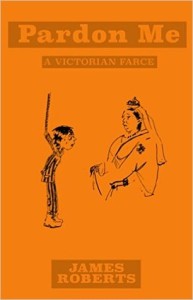
Q: Every book has its own story about how it came to be conceived and written as it did. How did Pardon Me evolve?
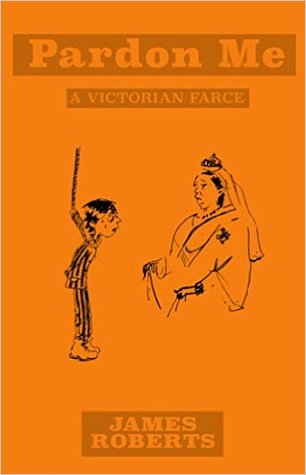
Pardon Me began life as an idea for a short story. I wanted to invent a rubbish British diplomat whose ineptitude would be the cause of many of history’s real calamities. This would be a man who would almost single-handedly bring down the British Empire and in doing so be inadvertently popular with nationalists and freedom fighters everywhere. The first short story, however, got a little out of hand and ended up being a full-blown novel. As a one time historian I am understandably interested in historical cause and effect. I liked the idea of messing with this a little. Pardon Me brings together the two great crises that knocked Pax Britannica for six in the year 1895 (and New Years Day 1896). One was a badly thought out colonial adventure known as the Jameson Raid and the other was the sentencing of Oscar Wilde. Neither was very funny on the surface, I grant you, but I made the first into a cricket match, the second a severe case of mistaken identity, and both the fault of one badly schooled and heroically inept individual. It’s called ‘Pardon Me’ because the story is presented in the form of an epistolary: a plea for clemency from a condemned man to his queen – with a few telegrams, notes and a play gummed in between the pages for good measure.
Q: Do you write with any particular audience in mind? Are there any particular audiences you hope will connect with this story?
Not consciously, no. Or at least not to begin with. I think as the novel progressed I started to become aware of an imaginary reader who would get some bits, like the historical references, and need other bits signalling and elucidating. I suppose I wrote the book primarily with the aim of entertaining myself and making myself laugh; the hope being that a few other people around the globe would share my poor taste.
Q: What is the first book you read that made you think, “I have got to write something like this someday!”
That’s a tough one, mostly because if I find a book really good I also tend to conclude I could never write anything that good and it puts me off the activity full stop. The first book that I read where the quality of the writing was inspirational was To the Lighthouse by Virginia Woolf, but I soon disabused myself of any pretentions to write that well, or that head-hurtingly metaphysically for that matter. As I’ve got older my favourite novels have been the ones that combine good writing, intelligence and extreme silliness. So I would have to say that anything by PG Wodehouse makes me want to put pen to paper, if only to get somewhere close to his shadow.
Q. How did you learn to write?
I am still learning! I studied history at university and then wrote a thesis so I suppose that’s where the mechanics of writing were drummed into me. But after that I would say trial and error. Although if you are one of my copywriting clients then rest assured I mean inherent genius.
Q: Do you adhere to any particular writing regimen?
I tried to treat writing the novel as I would any other writing task. Start around 9am and work till teatime. My brain goes to sleep a few hours before my body does and even as a young student I found working at night just tended to turn up a pile of unreadable nonsense. So I try to set aside whole days for my own writing, in between the stuff for other people.
Q: Are you a pantser (someone who writes by the seat of their pants) or a plotter? Given the complexity of Pardon Me, I imagine the latter, but I’m prepared to be surprised!
Sorry to let you down, but I plot like hell until I am certain of everything that is going to happen. I am big on plot, which I think is essential to comic farce. I really love the challenge of putting characters into impossibly sticky situations and then somehow rescuing them – or some of them.
Q: Johannesburg and its environs are described with a critical fondness that echoes my own memories of South Africa. What has been your own experience with that part of that world?
Purely from books I am afraid. As a student and as a lecturer I was always really fascinated by the whole colonial set up and that very British habit of trying to replicate home in the strangest of places. I read some old memoires by colonial officers and a few histories that gave the indigenous population’s side of the story. I then decided to exaggerate the rather rapidly thrown up nature of late nineteenth-century Jo-berg and make it a city of tents and corrugated iron huts. Sad to say that some parts of the city still look like that.
Q: My favorite line in the entire book is this:
Where the English public school system had really let the Empire down was in producing a generation of Englishmen that spoke in blasted euphemisms all the bally time!
As half the fun in Pardon Me has to do with wordplay and innuendo, how seriously do you take this cri de coeur yourself?
Well we Brits used to be famous for understatement and euphemisms. Parts of that culture, I think, were quite laudable: the old ‘stiff upper lip’ thing where you bore hardship without making a fuss. But I think there was also an unspoken code which prevented too many imperialists and colonial adventurers from asking “is this really good for anyone else but us?” So they hid their selfishness and occasional brutality behind phrases like “the natives have been getting uppish” when what they really meant was “they were trying to stop us nicking their country so we shot them.” And of course, no one ever mentioned sex, despite the population doubling in a few generations, so somebody must have been doing it.
Q: What can you tell us about your next project?
I haven’t quite got the time at the moment to contemplate another full blown novel and I have been aching to try my hand at radio comedy for some time. So my next project is going to be a script for radio. But I am always writing down nascent ideas and I have this reincarnated rabbit that wants to start an adventure and refuses to go away, so we shall see.
Q: Your website (http://www.jamesroberts.scot/) is a thing of comic beauty. I especially like how you discussed the way you researched writing the lingo of Pardon Me, by reading extensively of books of the period. Any gems you can recommend, both in terms of style and quality, to readers needing something to read while awaiting your next novel?
Thank you, I am flattered. I tried to write a sort of ‘anti-social media’ website, which is bloody hypocritical if you think about it! What I find is that latter Victorian writers could really write. Very leaden, detail rich prose that most readers today would put down after a few pages. But there are one or two that transcend the generations and managed to both paint portraits with words and tell a great story. Oscar Wilde needs no bigging up from me, but Rider Haggard’s Alan Quatermain stories were the inspiration for the hunting scene in my book, the one where the elephant runs amok and Paul Kruger gets his thumb shot off. A hundred years after publication it is amazing how unashamedly condescending and xenophobic the writing now appears. You really get a sense of the unquestioned superiority felt by the English gentleman abroad. It is this attitude that my book tastelessly lampoons.
Q: What are you reading at the moment?
Ben Elton’s Time and Time Again. People who only know his work through his comedy may be surprised to discover that he is actually a very good writer of historical drama (his uncle was a famous Cambridge professor of history as it happens). This is a real page turner and, speaking as an ex-historian, I am fascinated to see what he does with his re-writing of June and July 1914. Prior to this I read Syrup by Max Barry. For my money, nobody rips into the modern world quite like he does and with both humour and intelligence – a really underrated writer.
Q: Are there any new books or authors that have you excited?
The best book I have read in an age is The Extraordinary Journey of the Fakir who got Trapped in an IKEA Wardrobe by Romain Puerolas. It is both very funny and very thought provoking and every word sings off the page. A real joy.
Q: Tell us everything about your book and why you love it!
That’s a big question! I am not sure I love it as such. I think when you know the mechanics of a story and all the work behind it, it’s very difficult to enjoy it like a fan. I am very proud of the writing, or most of it, but then I think you always end up thinking something could have been better. Sometimes I read to be enlightened and provoked, sometimes to escape, and I really hope my book helps readers escape awhile. What’s it about? It’s a colonial farce which makes gentle fun of the assuredness and ill-founded sense of superiority that helped our little island govern a third of the globe for a brief moment in time. It’s got real people in it – Cecil Rhodes, Oscar Wilde, to name but two – and one definitely fictitious diplomat called Madagan Rùn (pronounced Rhune) who is spectacularly unqualified for the position and only got the job because he is… Well read it and find out.

Author Links
James Roberts Website
~~~
Pardon Me: A Victorian Farce was published October 8th 2015 by Mint Associates, and is available both through the author’s site and via all good book sellers. My review of the book itself may be found here.
 Al Singh
 Doug Merrill
 Doreen Sheridan
 Emily Lauer
 John Pitzel
 Lars N. Goldschlager
 Laura Eilers
 Professor X
 Robert Maedgen
 Sylvere Ap Leanan
 The Shire