Some time past the middle of the twenty-first century, Britain offers its citizens the safest, most democratic, best-adjusted society in human history.
Every person under the System is encouraged — though not compelled — to spend a certain amount of time each week voting, and is semi-randomly assigned to decision-making bodies for the duration of their session. Each body will most likely be around two hundred individuals strong, and will deal either collectively or in subcommittee jury group with anything from asylum requests or the allocation of medical resources to commercial disputes. It is the most nuanced and democratic system of direct governance ever devised, and it requires genuine participation from the polity. For the body of the state to perform its function properly, each person must make his or her own decision in the light of their personal experience and opinion without being influenced by others at the formative stage, so sessions are initially private and remain anonymous throughout. Each problem is proposed to each person in a way that is fractionally different, tailored precisely to pique their interest and understanding, their self-interest and their altruism, so that every choice is made with the greatest awareness of consequence and meaning. (p. 25)
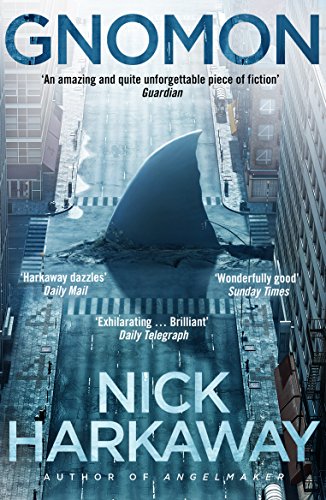
But the workings of a utopian participatory democracy are not what Gnomon is about. They are the necessary foundation of a story — or more properly a nested set of stories — that is both wider and deeper. It begins with Inspector Mielikki Neith making a televised statement about the death of a suspect in the custody of the Witness, while people use the System to examine her microexpressions to gauge whether her pained honesty about how everyone at the Witness feels this failure is faked, and Neith herself follows the polling numbers that trail across her screen. Or maybe it begins with the death of Diana Hunter, the death that distresses Inspector Neith because of the failure it implies, though Hunter’s case will do much more than distress her as Gnomon proceeds. Or maybe it begins with Hunter being called in for interrogation. The first words that she gives to the System are the title of the first section of Gnomon, “my mind on the screen.” In fuller form:
“I can see my mind on the screen.”
Hunter’s first thought during the examination is like the barb on a fishhook, and Neith instinctively loathes it. These eight unremarkable words cause her to tighten her jaw as if expecting a blow. The phrase is, to be sure, unusually clear and strong, quite ready to be vocalised. One must assume that Hunter was deliberately recording a message, in which case: to whom? To Neith, as the investigating officer? Or to an imagined historian? Why does the tone, the clean, discursive flavour of Hunter’s mind, trouble that part of the Inspector that is devoted to a professional mistrust of appearances? (p. 10)
A gnomon is the bar sticking out from a slab that turns a flat surface into a sundial. Its intrusion changes a physical phenomenon into a source of meaning and measurement. “In geometry, a gnomon is a plane figure formed by removing a similar parallelogram from a corner of a larger parallelogram; or, more generally, a figure that, added to a given figure, makes a larger figure of the same shape.” Gnomon is filled with such irruptions, things that intrude among planes, cast shadows, and change meanings.





 Al Singh
 Doug Merrill
 Doreen Sheridan
 Emily Lauer
 John Pitzel
 Lars N. Goldschlager
 Laura Eilers
 Professor X
 Robert Maedgen
 Sylvere Ap Leanan
 The Shire