This latest volume in Peyo’s translated oeuvre certainly shows how far we’ve come since the days when borderline offensive jokes about Smurfette were considered, if not outright hilarious, then certainly acceptable consumption for young children. Behold how in the 50 or so intervening years, the Smurfs universe has acquired an entire other village of female Smurfs, each with their own personality and specialty, and watch how the vague objectification of Smurfette falls away as other vital, interesting female characters get their time in the spotlight. There is a moral here about female solidarity being a tide that lifts all boats. But even if you don’t care for feminist discourse, however mild or subtle, there’s a lot to enjoy in this third volume of the Papercutz series.
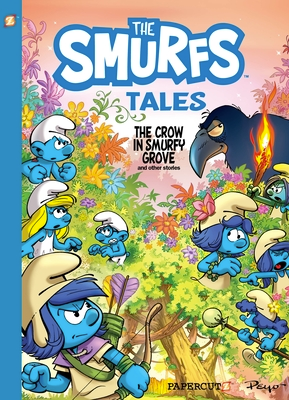 While on an expedition in the Forbidden Forest, Smurfette, Brainy Smurf, Hefty Smurf and Clumsy Smurf come across the hidden village of Smurfy Grove, populated entirely by female Smurfs. The villagers are initially suspicious of the newcomers but quickly befriend them, a process helped in large part by Smurfette’s sunny disposition. This volume actually begins after the Smurfs of Smurf Village have been accepted by the inhabitants of the grove. The first story, Brainy Smurf’s Walk, is an introduction to the many ways that Smurfy Grove differs from Smurf Village. The next tale, Challenges For Hefty Smurf, sets up a rivalry between the strongest Smurf and Smurfy Grove’s most accomplished warrior/huntress. Clumsy Smurf’s Dragonfly details how that hapless Smurf trains an insect friend, while the next three stories showcase the external threats facing Smurfy Grove. The last of these, as well as the final Smurfs tale in this volume, examine as well the internal threats to Smurfy Grove, and point to a new direction for our tribe of female Smurfs.
Also included here are two bonus throwback stories of the Smurfs facing off against Gargamel’s magic, as well as a tale of Johan and Peewit that, while brief, is chock-full of humor and surprises, particularly for those hoping to relieve Peewit of the musical instrument he plays so badly. Overall, the stories are extremely strong, bringing fresh plots and humor with their expanded cast of characters, tho emphasizing always the value of friendship and adaptability. I was really pleasantly surprised by the vivid color palette used for Smurfy Grove, too. While Smurf Village tends toward primary colors, Smurfy Grove loves its oranges, hot pinks and jungle greens, making for a lovely, lush contrast to the usual tones I’ve come to expect from illustrations of the Smurfs.



 Al Singh
 Doug Merrill
 Doreen Sheridan
 Emily Lauer
 John Pitzel
 Lars N. Goldschlager
 Laura Eilers
 Professor X
 Robert Maedgen
 Sylvere Ap Leanan
 The Shire