
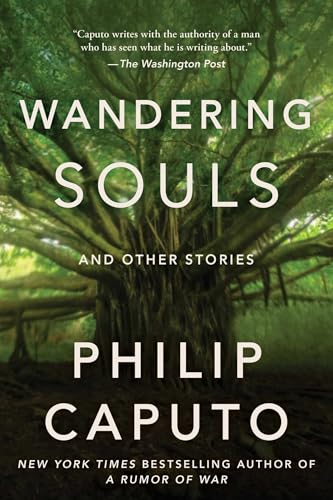
 I tend to read a lot more female authors than male, which apparently puts me in the minority of readers worldwide. It’s especially unusual for me to read “serious” fiction by men, and while there’s a touch of the supernatural in each story collected here, this is still very much the kind of literary writing I actually admire (and regular readers will know how much I despise the vast majority of modern literary fiction churned out by American MFA mills.)
I suppose I shouldn’t be surprised by my own reaction here given that Philip Caputo won a Pulitzer Prize for investigative journalism back in the 1970s. You know, back in the day when the fourth estate wasn’t primarily owned by the obscenely wealthy, who use it to hoard their fortunes by influencing the populace to not demand our nation’s rightful due via taxation. Ahem. Mr Caputo’s writing in this collection showcases his rightfully lauded journalistic background. It’s clear and strong and entirely devoid of fluff, even as he discusses such ephemeral subjects as guilt and its attendant ghosts. Because there are a lot of ghosts in this book, as troubled men seek to deal with the mistakes of their pasts, whether small or grand.
Vietnam figures heavily in the proceedings, again unsurprisingly given Mr Caputo’s experiences as a combat veteran in the Vietnam War. The title story begins with a former GI learning that he has a chance to help a woman recover the corpse of her brother Paul Salerno, who vanished while on a combat mission. Our unnamed narrator had actually been part of the squad who originally discovered the remains of Paul’s team. The extraordinary circumstances in which the corpses were found meant that our narrator’s company had had to leave them behind, in contradiction of the warrior ethos our narrator holds dear. The guilt of that has lingered over the decades, and comes roaring back to the fore when he learns of the ongoing grief of Paul’s remaining family.
Returning to Vietnam isn’t easy. He’s older and wiser, yet not cynical enough to dismiss out of hand the strange visions that seem to keep guiding him in the right direction. The younger people around him have perfectly logical explanations for his ghostly guides, and chide him for surrendering to mysticism. But none of them are prepared for what they find when they come back to the place where he first found Salerno’s bones.
While two of the other six stories here are also set in Southeast Asia, they’re not all war stories. Coils Of The Past does deal more directly with the horrors of the Vietnam War, as a veteran battles with his complicity in a past atrocity. The Traveler, meanwhile, reflects on a former foreign service officer’s youth in Cambodia.
The clash between youthful arrogance and the superstitions of the older generation takes center stage in The Deliverer, a tale set partly on the ocean and partly in the jungles of Central America. The African bush is the setting for A Near-Death Experience, as a photographer falls in love with a doctoral candidate. And while the book’s closer, Ezra’s Door…, is set on the far less exotic campus of Wabash College, Indiana, it also deals with themes of longing and the supernatural.
All of these tales are infused with a maturity that makes each ghost — or Wandering Soul — story feel entirely anchored in reality, while still leaving space for wonder. The regrets and concerns of the protagonists are all valid. Perhaps the reason I enjoyed these stories so much is how active the main characters are in not wallowing in their feelings but in rectifying what they think is wrong. These aren’t cautionary tales: instead, they promise that you can atone and do better, no matter how much time has passed, as long as you put the actual effort in. And yeah, that effort is gonna suck sometimes, but a genuinely clean conscience is worth it in the end.
There are, ofc, variations between each story. The protagonist of The Traveler certainly has nothing to feel guilty for except, perhaps, marrying poorly. The sailors of The Deliverer don’t know the villain’s full story, but certainly can’t be blamed for what they do. Refreshingly, guilt never turns into neurosis in any of these stories, despite the main character of Ezra’s Door… suffering a severe case of writer’s block (with which I can certainly sympathize.)
This collection certainly has a frisson of genre but the stories are all solidly literary, and of an exceptionally high quality. I’m glad I had the chance to start off 2026 with a solid representative of new and truly literary fiction.
Wandering Souls and other stories by Philip Caputo was published January 20 2026 by Arcade and is available from all good booksellers, including

 Al Singh
 Doug Merrill
 Doreen Sheridan
 Emily Lauer
 John Pitzel
 Lars N. Goldschlager
 Laura Eilers
 Professor X
 Robert Maedgen
 Sylvere Ap Leanan
 The Shire