I’m pretty new to the Radiant universe (tho I’ve always had a weakness for the name since Magic The Gathering’s badass Radiant Archangel.) This was a pretty great way for me to get started, tho, with the backstory and ongoing adventures of the superhero known as Radiant Pink.
Eva is a video game streamer trying to hold her life together in the face of both self-doubt and the criticism of people who don’t think that what she’s doing is a real job. One of these latter is her soon-to-be-ex-girlfriend, who doesn’t take her sponsorships or stressors very seriously. When Eva’s mic setup crashes one evening, her desperate search for a replacement leads her to a mysterious symbol that, much like the rest of her Radiant counterparts, imbues her with superpowers.
As Radiant Pink, Eva can teleport from place to place via neon pink portals. She uses her newfound abilities not only to fight crime but to hype up her stream, raising hundreds of thousands for charity from her small bedroom in Indiana. But not even a teleporter can be in two places at once, so she has to rope in her best friend Maddy to help keep her secret identity secret while Radiant Pink drops in from time to time to boost viewership on the EvaPlayys channel.
Maddy is worried that Eva is stretching herself way too thin, but Eva claims that becoming a superhero has also lessened her need for sleep. When Eva’s latest charity appearance at a children’s hospital goes terribly awry, Maddy is left holding the bag. How long can she cover for Eva, as a disoriented Radiant Pink traverses the galaxy, searching for her final leap, I mean portal, home?
Continue reading
Permanent link to this article: https://www.thefrumiousconsortium.net/2023/08/11/radiant-pink-vol-1-across-the-universe-by-meghan-camarena-melissa-flores-emma-kubert/
I adore Art Baltazar’s artwork, with its bright neon colors and cute, expressive characters. Little wonder that his Tiny Titans comics have become a New York Times bestseller, showcasing his excellent interpretations of DC Comics stalwarts.
His original creations lack that household familiarity, but are just as worthy of checking out, especially for young readers wanting an easy but fun read. There’s lots of action and adventure in this first installment of a series created ages ago, brought back now for a new generation.
Craynobi is an adventurous member of the Cray, one of the races that co-exist peacefully on a world filled with mystery and wonder. Their allies are the gentle Yahgeez who live in the title land of Yahgz. Whenever hostilities threaten the Yahgeez’ peaceful nation, they call upon their more action-minded Cray friends to help them repel invaders. Craynobi has become so honored for this by his Yahgeez friends that he’s considered family, earning the moniker “Craypa” as he grows older and entertains Yahgeez children with stories of his adventures.
While his own son Crayski has loved growing up with the Yahgeez, their little unit — including their Cray companion Weez — is eager to travel back to Cray City. Crayski wants not only to see the land of his Cray family but to answer the call of destiny. He has, after all, been prophesied to be a savior and leader of both Cray and Yahgeez origin. When Weez receives a mystical summons informing him of great danger coming to Cray City, our intrepid heroes must pack up and head to a home some of them have never even seen. But not without telling a few stories first, of course.
Continue reading
Permanent link to this article: https://www.thefrumiousconsortium.net/2023/08/07/yahgz-the-craynobi-tales-1-by-art-baltazar/
It’s been almost a year since Rana’s best friend died, inexplicably going too fast in a car that he typically drove over-cautiously. Louie was smart, sensitive and accepting of Rana’s struggles as a closeted Iranian American Muslim lesbian with a difficult home life. Her dad works back in the Middle East while his family stays safely in the San Fernando Valley, coming to visit his wife and kids for only a month out of every year. Her younger brother Babak gets to do whatever he wants while Rana is told what to wear, what to eat and what to do by her immaculately groomed, perpetually neurotic mother.
In her grief, Rana has quit the basketball team and started joylessly hooking up with Louie’s twin brother Tony. When she learns that a major rap battle that Louie had dreamed of taking part in is coming back to the area, she decides that she’s going to honor his memory by competing. Trouble is, public speaking terrifies her. In fact, the most rapping she’s ever done is while listening to Tupac while hanging out with Louie.
Her other best friend Naz encourages her not only to practice, but to use her own poems instead of just channeling the fragments of Louie’s writing that are in her possession. Rana’s late grandfather had instilled a love of poetry in her, but Rana is too unsure of her own talent to take that step. If she’s going to overcome her fear of speaking up tho, why not take the full leap and expose her deepest feelings to the world?
Complicating matters is her growing bond with Yasaman, a half-Persian schoolmate who adores visual art and is eager to share that love with her. Rana is pretty sure that bubbly, red-headed Yasaman is interested in her romantically, but she’s too caught up in her own head to know what to do about the possibility of her first relationship with another girl. Will Rana be able to honor both her own feelings and the memory of her late best friend as her turbulent high school days draw to a close?
Continue reading
Permanent link to this article: https://www.thefrumiousconsortium.net/2023/08/03/rana-joon-and-the-one-and-only-now-by-shideh-etaat/
collecting the entire 8-issue series.
I knew I was in for something good when I read the name of the creators’ company, Silent E Productions. It’s a joke at once elegant and simple, and sets the perfect tone for this thoughtfully maximalist look at the nightmare question of what would happen if everyone in the world was granted the instant fulfillment of one wish.
Or to be more precise — and as indicated in the title — if each of the 8 billion people on the planet suddenly gained a genie who would grant them one wish. The genies’ handling of these wishes is intent-based and flexible, so someone wishing for world peace wouldn’t find everyone else instantly killed, as the typical cautionary tale goes. Instead this comic explores not only the logistics of wishes but also the most likely outcomes, and a lot of unintended outcomes, too.
The story itself begins in a dive bar, as eight people congregate there for various purposes. Will Williams owns the place, and Brian, Alex and Daisy are members of a rock band about to play a gig there. It’s Robbie’s 12th birthday, and he’s trying to rouse his drunk dad from where dad is slumped on a bar stool. Finally, a young Chinese couple who speak little English stop in looking for directions.
Continue reading
Permanent link to this article: https://www.thefrumiousconsortium.net/2023/08/01/eight-billion-genies-deluxe-edition-by-charles-soule-ryan-browne/
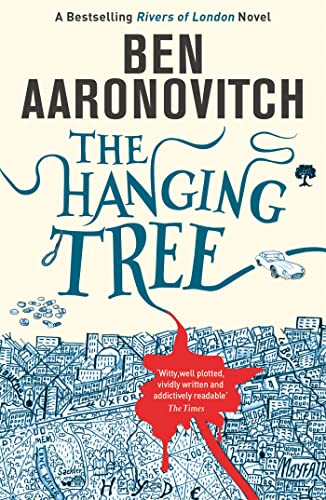
One of the ways that the Folly — the secret unit of London’s Metropolitan Police Service that deals with the supernatural — is integrated into regular police work is that they receive reports concerning missing children. Apparently in previous eras, rogue practitioners used to use children for some very rogue practices. And so Nightingale dispatches Peter to fictional Rushpool in not-entirely-fictional Herefordshire on the English-Welsh border to lend a hand to the local police in the disappearance of two eleven-year-old girls.

Nightingale explains:
“… It’s always been our policy to keep an eye on missing child cases and, where necessary, check to make sure that certain individuals in the proximity are not involved.”
“Certain individuals?” I asked.
“Hedge wizards and the like,” he said.
In Folly parlance a “hedge wizard” was any magical practitioner who had either picked up their skills ad hoc from outside the Folly or who had retired to seclusion in the countryside—what Nightingale called “rusticated.” (p.5)
Nightingale has someone in particular in mind.
I popped back to the Folly proper and met Nightingale in the main library where he handed me a manila folder tied up with red ribbons. Inside were about thirty pages of tissue-thin paper covered in densely typed text and what was obviously a photostat of an identity document of some sort.
“Hugh Oswald,” said Nightingale. “Fought at Antwerp and Ettersberg [the WWII clash between British and German magicians that left few alive on either side].”
“He survived Ettersberg?”
Nightingale looked away. “He made it back to England,” he said. “But he suffered from what I’m told is now called post-traumatic stress disorder. Still lives on a medical pension—took up beekeeping.”
“How strong is he?”
“Well, you wouldn’t want to test him,” said Nightingale. “But I suspect he’s out of practice.”
“And if I suspect something?”
“Keep it to yourself, make a discreet withdrawal and telephone me at the first opportunity,” he said. (pp. 6–7)
Continue reading
Permanent link to this article: https://www.thefrumiousconsortium.net/2023/07/29/foxglove-summer-by-ben-aaronovitch-2/
Jms really wanted to read this installment of the Diary Of A Wimpy Kid series together, and I was happy to continue the sports theme here and oblige! I’m actually really glad we got a chance to, and for more reasons than just one.
In Big Shot, our hero Greg Heffley details his various disastrous experiences with sports in middle school. There’s a delightful all-school showdown involving Field Day, as well as an ill-fated attempt by Greg’s dad to bring him to a grown-ups-only gym. Over the course of the series, Frank has displayed the really bad habit of leaving Greg to his own devices, which usually backfires on Frank more spectacularly than on Greg. You’d think Frank would have learned his lesson after their only visit to a football game together, but Greg certainly inherits his cluelessness from someone!
Alas that he didn’t inherit his mother’s athleticism. Some of Susan’s fondest memories of middle school involve her time on the basketball team, as she never tires of telling Greg. It isn’t just about the sports, tho: Susan genuinely believes that being on an athletic team helps build character, and she’s not entirely wrong. When Greg somehow muddles his way onto a school basketball team, she gets really excited, leading to the hapless but highly entertaining series of events chronicled in these pages.
(My kid also pointed out to me how each book has the same number of pages, in keeping with the conceit of Greg filling out a standard notebook for each of his adventures.)
Continue reading
Permanent link to this article: https://www.thefrumiousconsortium.net/2023/07/28/big-shot-diary-of-a-wimpy-kid-16-by-jeff-kinney/
Between watching Arsenal play in person (twice!) and the Women’s World Cup, it has been a satisfyingly sports-mad week for me. Why not keep the streak going with this adorable graphic novel featuring anthropomorphic animals getting together to play baseball?
The Fernwood Valley Fuzzies are enjoying the start of their off-season before they figure out what to do once the weather gets cold. They’re all gathered to watch Game 7 of the World Series live when their wistful discussion about playing more is overheard by a bat named Count Flappula. He asks if the Fuzzies will come play one last game before the year ends, against his team, the Graveyard Ghastlies.
Turns out that the Ghastlies only get together one night each year, on Halloween night, naturally. After the game, they’re looking forward to having the Fuzzies for dinner. Or, as Flappula quickly explains, having the Fuzzies as their guests for dinner. Certainly not as the meal, chortle chortle.
The cheerful Fuzzies are definitely up for a friendly before hibernation season, but even they are unsettled to arrive at the Ghastlies’ home field and discover that it’s a graveyard next to a creepy forest. Will they be able to enjoy a good game and a great feast in the company of folks some might consider creepy… or will something far more sinister befall our furry heroes?
Continue reading
Permanent link to this article: https://www.thefrumiousconsortium.net/2023/07/26/fuzzy-baseball-vol-5-baseballoween-by-john-steven-gurney/
Terry Pratchett: A Life With Footnotes is something of a second-hand autobiography. Wilkins was Pratchett’s personal assistant from 2000 until Pratchett’s death in 2015 of a rare form of early-onset Alzheimer’s. He was also in possession of the notes toward an autobiography that Pratchett made but never turned into a full manuscript. As time went on, and particularly in the final years as Pratchett’s faculties diminished, Wilkins’ role increased: he read speeches that Pratchett had written; when Pratchett eventually took to social media, the Twitter account was @terryandrob. “Later on, Terry said to me, ‘It appears we now share a brain.'” (p. 11) So this is as close as readers will ever get to a Pratchett autobiography, and it is also a biography by someone as close to him as anyone who wasn’t family.

The truth is, I bounced right out of A Life With Footnotes the first time I sat down to read it and didn’t even make it through the introduction. Here’s what threw me:
I was also fired many times over, although one quickly learned that Terry, being a writer, had an experimental interest in saying things to see what they sounded like, and that if you adopted an experimental approach yourself, and simply turned up the next day, it would normally turn out that you hadn’t been fired at all. (p. 9)
I think that’s a rotten way to treat someone, let alone someone who works for you, let alone someone who’s meant to be your personal assistant. Immediately after that alarming report, Wilkins mentions Neil Gaiman’s introduction to a collection of Pratchett’s non-fiction in which he made a point of noting that Pratchett was not a jolly old elf. Pratchett had a deep well of anger — “This anger was the engine that powered Good Omens,” he told Gaiman — but it was anger in service of fairness and of decency. Fortunately, Pratchett had an expansive definition of who deserved fairness and decency: everyone.
Continue reading
Permanent link to this article: https://www.thefrumiousconsortium.net/2023/07/23/terry-pratchett-a-life-with-footnotes-by-rob-wilkins/
S.A. Chakraborty spends the first fifty or so pages of The City of Brass creating an alternative fantasy Cairo that’s so multifaceted, so lively, so enthralling and exciting that I never really reconciled to the characters’ departure. Sure, Daevabad is the fabled City of Brass. It’s full of djinn in all of their different clans; it’s practically pulsing with magic; it’s monumental and gorgeous. But give me Cairo’s alleys and markets where Nahri plies her various trades of thieving and deceiving. Give me all the peoples that the Nile, history, and Cairo’s fabulous wealth have brought together. Give me her Jewish apothecary friend and teacher, though they exasperate each other. Give me gullible Turks, Nubian ceremonies, Franks as unseen rulers of the city whose authority clearly does not extend to much of the streets.

Nahri is a young woman of uncertain background — though she says “I am as Egyptian as the Nile” (p. 6) to a Turkish basha she is setting up for a burglary — who is making her way by her wits, healing talents, and convincing impressions of being a medium. She steals, of course, but it’s in the best traditions of the protagonist of a fantasy story. She does it with style and élan, mostly from people who can well afford it, and she aids people less fortunate than even her precarious self.
Until one day when she accidentally calls forth a real djinn mere hours after she said to her apothecary friend “There’s no magic, no djinn, no spirits waiting to eat us up.” (p. 27) By the time she regrets her words, she’s caught between a djinn, an ifrit, and grabbed by ghouls springing up from Cairo’s largest burial grounds. To say nothing of the flying carpet.
Continue reading
Permanent link to this article: https://www.thefrumiousconsortium.net/2023/07/21/the-city-of-brass-by-s-a-chakraborty/
An LGBTQIA+ Love Anthology.
While all anthologies can be hit and miss, comics collections tend to be more so, I feel, as it’s a more complicated medium to synthesize into one cohesive collection. This is, ofc, due in large part to the visual aspect making it immediately obvious if things aren’t meshing.
Thematically, this book works, even if the overall beats of the collection tend to land a little strangely. The title opener by Brent Fisher, Elisa Romboli and Ariana Maher is an upbeat tale of courage and love, and is the most polished, art-wise. This is immediately followed by the sweet Claddagh by Julia Paiewonsky and Alex Putprush, an affecting slice-of-life comic about falling in love.
The next story, Tethered, is a lot of people and a lot of pages to tell not very much at all. Fortunately, the volume picks up again with Lilian Hochwender and Gabe Martini’s Sea Change, telling the story of a young sailor who falls overboard during a storm and finds terror and transformation within the ocean depths. Letting It Fall by Priya Saxena and Jenny Fleming is really great until the awkwardly underwhelming art of the last full-page panel, which does a disservice to the rest of the story and its delightfully retro illustrations.
Long Away by Tillie Bridges, Susan Bridges and Richard Fairgray was one of my favorite stories here, as a young woman travels back in time to meet the father who died way too soon. All That Glitters by Michele Abounader and Tench uses very few words to elegantly describe how a struggling nonbinary person gets some great advice from a drag queen.
Continue reading
Permanent link to this article: https://www.thefrumiousconsortium.net/2023/07/20/the-color-of-always-edited-by-brent-fisher-michele-abounader/