Jane Steele by Lyndsay Faye

Reader, I devoured this book on my road trip to visit my in-laws over Mother’s Day weekend. It is, as the author admits, something of a ridiculous novel: a contemporary of Jane Eyre’s contemplates the similarities between their lives even as she herself, the titular Jane Steele, solves problems by means of murder, and finds herself involved in conspiracies involving the East India Company and expatriate Sikhs in England. But it is this sense of absurdity that carries the goings-on agilely forward, making for a deeply satisfying, entertaining novel.

Essentially: Jane Steele is a friendless orphan who is sent away to a dreadful boarding school from which she escapes with her best friend to brave the seamy underbelly of London. Upon separation from her dear friend, she ekes out a living till a notice of position for governess in her childhood home crosses her path. Compelled by curiosity and a sense of proprietorship, she applies, and finds herself welcomed and absorbed into a (curious for its era) household that is far more Punjabi than English. Oh, and she kills a bunch of people along the way.

But Jane isn’t a sociopath. In many respects — and I hope this isn’t too, too much of a spoiler — murder is the only option she has as a young woman in a society that grants little social and legal power, much less redress, to those of her sex. This novel is, essentially, a feminist, globalist, revisionist fantasy loosely based on Jane Eyre. There’s also a very solid murder mystery in it, and while I did have reservations as to the presentation of the identity of the killer I do think that, overall, Lyndsay Faye was respectful of the culture, history and religion of Sikhism. I certainly learned much more of it, and I already have Sikh friends.

Permanent link to this article: https://www.thefrumiousconsortium.net/2017/05/15/jane-steele-by-lyndsay-faye/

Militärmusik by Wladimir Kaminer

The cover says that Militärmusik is a novel, but I suppose the main point of that designation is to relieve Wladimir Kaminer (why doesn’t he use the usual transliteration in English?) of any obligation even to pretend to be telling a true story. I mean, Militärmusik is told in the first person, the main character is named Wladimir Kaminer, and all of the main events are things that actually occurred to him, as far as I can tell. Still, early on he relates that he had both a habit and a talent for telling tales, and that got him into plenty of trouble in the later years of the Soviet Union when he was growing up. Best to call this book a novel rather than an autobiography, no need to worry about the details of what happened, lest they get in the way of a good story. Though that may not be entirely in his favor; reality is under no obligation to be as believable as a novel. It often wasn’t, especially in the Soviet Union.

Kaminer recounts his life from birth up to his early 20s, when he left Moscow for Berlin. He was born in 1967, so his childhood was marked by the stagnation of Soviet society under Brezhnev, and his teens and young adulthood by the ferment and upheaval of the Gorbachev era, when first Soviet certainties crumbled, and then the Union itself vanished in a round of signatures in the Belarusian woods. By that time, Kaminer has fled to the West, and Militärmusik has come to an end.

Kaminer’s Moscow is not the home of great thinkers, of depressives wrestling with the great questions of existence, or political firebrands trying to make the world anew. He and his friends — the stories in this slender volume are mostly of boys and young men — are sly dogs and slackers, trying to get by, trying to put one over on the system, trying to figure out what to do with their lives. Most of all it’s funny! Anyone who says the Soviet Union was nothing but gray and drab and horrible doesn’t know what they’re talking about. Especially by the Brezhnev years, the system had mellowed into shambling corruption, and the late-night knock on the door came for very few. Knuckleheads like Kaminer could bounce from a young sailors’ camp (they climbed the fence of the nearby Communist Youth League camp to meet girls) to theater school to low-level jobs where ensuring the actors’ sobriety was one of the greatest challenges. He says that he himself indulged very little, only enough to keep the actors company.

The closest that anyone comes to Communism is the free-floating camp deep in a Latvian forest that Kaminer and a friend hitchhike to one summer. It’s actually three camps: Idos (idealists, people who have found their one answer to life and want to persuade everyone else), Narcos (people who have found their drug and just want to indulge all summer) and Indos (from the Soviet idea of American Indians, but basically everyone else). They are all young, fit, and free, and everyone contributes one way or another. It’s the kind of anarchy that cropped up surprisingly often in the cracks of Soviet society.

His friends were also among the first to organize rock concerts. These usually took place in apartments, as they were not strictly legal. He talks about how they spotted the KGB ringers and made sure not to charge them admission, so as not to be charged with profiteering, which was still illegal at the time. His story of encountering other KGB agents when they took one of their acts to Kiev is emblematic of how in the 1980s repression was routinized, for better and for worse. Kaminer’s time in the Army also surely glosses over hardships and possible bad outcomes. Possibly the most important event for his future was his father’s successful effort to get him taken into a cushy unit, one that turns out to be home to sons of generals and ambassadors. Readers will only know how much that mattered if they know what other fates are possible for young recruits in the Soviet Army, even in peacetime. Kaminer does not dwell on this detail; his main purpose is to tell funny stories. But it is still there.

Kaminer writes briskly, one of the advantages of telling stories in his second language. He’s funny, he’s personable, he’s a good companion for tales that may or may not be true. As far as I can tell, Russian Disco (his first book) is the only one available in English. It’s a good starting point: stories of life as an immigrant in early-1990s Berlin, when both he and the city are still caught between East and West.

Permanent link to this article: https://www.thefrumiousconsortium.net/2017/05/11/militar-musik-by-wladimir-kaminer/

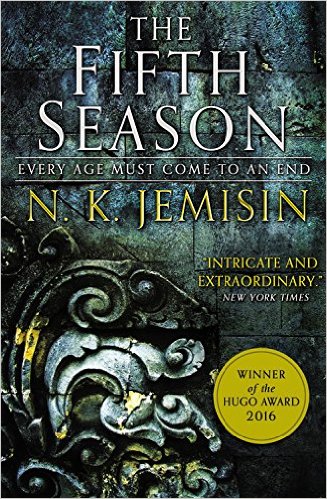
The Fifth Season by N.K. Jemisin

The Fifth Season is a very bleak book. It is riveting, engrossing, engaging, compelling, thought-provoking, and more, but it is also very, very bleak. When I was finished, I picked up a slim Soviet-German comedy (not an oxymoron!) by way of lightening the mood.

The Fifth Season begins with a mother still tending the body of her dead son. Soon, readers learn that the murderer was the child’s own father, and that the father has taken their daughter with him as he fled town before his act was discovered. Soon, readers learn that the father killed his son because of what the child was: someone who could perform earth magic, automatically, unconsciously, drawing on the power of life around the practitioner to fuel the magic, sometimes expending that life in the process. Not long after, readers learn that much of the town does not regard the killing as a crime so much as the removal of a danger to the community. Later, seeing what the orogenes, the magicians, can do, readers may feel that the people of the town are not entirely wrong in their estimation.

The Fifth Season begins with a powerful orogene just outside the greatest city on the continent known, with geological irony, as the Stillness. Though the city stands atop a great fault, it has been stable for twenty-seven centuries, and people there build more extravagantly than anywhere else on the very active continent. “He takes all that, the strata and the magma and the people and the power, in his imaginary hands. Everything. He holds it. He is not alone. The earth is with him. Then he breaks it.” (p. 7) The magician not only destroys the city, he opens up a cut across the continent that will break it in two. The ash from this cataclysm will blot out the sun for years, spreading devastation across all of the lands. Eventually, things will return to normal. “Eventually meaning in this case in a few thousand years.” (p. 8)

The Fifth Season tells the stories of what happened after the first discovery, and what happened before that terrible catastrophe.

Continue reading

Permanent link to this article: https://www.thefrumiousconsortium.net/2017/05/10/the-fifth-season-by-n-k-jemisin/

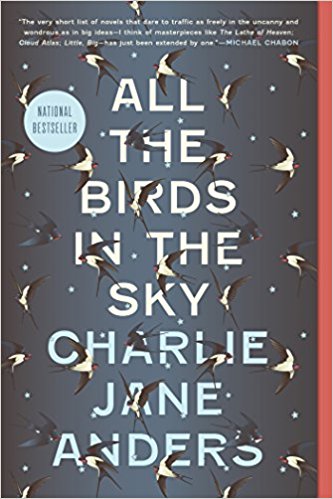
All the Birds in the Sky by Charlie Jane Anders

One of the things I particularly liked about All the Birds in the Sky is how Charlie Jane Anders chose to break up the story. It’s a two-sided, save-the-world story, and all of the basics are there: interesting leads, good counterparts, quick pacing, fun dialog, and so forth. She’s strong enough on the essentials even in her debut novel that it’s more interesting to talk about the more advanced parts of telling the story that she has chosen.

The setup: Patricia is a witch; her childhood friend Laurence is a scientific genius. They are very close in middle school (the story is set in the US), but drift apart and are then dramatically separated. They meet again as young adults, advanced in their respective realms, as the world is starting to get badly out of joint. They are still drawn to one another, but find themselves on opposite sides of attempts to prevent catastrophe.

That bare summary does not do justice to the wry humor and the warmth with which Anders tells their stories. Part of it is where she chooses to put major breaks in the narrative. Book one introduces each of them and brings them together briefly, with chapters set when they are small children. Patricia discovers that she can talk to animals, and the birds take her to a Parliament of Birds that meets at a great Tree in the deepest part of the forest. Laurence builds a time machine that can jump two seconds ahead in the future, and runs away to MIT where there’s a rocket launch and he discovers a group of students who followed the same schematics he did to build their own two-second time machines.

Each of them has had a glimpse of their place in the world, but it is only a view. Patricia comes back from the woods and doesn’t hear from the animal world again for years, despite her best efforts. Laurence’s parents pick him up from MIT and drive him back home, all the while lecturing him on how life is all about responsibility not adventure. In the back seat, he doesn’t hear a word as he zips through a newly acquired copy of Have Spacesuit — Will Travel.

Continue reading

Permanent link to this article: https://www.thefrumiousconsortium.net/2017/05/08/all-the-birds-in-the-sky-by-charlie-jane-anders/

“The City Born Great” by N.K. Jemisin

The City Born Great” by N.K. Jemisin should win this year’s Hugo for short story. The conceit of the story is that great human cities have a life of their own. Maybe that life awakens quickly, maybe it takes centuries or millennia, but at some point the genius loci becomes a thing in itself. Birth is never easy, not every potential new life makes it into the world, and Jemisin’s story tells the tale of New York’s attempt from the point of view of its midwife. Who has no idea what he is doing. He mainly knows that some very strange things are happening, and maybe all is not as it seems and he is seeing a higher reality, “Or maybe my mama was right, and I ain’t never been right in the head.”

What makes this story great is the sheer exuberance with which it’s told. It’s fast, it’s furious, but it’s also tremendous fun. And sure, it’s a power fantasy, too, but if that gives readers sentences like “I backhand its ass with Hoboken, raining the drunk rage of ten thousand dudebros down on it like the hammer of God. Port Authority makes it honorary New York, motherfucker; you just got Jerseyed.” then let a thousand fantasies bloom. It’s a story about life, and living, and that’s what it’s most full of: the very stuff of life.

There’s more going on, too. Stories about cities as things in themselves have a long SF tradition, including James Blish’s Cities in Flight novels from the 1950s and 1960s or John Shirley’s punk approach in City Come A-Walkin’. Not for Jemisin the cool distance of Blish’s technocrats, or the dark decline of Shirley. Jemisin’s city overwhelms; it’s on all the time in Ultra HD saturated color 3-D overdrive.

But Paulo’s full of shit, too, like when he says I should consider meditation to better attune myself to the city’s needs. Like I’mma get through this on white-girl yoga.

“White-girl yoga,” Paulo says, nodding. “Indian man yoga. Stockbroker racquetball and schoolboy handball, ballet and merengue, union halls and SoHo galleries. You will embody a city of millions. You need not be them, but know that they are part of you.”

It’s also a story of the chosen one, because every city needs an avatar. And it could be a riff on Christian themes, because the one who is chosen is among the least of these: black, gay, homeless, teen, broke, thrown out of his churchgoing home, street artist, hustler, con man, uncertain, and scared. But also confident, brilliant, unabashed, and willing. He’s terrific.

“I sing the city,” writes Jemisin to start the story. Echoing Langston Hughes, without the qualifying “too.” Echoing Walt Whitman. Echoing Bradbury. Singing a new New York into the world.

+++

The short stories were the fifth bit of Hugo-related reading I have done this year, and the second I have written about.

Permanent link to this article: https://www.thefrumiousconsortium.net/2017/05/07/the-city-born-great-by-n-k-jemisin/

Deathless (Leningrad Diptych #1) by Catherynne M. Valente

There’s no denying that this is a beautifully written book. Catherynne M Valente takes Russian and Slavic folktales and melds them with Russian, particularly Leningrad, history of the early 20th century. Her descriptions of falling in love and of the secret languages and compromises of marriage make for compelling, wholly believable and empathetic reading.

And yet, and yet. When I find myself disliking a book but not actually able to elucidate why, I tend to turn to other reviewers to see if they felt similarly but had an easier time of describing their discomfort. In the case of this book, especially, that helped a lot. Many other reviewers, especially those of a Russian/Slavic heritage, brought up the issue of cultural appropriation. I can’t really speak to the authenticity of her work, to how Russian it really is (a bit more on that later) but I can tell you that when she talks about life and power, my entire being rebels at the ideas she’s presenting as, if not somehow good and aspirational, at least acceptable, even romantic.

I’m not even sure if the rest of this discussion counts as spoiler-y because Deathless is less a story than a whole lot of metaphors layered and strung together. Quite artistically, granted: there’s no doubt that Ms Valente writes beautifully. Essentially, a young woman — no. A girl in Leningrad falls in love with Koschei the Deathless, who here is presented as the Tsar of Life, a god/archetype who represents the long, grinding, materially rich but ultimately despairing fate of all mortals: to succumb to his brother, the Tsar of Death. Life is presented not as a gift but as a burden, not as a source of joy but a font of pain. It is made out to be grotesque. And yes, it is all these things, but it’s also so much more. Life is endless possibilities and hope and renewal, but that is rarely (if ever!) brought up in this book. To a certain extent, Deathless was very much like a long discussion with my depressive Bulgarian friend, Slav: he and I are not unfamiliar with the trope of the Eastern European as nihilist, one he occasionally propagandizes for all he’s worth. But his lived experience is not the only kind of Slavic experience, and that lack of diversity in a book that claims to retell the folklore of the region is, at best, disquieting.

That was my issue with her representation of Life. Now we get to the even more problematic representation of Power. Politically, I thought she did a good job, but when it came to the personal relationships, I was, once more, aghast. The creepiness of the romance between Marya and Koschei aside (honestly, it felt a lot like a better written, more explicitly fairy tale version of 50 Shades Of Grey,) I really, really hated the oft-bandied idea that the main concern in marriage is “Who rules?” I’ve been married for 7 years now, more or less successfully: my husband and I get along quite well, and we have three wonderful children we’re devoted to. We have never engaged in the insane power struggles that define the romantic relationship at the heart of this book. Our marriage recognizes each other as individuals, and we try to be good to one another while still honoring our own needs. We don’t make threats and ultimatums like Marya and Koschei (and later Ivan) do because that is all toxic bullshit. We’re not a perfect couple by any means, but we’re in a far, far healthier place than the self-destructive insanity of the main romances depicted in this book.

And it’s not like I think bad marriages shouldn’t be depicted in popular culture. I loved the dysfunctional marriage at the heart of Gillian Flynn’s Gone Girl because it was never romanticized. Marriage can be a shitshow, but representations of such should be considered a cautionary tale, not a love for the ages. Which is why it was even more perplexing when Ms Valente would write so movingly about the compromises of matrimony. Any relationship involves a push and pull, but the healthy ones aren’t about controlling your partner: two vastly differing concepts that Ms Valente never reconciled in this book.

And then the book just sort of ended, and I was all “Ugh, I have to read another book to get an actual story out of this?” Maaaaaybe I will, eventually? There’s no denying that Ms Valente has some great ideas and a lovely style, but her endorsement of mentally unhealthy attitudes (wrapped up in a vaguely “oh but this is just how Russians are” veneer) really bothers me. I really wanted to like this book, but instead I’m kinda grossed out.

Permanent link to this article: https://www.thefrumiousconsortium.net/2017/05/02/deathless-leningrad-diptych-1-by-catherynne-m-valente/

Tales of the Squee

The height of my to-be-read pile could be measured in years, if the books could somehow fit into a unified pile. And that doesn’t count a particular moving box in the basement, in which some really good books, or at least some really interesting-looking books are awaiting their turn to come upstairs. (Some of them do make it!) Nor does it count the acquisitions on my phone, some recently made, even though I am nowhere near finished with the great set of books I picked up for silly cheap from a Humble Bundle a couple of years back. (Some of those get read, too! I’ve even written here at Frumious about nearly a dozen books from that bunch.) Nor does it count the unread books on my Kindle. Now, I am not the Frumious contributor who discovered that there is in fact a limit to the number of books that fit on a kindle (she actually reads them all), but the miraculous technology of the 21st century has left me with lovely books there, too, just waiting to be read and savored.

What was I thinking when I bought them? Generally, it was more than “How do I round out the order of other stuff so that I get free shipping from Amazon?” although that has happened sometimes. I have a to-buy list that I can dip into when that happens. And I suppose the existence of that list reassures me, because without it the t-b-r piles (notional as they are) would be higher by another good year or two.

I wasn’t thinking any one thing; I’m not buying by color, or to get familiar with a subject area, or to collect an author’s complete works, although I have done two of those three in the past. So here is a glance of the shelves of unread books on paper, along with what I think possessed me to pick each one up at the time.

1913: Der Sommer des Jahrhunderts (1913: The Summer of the Century) by Florian Illies. Published in 2012 in advance and anticipation of all of the centenary observations of the start of the Great War. Illies got famous for a book titled Generation Golf (named for the VW car, not the game with the dimpled ball), which was funny, and this looked like something more serious but still accessible. Besides, it was 2013, and I thought I might like thinking about the last of Belle Epoque Europe. I still might.

Memoirs of the Polish Baroque: The Writings of Jan Chryzostom Pasek, a Squire of the Commonwealth of Poland and Lithuania Edited, translated, with an introduction and notes by Catherine S. Leach. Isn’t that title a splendid example of what it illustrates? To be perfectly, or at least more, accurate, I read patches of this back when I was in a graduate seminar about the history of the Polish-Lithuanian Commonwealth. Back then (during grad school, not during the time of the Commonwealth of Two Nations), copies were more difficult to come by, and I read from photocopied pages I made at the Library of Congress. I mentioned Pasek a couple of times when I was writing about Milosz’s History of Polish Literature. The memoirs are a hoot, not quite like anything else ever. My used copy has enthusiastic marginalia in the first three years of the memoirs. Someday I hope to read further myself. [I did! Finished it all and enjoyed it; the marginalia indicated that the previous owner of my copy only got about a third of the way through. Reviewed in September 2023.]

Embassytown by China Miéville. I enjoy reading Miéville’s work; the only early one of his I put down is Un Lun Dun, and the only one I haven’t picked up is King Rat. I think that I liked The City & The City best, but I have liked all of them to varying degrees. I haven’t read Embassytown or anything more recent, which puts me about five years behind on his career. I’m a Hugo voter this year, though, so I expect I will read This Census-Taker by the end of July.

The Incorruptibles by John Hornor Jacobs. Roman legions on the Texas frontier, with gunslingers and monsters. What’s not to like? This looked like a fun mix, and indeed it was in the first 30 pages that I read before distraction got the better of me. Sometimes I just start in again wherever I left off; sometimes I go back to the beginning. [Update: I went back to the beginning, read it all, and liked it!]

Foreign Devils by John Hornor Jacobs. One of the things about buying actual paper books at an actual bricks and mortar store in a non-English-speaking country is that if you don’t grab a book the first time you see it, there isn’t a second chance. Of course there’s the whole internet to get around that problem, but somehow that’s not as much fun. This is a sequel to The Incorruptibles that I picked up on the principle that I might not see it again. [Update: Good, but very much a middle book. I also acquired and read the third book in the trilogy.]
The Doomed City by Arkady and Boris Strugatsky. Roadside Picnic was very weird and very Russian. More, please. I read it not long before we really got going here at Frumious, but when I get around to The Doomed City I will write about it so I can remember more of what I thought of the weirdness. I don’t think I saw it in the store here, so thank you internet.

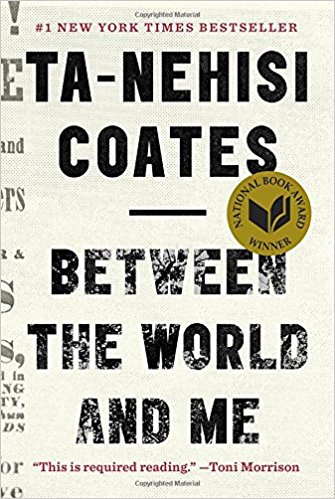
Between the World and Me by Ta-Nehisi Coates. Back when Coates was engaged with his blog at The Atlantic, I was a semi-regular commenter. I enjoyed the back-and-forth, mainly regretting that the difference in time zones meant that I missed out on a lot of live discussion. I think he’s extremely sharp, and am pleased to have witnessed at close hand part of the development of a major public intellectual. How could I not get his new book? (I like the writing he has done on Black Panther, too, though I am getting the compilations rather than the monthly book.) [Update: This is a great book.]

The Issa Valley and Native Realm by Czeslaw Milosz. His To Begin Where I Am is a book of essays I would go back to again and again, if I were the kind of person who went back to books of essays more often than I do. Which is to say I thought they were terrific, even profound in parts. These two books are novels set in the areas where Milosz grew up, when they were part of inter-war Poland. Several of the best essays in Milosz’ collection were also set in the area. I bicycled across the countryside not too far away, now that they are part of post-Soviet Lithuania. I look forward to seeing how all three — essays, novels, bike tour — line up. Someday. [Update: It turns out that Native Realm is a memoir, and a very good one at that.][Update update: I read The Issa Valley, which is also very good, and reviewed it in April 2024.]
Permanent link to this article: https://www.thefrumiousconsortium.net/2017/05/01/tales-of-the-squee/

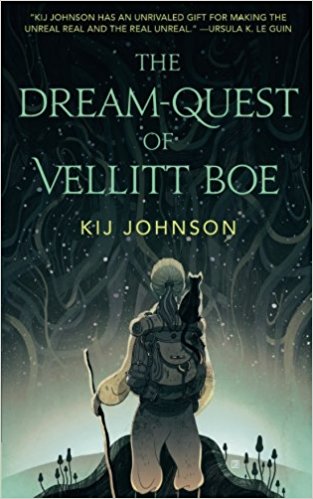
The Dream-Quest of Vellitt Boe by Kij Johnson

“And I must of course acknowledge Lovecraft’s The Dream-Quest of Unknown Kadath. I first read it at ten, thrilled and terrified, and uncomfortable with the racism but not yet aware that the total absence of women was also problematic. This story is my adult self returning to a thing I loved as a child and seeing whether I could make adult sense of it.” — Kij Johnson

In the Dream-Quest of Vellitt Boe, Johnson turns much of Lovecraft’s novel of a dreamworld on its head. The main characters live in the dreaming world, which is as real to them as Earth is to its inhabitants. Almost all of the characters are women; men play but fleeting roles in the quest.

Vellitt Boe, the protagonist, has settled down from a life of far-traveling to become a professor of mathematics at the Women’s College of the University of Ulthar. At the story’s opening, one of her most promising students has fallen for a man from the waking world and followed him there. The University is a very old-fashioned place, and such a defection could confirm the doubts that the powers-that-be have about educating women. Worse, the missing student is the daughter of a high official. His wrath could close the College just the same. Vellitt (Johnson generally uses the character’s personal name) resolves to retrieve the student from the waking world and save the College.

The opening scenes riff on cloistered educational institutions throughout fantasy — from Hogwarts to Pullman’s Jordan College and onward — and they are a fun mixture of social observation and speedy action. Soon, Vellitt is out the gates of Ulthar in pursuit of the wayward student and her man.

From that point, Dream-Quest becomes two different things: a character study of Vellitt, as she recalls her younger wanderings and makes her way back into the world, and a reprise of the journeys in Lovecraft’s book, seen, after a fashion, from the other side. Vellitt is an interesting companion. She is capable and experienced, and the University has provided her with funds to cover her journey, so much of the ordinary worries of a traveler are taken care of at the start. The story starts out as one of hot pursuit, but shifts, as a dream will do, into a different mode.

I read Kadath when I was a bit older than Johnson was that first time, and I have retained only the dimmest recollection of its contents. Quick research, however, shows me that Vellitt revisits many of the same locations where Lovecraft’s protagonist, Randolph Carter, journeyed. Vellitt and Carter even traveled together for a while, at least in Johnson’s telling.

On the whole it’s interesting. People in the dream world have but 97 stars, and they cannot believe that Earth’s sky is just plain blue. Theirs is much more interesting. They might prefer to have distances that do not change, but on the whole they have lived with the way their world works. I found myself skimming a bit toward the end, as Johnson’s tale banged up against one of the structural difficulties of quests: one damn thing after another. Fortunately, that part did not last long, and the conclusion is both satisfying in itself, and how it addresses questions implicit in Lovecraft’s narrative and setting.

This is the second Hugo finalist I have read this year, but the first that I have written about. It was nominated in the category of novella. The winner will be announced at Worldcon 75, August 2017 in Helsinki.

Permanent link to this article: https://www.thefrumiousconsortium.net/2017/04/26/the-dream-quest-of-vellitt-boe-by-kij-johnson/

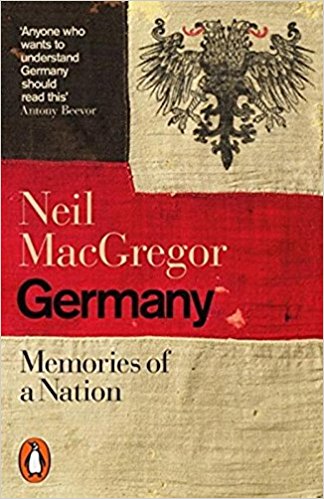
Germany: Memories of a Nation by Neil MacGregor


Neil MacGregor was Director of the National Gallery in London from 1987 to 2002 and of the British Museum from 2002 to 2015. He is now Chair of the Steering Committee of the Humboldt Forum in Berlin. His best-known previous book is A History of the World in 100 Objects. That background goes a long way toward explaining his approach to German history in Germany: Memories of a Nation, a book that accompanied an exhibit at the British Museum and a radio series on BBC Radio 4. He builds ideas about history from concrete objects, using their nature and stories to illustrate larger themes in German history.

This book is a testimony to contemporary publishing technology, a latter-day tribute to Gutenberg’s heirs. There are some two-page spreads that are only text, but they are few and far between. Such a lavish use of images would in previous decades have been confined to art books or more traditional exhibit catalogues. Digital publishing means that several hundred examples are right at a reader’s fingertips, and at a reasonable price. While Germany: Memories of a Nation has some of the functions of a catalogue, it is more several arguments about Germany, illustrated not only by the author’s writing but also by pictures of the objects in the exhibit. These add up, first, to a corrective of how Germany is typically seen in Britain; second, to a reconsideration of Germany for general readers; third, to a quick guide to the contradictions in Germany history.

The first argument arises from the title of the book’s opening section: “Where Is Germany?” If Germany is not quite, as has been quipped about Poland, “a nation on wheels,” its location has not been nearly as fixed as that of other European nations.

In thinking about the intellectual history of any country, a good place to start is its oldest university, the place where that society first organized the public teaching of ideas. For France it is unsurprisingly the capital, Paris; for Scotland, the seat of the archbishop, St Andrews; for England, nobody really knows why, insignificant Oxford. For the Germanophone world, it is Prague, where in 1348 the emperor Charles IV founded the first German-speaking university. For centuries Prague, capital of Bohemia and occasional residence of the Holy Roman Emperors, was at the heart of German cultural and intellectual life. The Karls Universität, the Charles University, stands at the head of the great German university tradition. (p. 39)

MacGregor adds Königsberg, now Kaliningrad, to Prague in a chapter titled “Lost Capitals” to illustrate the history of cities that were key to German history but that now are claimed by other nations. “It is not just that the political boundaries of the German lands have always been many and moveable, but that from the early Middle Ages onward, German-speaking communities settled all over Central and Eastern Europe as a result of conquest, partnership, or invitation.” (p. 40) In this part, MacGregor glosses over the variety of German that were spoken across that range. Dialects from Frisian to Swiss to Bavarian to Transylvanian to Silesian to Volga German were by no means mutually intelligible, even if they were all some form of German. “Most of these [communities] were extinguished brutally in 1945, but in the German cultural memory they remain, like phantom limbs: once constituent parts of the body, greatly valued, now definitively amputated and lost. The only comparable phenomena are perhaps the long-established Greek elites in Constantinople and Alexandria, equally integral to the national cultural self-image, and similarly dissolved by the politics of the twentieth century.” (pp. 40–41) To those two I would add, on a more compressed time scale, Russian communities across the expanse of the former Soviet Union.

Continue reading

Permanent link to this article: https://www.thefrumiousconsortium.net/2017/04/25/germany-memories-of-a-nation-by-neil-macgregor/

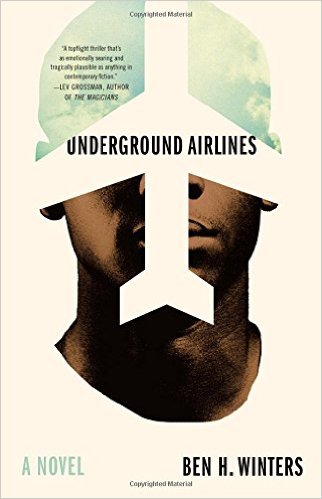
Underground Airlines by Ben H. Winters

Underground Airlines by Ben H. Winters is a hell of a book. The premise is that amendments to the US Constitution in the 1860s preserved the Union and averted the Civil War, but at the cost of continuing to accept slavery in states that chose to keep their peculiar institution. In the 21st century, a world of smart phones and GPS, slavery is still around in the Hard Four states: Louisiana, Mississippi, Alabama and a merged Carolina. Slave labor isn’t as useful for picking cotton in modern times, though “persons bound to labor,” as the book’s euphemism runs, still do that. They also work in factories making things from clothes to cars. Surveillance is up to modern standards.

So are attempts to escape, to reach the underground airline of “baggage handlers” who deliver slaves eventually to freedom in Canada. And so are the efforts of the slave catchers. Winters’ novel follows one of those, a man who is himself a former slave, back and forth through both sides of the looking glass as runners try to run and maybe catchers try to catch but maybe try to set themselves free of the system or maybe are just telling lies all around.

Through the eyes of the first-person narrator, readers see what oppression could, does, look like in 21st century America. People play roles, play dumb, until it’s hard to see who is getting played. Except every play leaves the white people on top, and the vast number of black people on the margins or worse.

Now I see things differently. It took me some time, but I know the secret now. Freedman Town serves a good purpose—not for the people who live there, Lord knows; people stuck there by poverty, by prejudice, by laws that keep them from moving or working. Freedman Town’s purpose is for the rest of the world. The world that sits, like Martha, with dark glasses on, staring from a distance, scared but safe. Create a pen like that, give people no choice but to live like animals, and then people get to point at them and say Will you look at those animals? That’s what those kind of people those people are. And that idea drifts up and out of Freeman Town like chimney smoke, black gets to mean poor and poor to mean dangerous and all the words get murked together and become one dark idea, a cloud of smoke, the smokestack fumes drifting like filthy air across the rest of the nation (p. 140)

Winters’ protagonist is human, and unreliable. That view of society stands in contrast to how he feels another night:

The great bulk of my life, then, had passed outside the Hard Four, in the free part of the land of the free. But even after all these years, I still found myself astonished daily by the small miracles of liberty. Just walking out of a restaurant with a clear head and a full stomach, holding a Styrofoam box with leftover food inside it. Just lingering in the parking lot a minute before getting in the car, smelling the wet asphalt, feeling a light drizzle as it condensed on my forehead. Just knowing I could take a walk around the block if I wanted to, go to a park and sit on a bench and read a newspaper. Just getting in that car and feeling the vinyl give under my ass, feeling the cough and purr of the engine. All these things were small astonishments. Miracles of freedom. (p. 12)

In due course, some of the novel shows what corporatized slavery is like: factory songs, uniforms, schedules, enforced company cheerfulness. It would probably be familiar to many kinds of workers around the world today.

The book is a taut thriller; there are characters from all sides of the institution, and they have depth and complications. There are fools, sinners, and plenty trying just to do the best they can. It isn’t perfect. To my mind it misses the everyday corruption that such a system would require, and its enforcers are capable in a way that cogs in a totalitarian machine generally aren’t. But changing those aspects would make Underground Airlines closer to The Foundation Pit, and that’s not what Winters is aiming for. He aims for, and delivers, a harrowing, compulsively readable story of a plausible America, one that reflects the real America in all too many ways.

+++

Doreen’s more political review is here.

Permanent link to this article: https://www.thefrumiousconsortium.net/2017/04/24/underground-airlines-by-ben-h-winters/