So on the one hand, a tale of courtly intrigue in the dazzling court of a foreign empire as seen through the eyes of a vulnerable young ambassador from a much poorer nation. In space! Based on Aztec-Byzantine history and practices instead of your standard Western Europe-Asian influences!
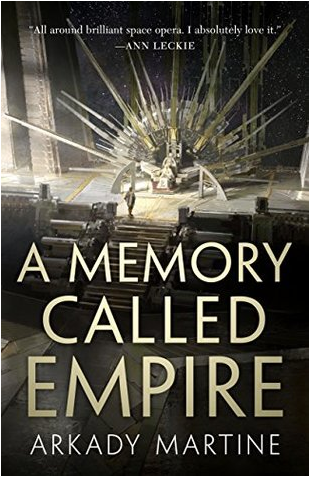 Mahit Dzmare is from Lsel Station (modeled loosely on Armenia), home to a planetless people anchored in a sector of space next to an important space travel jump point. She’s been in love with the Teixcalaanli Empire since she was a child, memorizing their language and literature and dreaming of one day getting a visa to visit. So when she’s selected as Lsel Station’s next ambassador to Teixcalaan, based not only on her own aptitudes but also on her compatibility with the last ambassador, Yskandar Aghavn, she’s both ecstatic and nervous. It’s one thing to go as a tourist, quite another to go as The Official Representative, especially since no one on Lsel knows exactly what happened to Yskandar to prompt such an urgent summons for a new ambassador from the Teixcalaanli capital. Mahit arrives to find an empire in the throes of a succession struggle and, in the manner of such novels, finds herself a key player in determining the future of Teixcalaan.
For all the sci-fi trappings, this is a surprisingly ordinary tale of diplomatic intrigue. The plot itself isn’t bad. It’s just not, once stripped of the tech stuff, at all unusual, especially if you’re a thriller aficionado like myself. What is unusual and thus of interest to jaded genre readers is the gorgeous, intricate world-building coupled with the incisive eye Arkady Martine brings to, if you’ll excuse the trite late 20th century phrase, cultural imperialism, in all its seductive glory. As a young girl growing up in Malaysia who adored America — and who was very, very lucky to have not only the tempering influence of her native culture but also the countering influence of the British Commonwealth — I felt for Mahit to my core. I understood all the longing for assimilation and, to turn another late 20th century phrase, culture shock of meeting in person what had only been admired from a remove. And this was despite having gone to elementary school on the East Coast for several years before picking up sticks for Southeast Asia. Weirdly, I’ve always felt it easier to adapt to living in Britain, but perhaps that’s because the UK feels less exclusionary when it comes to people who aren’t white natives (but also I’ve only lived in London, however briefly.)
Anyway, my point is that this is a fascinating cultural case study with sci-fi and revolutionary trappings, and is definitely different from anything else currently out on the market. I could have done with about 90% less italics tho. Every other page used italics in the third-person narrative, not to mention within the dialog, making me want to shake an editor.
One Hugo nominee for Best Novel down, five more to go! And they just gave us an extra week for voting, glory be!









 Al Singh
 Doug Merrill
 Doreen Sheridan
 Emily Lauer
 John Pitzel
 Lars N. Goldschlager
 Laura Eilers
 Professor X
 Robert Maedgen
 Sylvere Ap Leanan
 The Shire