In the absurdist tradition of Sergio Aragones comes the work of his compatriot Fermín Solís, who goes forward in time instead of back a la Aragones’ Groo to bring us the adventures of Astro Mouse, a mouse who’s an astronaut, and his companion Light Bulb. The comic starts off quite cleverly, as our heroes are on a strange planet and realize that their lack of hunger and other bodily urges is both unnatural and potentially deadly. But that original bit of sophistication eventually leads to the introduction of, sigh, their pet poop, translated here by Jeff Whitman as Caca.
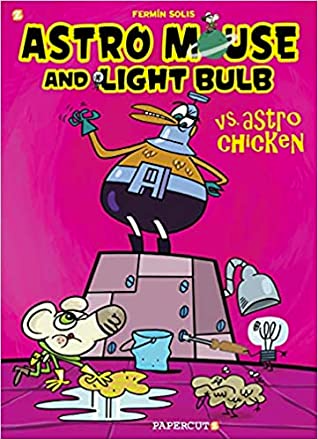 Kids who are at the stage of best appreciating gross-out humor will love this, but I admit to being too grossed out to fully appreciate the humor in their initial adventures. While Mr Solís has the excellent point that every parent thinks their kid is cute and everyone thinks their farts don’t stink, that doesn’t mean I want to look at the poop of others! By the time Astro Chicken rolls around in the second half of the book tho, I guess I’d gotten used to having Caca around, as I quite enjoyed that more traditional tale of Astro Mouse and Light Bulb butting heads with the domineering chicken who has come aboard to boss them around. The way they resolve their conflict with him is cute and, eventually, wholesome.
The art isn’t incredibly detailed, but adequately conveys the story. It’s definitely on the cartoon-y side, and seems to undergo a subtle change between the halves of the book. While the first part displays a traditional hand-drawn style, complete with visible art marker strokes, the second half employs more digitized effects. The art marker strokes are still visible, but the backgrounds are better filled in and the colors both more vibrant and more smoothly gradated. Interestingly, the line work suffers a bit for it, losing sharpness for several pages before balancing out better as the book closes.



 Al Singh
 Doug Merrill
 Doreen Sheridan
 Emily Lauer
 John Pitzel
 Lars N. Goldschlager
 Laura Eilers
 Professor X
 Robert Maedgen
 Sylvere Ap Leanan
 The Shire