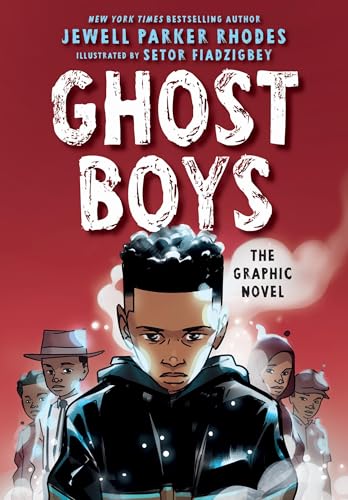
 adapted from the bestselling novel of the same name.
I love that this powerful middle grade story was adapted to the graphic novel format because that feels so much more accessible to a wider variety of readers, not only to kids with short attention spans but also to adults with less time on our hands (and also for adults with shorter attention spans, lol, because who am I kidding?) Making this important story more available to all level of readers — without, presumably, sacrificing any of the nuance of the original novel — is unequivocally a good thing.
The story itself revolves around 12 year-old Jerome Rogers. He lives in the Chicago projects, where safety is never a certainty despite the best efforts of his loving parents and grandmother. One day, he decides to go play outside by himself, in one of the few open spaces in his neighborhood, with a toy gun. Someone calls the police. A cop shoots him twice in the back, killing him.
Jerome’s spirit can’t move on. As he tries to make sense of what happened to him, he connects with not only another ghost boy done dirty by a racist society, but also with the daughter of the white cop who shot him. The three of them try to figure out how to make peace with what happened to Jerome, and how to make society better so that it won’t happen again.
That’s the bare bones of the story: there’s a lot more depth and nuance that I’m skipping over here as multiple people wrestle with guilt and grief. Setor Fiadzigbey’s illustrations — with a big assist on colors by Abigail Paradis — bring the story to life perfectly. His close-up on expressions, especially, are an exceptional substitute for words to describe the myriad emotions felt by so many of the characters here.
There are going to be spoilers next, so you can feel free to skip the rest of this review while I argue with one aspect of the ending. I did love the framing of the story, as much as I hate that tales like this continue to be necessary. No kid should be shot in the back, ever. Cops in this country are way out of line. You can’t expect to be armed and equipped and remunerated better than an actual soldier while being held to laughably low standards of conduct and discipline. It’s disgusting (and you can probably guess from this little rant which part of the ending I’m about to fight with, lol.)
So while this story is powerful, and told so fluidly in this volume that I devoured it in one sitting, I have to admit that I’m so tired of people in positions of power not having to take accountability for their actions. Boo-fucking-hoo, the cop who shot Jerome feels bad about what happened. He fucking should! He not only shot an actual child in the back, twice, he also waited hours before calling in the paramedics. He and his partner should have absolutely gone to jail for aggravated manslaughter (or whatever it’s called in Illinois) at the very least, and their dispatcher should also be convicted as an accomplice. But none of them face any actual consequences in this book for their role in deliberately killing a child. While this may be realistic, it’s not presented in such a way as to provoke outrage. Instead, the cop who shot Jerome is seen as trying to reckon with what he did by helping his daughter with her website highlighting how our justice system fails Black people. And that’s his entire punishment! I’m sorry, America, but that is not enough!
I’m so tired of racial supremacy protecting people who deliberately do bad things. Honestly, if the cop had called the paramedics after he realized Jerome was a kid, I’d feel a little better about him getting off scot-free. I get how conditioning and the survival instinct can override good sense in the heat of the moment, but there’s no excuse for waiting three hours to call the paramedics! And you know what, Idc that the guys who killed Emmet Till didn’t think they were doing anything wrong. That’s no excuse. The justice system exists to reinforce the common ethical code that underpins society, and to punish transgressors who stray way over the line. A system that excuses racism belongs to a deeply corrupt society that needs desperately to be reformed and healed.
Idk, maybe this book was supposed to make me angry. I don’t feel like that was the point tho: I felt that I was supposed to see the cop’s extremely mild, extremely conditional support of his daughter’s work as being somehow indicative of true progress. We need to expect better of our society and our justice system, tho — which I know is asking a lot in the big two five. But 2026 is just around the corner, and here’s hoping we can make bigger steps in dismantling white supremacy and its fascist handmaid systems then.
Ghost Boys: The Graphic Novel by Jewell Parker Rhodes & Setor Fiadzigbey was published December 2 2025 by Little, Brown Ink and is available from all good booksellers, including

 Al Singh
 Doug Merrill
 Doreen Sheridan
 Emily Lauer
 John Pitzel
 Lars N. Goldschlager
 Laura Eilers
 Professor X
 Robert Maedgen
 Sylvere Ap Leanan
 The Shire
1 comment
Hear, hear!