In deepest, darkest Kent, Coopers Chase is a retirement community built from what was once a convent. As part of its sale to private investors, the development has kept its original chapel and the burial ground where the sisters were laid to rest from the 1870s until the late twentieth century. Coopers Chase is bucolic, pleasant and apparently well run. It offers residents who are in reasonably good health a wide range of activities, one of which is solving murders.
That’s not strictly true, in that the Thursday Murder Club is by invitation, and thus not provided by the community and its management. On the other hand, the club does have a fixed time in the official schedule of the Jigsaw Room, one of the community spaces where residents can get together outside of their own rooms or apartments. Mum’s the word about murder, though. “It was Thursday because there was a two-hour slot free in the Jigsaw Room, between Art History and Conversational French. It was booked, and still is booked, under the name Japanese Opera — A Discussion, which ensured they were always left in peace.” (p. 18)
The Club began with Penny, who had been an inspector in the Kent Police for many years and Elizabeth, whose professional background is never stated explicitly, but she is described at various points as “terrifying,” “effective,” “not likely to take no for an answer,” and “occasionally played fast and loose with the Official Secrets Act.” She reminisces about past times in East Berlin and Leipzig, knows people in Cyprus, and is capable of calling in all manner of favors. They went through files that Penny had, against regulations, kept following her retirement. They would comb through cold cases “line by line, study every photograph, read every witness statement, just looking for anything that had been missed.” (p. 18)
Ibrahim, a semi-retired psychiatrist, soon joined them, as did Ron, a firebrand labor leader who had his heyday before Thatcher did her various things. “[Elizabeth] soon spotted Ron’s key strength, namely, he never believes a single word anyone ever tells him. Elizabeth now says that reading police files in the certain knowledge that the police are lying to you is surprisingly effective.” (p. 19)
Not long before the novel’s opening, Penny’s health has taken a considerable turn for the worse, and she has been moved to the Woodlands, a more medical part of Coopers Chase, where treatment runs toward the palliative. Penny can no longer speak, and the people who spend time with her are not entirely sure that she can hear or see either, though that does not stop them from talking to her. Her successor in the Club is Joyce, a retired nurse. Most of The Thursday Murder Club is written in the third person, but Joyce has decided to start keeping a diary again after many years, and so Osman relate some events in the first person from Joyce’s perspective, as told to her diary.
Osman introduces the official side of things by including two members of the local police force, Donna De Freitas and her boss Chris Hudson. Donna, who is Black, has scampered from London to the countryside in the wake of a break-up and has come to regret the choice. As the new person on the local force, she has been assigned the least interesting duties, one of which is a group event at Coopers Chase to talk to the residents about personal security. The assembled older people derail her immediately but amusingly, and as a follow-up the Thursday Murder Club invites her to lunch. Even in this first conversation, she holds her own with Elizabeth.
“We bore easily,” adds Elizabeth, also polishing off a glass [of wine]. “God save us from window locks, WPC De Freitas.”
“It’s just PC now,” says Donna.
“I see,” says Elizabeth, lips pursing. “And what happens if I still choose to say WPC? Will there be a warrant for my arrest?”
“No, but I’ll think a bit less of you,” says Donna. “Because it’s a really simple thing to do, and it’s more respectful to me.”
“Damn! Checkmate. OK,” says Elizabeth, and unpurses her lips.
“Thank you,” says Donna. (p. 10)
Though the club deals with cold cases, they soon have a hot one. Ian Ventham, the man who developed Coopers Chase, is, at least in his own mind, a hard-driving businessman. Unfortunately for him, he’s as clueless as he is heedless. He’s also in business with Tony Currant, a man with a decidedly checkered past. The police never managed to pin anything on him, but he was up to his eyeballs in the local drug business, with all of the violence that that implied. Coopers Chase is partly up a hill; the further reaches are still picturesque sheep pasturage, but Ian has visions of two more developments that will go up to the crest, and make him millions more. He has also decided that he no longer wants to share that business with Tony, and there’s no time like the present to break the news about the break-up. Ian may be bull-headed but he’s not entirely stupid about Tony’s nature, and he makes sure to end the partnership in a public place, Coopers Chase, where plenty of people can see what is happening but none of them are within earshot.
One of them does not live out the afternoon, but contrary to expectations, it’s Tony who gets bludgeoned in his own kitchen. The police investigate; the Thursday Murder Club investigates; Donna is rather caught in the middle as suspects multiply and alibis start to collapse. There are a lot of funny scenes in this part of the book. Club members play up their age and infirmity when it suits them, using other people’s prejudices about the elderly to wrong-foot them and get their way, or get important information. More and more backstories emerge, sometimes giving motives for killing Tony, sometimes revealing criminal or semi-criminal pasts that looking too closely at Tony’s murder might bring to light.
Osman has some good observations to make away from the case, too. Joyce’s daughter Joanna is spectacularly successful in business, but there are bits from their past that they’ve never gotten past, and as proud as Joyce is of her daughter, there are still strains. At one point, Joanna has come out to Coopers Chase: “I can hear Joanna getting up from a nap [Joyce writes in her diary], so I’ll say bye for now. You wouldn’t know it, but I’ve been typing quietly. My gorgeous baby, happy and sleeping in my bed, and two murders to solve. Who could ask for more?” (p. 203) There’s also Ron and Ibrahim taking a bit of a break in Ibrahim’s apartment.
“Where is your place, Ron?” asks Ibrahim. “Where do you find your peace?”
Ron purses his lips and chuckles. “If you’d asked me a question like that a couple of years ago I’d have laughed and left, wouldn’t I?”
“You would,” agrees Ibrahim. “I have successfully changed you.”
“I think,” starts Ron, face alert, eyes alive, “I think …” Ibrahim sees Ron’s face relax as he decides to just to let the truth come out, rather than think. “Honestly? I’m flicking through it all in my head, all the things you’re supposed to say. But, listen. It might be here in this chair, with my mate, drinking his whisky, dark outside, with something to talk about.
Ibrahim knots his hands together and lets Ron talk.
“Just think of everyone who isn’t here, Ibbsy. Every bugger who didn’t make it? And here we are, a boy from Egypt and a boy from Kent, and we made it through at all, and then someone in Scotland made us this whisky. That’s something, isn’t it? This is the place, isn’t it, old son? This is the place.” (p. 210)
Joyce’s diary mentioned a second murder, didn’t it? That was for me the best turning point in the book. Someone close to the story drops dead just minutes after another public quarrel at Coopers Union. Only it’s not the kind of dropping dead that’s expected in a retirement community, it’s a lethal dose of fentanyl administered by injection. The club and the police both arrive at this conclusion separately but almost simultaneously. One thing about a retirement community in a rural area is that many people are skilled with needles: diabetics, retired doctors, people on blood thinners, former nurses, veterinarians both active and retired. With fentanyl’s use as an animal anaesthetic in addition to its various human uses, a surprising number of people have access to the substance as well. The second murder opens up the story, as both police and club scramble to piece together what has happened and why.
Unfortunately, that very opening brings with it several things that I liked less about The Thursday Murder Club. One of them is an awfully high body count in a book that, I think, is meant to be mostly light-hearted. When all is said and done — when the events of decades past come to light, and people discover how they relate to the present — nearly a dozen deaths, including at least three suicides, fill the pages. Maybe Osman is making a comment about the amount of violence lurking in the shadows of sunny Kent, but I found that the mostly breezy tone did not fit with the content of the tale, once I stopped to think about it. Another aspect of the book I liked less is that in the second half of the book, a number of chapters are obviously constructed so that the characters would know certain things, but the reader would not. Osman shows them reading a report or a note, or he summarizes a conversation without giving the important details that relate to the crimes. It was the obviousness of the withholding that grated on me; it’s not that I wasn’t clever enough to figure out the culprit, it’s that the characters knew things that I, as a reader, could not. It felt like a breach of the bargain of the genre, but I do not read many mysteries, so maybe this is a different kind of approach rather than a flaw.
Late in the book, one of the characters says that several of the killings in the story were motivated by love, “always love.” Unfortunately, I neglected to flag the page as I was reading, so I can’t pull up the rest of the context, but at any rate: no. This seemed to me as being of a piece with the book presenting suicide as an honorable way out of a situation, and in one instance countenancing the murder of a terminally ill person who was unable to make their preferences known. These incidents left me feeling less than jolly about a book that, again, I think is meant to be mostly light-hearted within the conventions of the mystery genre.
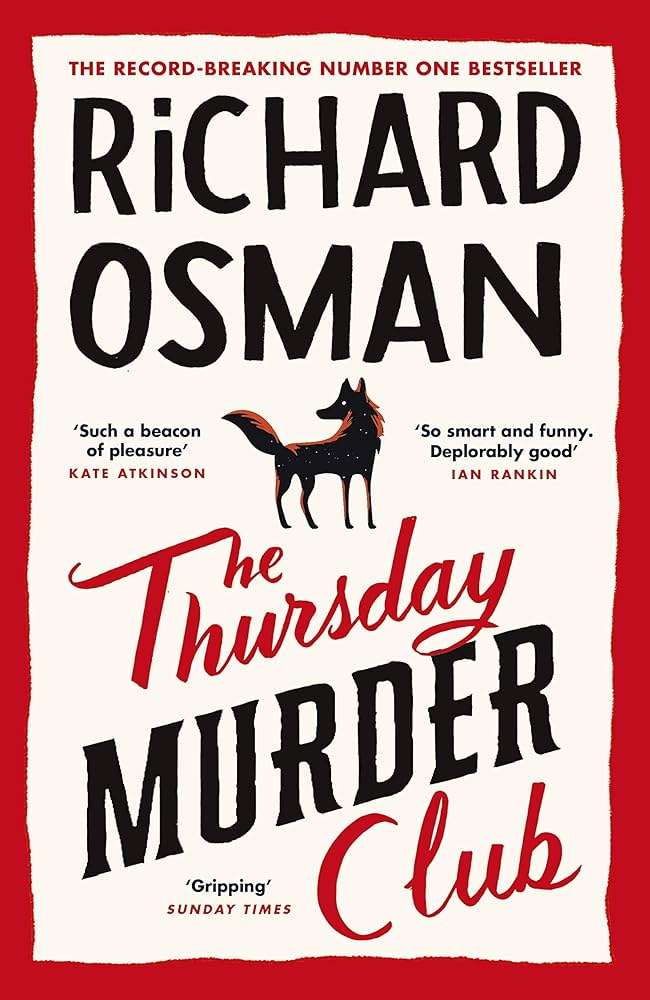
My view may very well be a minority opinion. The cover of my UK paperback proclaims The Thursday Murder Club not only “the record-breaking number one bestseller” but also “the bestselling book of the decade,” which is an interesting claim considering the decade is only just halfway done. The Guardian reported that the book was the subject of a 10-way bidding war among publishers, and that Osman landed a seven-figure deal. People outside the UK probably don’t know that Osman is the long-time presenter of a BBC quiz show; apparently his status is somewhere between extremely famous and national treasure. A book from him would not have needed too much of a marketing campaign, but a publisher investing at least 200 times the typical advance for a debut mystery surely put all of the marketing muscle at its disposal to recoup its investment. I can’t exactly fault the publisher for taking on an author for whom the extremely hard work of getting known was already done — there are now four books in the Thursday Murder Club series, so it was not a dud — but I do wonder about the authors for whom a sliver of that advance and that marketing support would have been life-changing.

 Al Singh
 Doug Merrill
 Doreen Sheridan
 Emily Lauer
 John Pitzel
 Lars N. Goldschlager
 Laura Eilers
 Professor X
 Robert Maedgen
 Sylvere Ap Leanan
 The Shire