One of the things about living in a country where English is not the dominant language is that when books turn up at your local English-language bookstore, you snag them because there may not be another chance any time soon. (People will say that a quarter of the way through the twenty-first century, I am ignoring options for online shopping. Yes, I am.) For whatever reasons within the UK publishing business, T. Kingfisher aka Ursula Vernon is enjoying a publication renaissance there, and many of her works from the mid-2010s to the present are appearing on Berlin booksellers’ shelves for me to snap up. Since May, I have acquired ten, read three so far, am looking forward to the rest, and regret nary a penny spent.
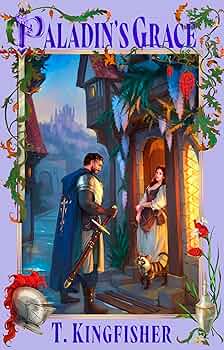
The three that I have read so far — Paladin’s Grace, Swordheart and Clockwork Boys — all share a setting: the world of the White Rat. It’s a recognizably low-magic fantasy world, long on details that matter to the story but otherwise uncluttered by languages, magic systems, maps, plate tectonics or any of many dozens of other things that can fill up a novel without filling out the characters or their stories. Kingfisher is writing about people first and foremost, and while she brings the setting sufficiently to life for me to believe in it, her world is not likely to inspire its own reference works. One aspect that is important in all three is that the world’s gods are real and demonstrably active in human affairs. Some people, paladins called to service and clergy above all, have direct contact with the god they have chosen, or that has chosen them. Divine effects are not as reliable as science or other crafts, but enough of them are real that acknowledgement of the gods is close to universal.
As of this writing, there are three different series set in this world. The two Clocktaur War books tell of a terrifying semi-mechanical, semi-magical army that seems relentless in its ability to conquer the lands around the city where they first appeared. Swordheart came about when
my husband and I were in the kitchen and I was ranting about how much Elric—Michael Moorcock‘s Elric—whined about everything. “If you ask me,” I said, “the real victim was the sword Stormbringer. The sword had to listen to him whine and couldn’t leave. But does anybody ever ask the magic sword’s opinion? Noooo.” (p. 437)
Swordheart has a lot to say about what the magic sword thinks about everything going on nearby. Since its publication in 2018, it has been a standalone novel, though one that very much wants a sequel. Earlier this year, Kingfisher revealed that a sequel, titled Daggerbound, will be published in the second half of 2026. The third series is called The Saint of Steel, and so far there are four — Paladin’s Grace, Paladin’s Strength, Paladin’s Hope, Paladin’s Faith — out of an expected seven. On her web site, Kingfisher recommends reading them in the order just listed: Clocktaur, Swordheart, Paladins.
I didn’t do that.
In fact, I did the exact opposite, because Paladin’s Grace was the first one I spotted at the glorious downtown English-language bookstore, and so I bought it right away. It worked out fine, though. I don’t think that the events of Swordheart impinge on the larger world at all. In the other series, the clocktaur army is in fact defeated, though I don’t know how because I have only read the first of the pair, Clockwork Boys. I’m not surprised, as the first is very much not the kind of book whose sequel will end in a crushing defeat for the protagonists and the collapse of the world that they know. I am keen to find out how it happens. I could get an electronic version of the second book The Wonder Engine right now and find out. On the other hand, an edition will come out next spring that matches the very pretty copy of Clockwork Boys that I have, and I like matching editions. I guess it’s mostly a question of how quickly I read the other seven Kingfisher books on my tbr shelf.
With Paladin’s Grace, Kingfisher turns her main character’s world upside down in the book’s very first sentence. Stephen is a paladin of the Saint of Steel, and his years of service have been relatively straightforward. He “rode out when the Saint’s duty demanded swords and men to wield them, and rode back to the temple nursing their wounds, only to ride out again when they had healed.” (p. 1) Readers learn that the Saint’s paladins can enter a berserker state, fighting with superhuman strength and ignoring wounds as the god enters them and lends them power. The Saint’s servants also cooperate with devotees from other temples. As the book begins, Stephen is on his way back from demon hunting with paladins of the Dreaming God. Such hunting “mostly involv[ed] possessed livestock, and while the Dreaming God’s chosen were skilled at exorcism, a two thousand–pound bull inhabited by a furious demon was not something anyone wanted to tackle alone.” (p. 1)
So far, so normal for Stephen’s life. And then that first sentence: “Stephen’s god died a little after noon on the longest day of the year.” (p. 1) Kingfisher does not say how or why, only that it happened. “It had never occurred to Stephen or any of the others that a god could die. Such things happened in mythology, not in real life.” (p. 1) He feels the death the way he had felt the god’s presence for many years. His first thought is that his own heart has stopped; his second is hearing his brother paladins collapsing as they too feel the death. “And then he heard the sound of his brother Istvhan praying, harsh and rapid, and it was such a strange thing, that prayer, because Stephen knew instinctively that no one was listening.” (p. 2) Then the blackness of the berserker state takes him, and he knows no more.
Three years elapse before the second chapter begins. Stephen and Istvhan have both survived the death of their god. Almost all of their fellows did not. After their berserker frenzies had abated — and they had done terrible things in that state — the seven survivors were taken in by the Temple of the White Rat. “The Rat’s priests fixed things that could be fixed, and when things were broken past all mending, they helped people pick up the pieces.” (p. 3) Eventually, the seven survivors decided that even though they had lost the grace of their god, they still had duty, and duty would have to do. They are not stoics, and they often cover their bereavement with sardonic humor. They take on various services for the temple that has given them sanctuary, and they have complementary skills. “The White Rat claimed no paladins. He was served by law clerks and healers and diplomats, not by steel.” (p. 4) On the day that the main story of Paladin’s Grace starts, Istvhan is set to loom menacingly at a trial. Stephen’s task is to escort a healer through one of the city’s rough neighborhoods.
The idea of a rough neighborhood amuses Stephen, and the healer he is supposed to accompany is known well enough by the residents that he’s confident that he won’t have any trouble. But the temple’s leaders are unsettled by a string of beheadings that the local guard has been unable to solve, and so Stephen, faithful to his duty, goes along. The brief scenes of the healer’s rounds that follow are typical of Kingfisher’s work, in that they reveal bits of the background incidentally, they are full of heart because while the people may not play big roles in the book’s plot they are all the main characters in their own stories, and they are funny because when you take the time to listen to them nearly everyone is funny, whether intentionally or otherwise.
“Brother Francis!” said his patient, aghast, struggling to set up. “You can’t — a caller — and me looking such a sight—!”
“Miss Abernathy,” said the healer, pushing her gently back down, “you’re beautiful no matter how you look.”
… Stephen bowed. “You look magnificent, madam” he said. “I should apologize to you for coming armed, in all my dust.”
Miss Abernathy, who was at least eighty, blushed.
“Forgive me,” murmured the healer, after they left. “There’s not a great deal with her that I can fix, but she’s bored and lonely on top of her aches.” He grinned up at Stephen. “Having a handsome young fellow to look at for a few minutes was better than any medicine I could mix up.”
“Young? I’m thirty-seven.”
“And I’m sixty-one, so I don’t want to hear it, child.” (pp. 10–11)
Stephen’s self-deprecation will turn out to be important to the story. Or as one of the characters puts it about two-thirds of the way through the book, “He’s a paladin. … They only have a couple of emotions and the primary one is guilt. You’ll see.” (p. 222) His talent for improvising is key, too, and he puts it to good use in the very next chapter when a woman runs right into his arms and implores him to hide her. She’s being pursued by some Servants of the Hanged Mother, as unsavory a priesthood as exists in the city, with a talent for sucking up to power and treading heavily on anyone lower down the hierarchy. The two of them feign a paid-for intimate encounter, and the Servants eventually decide they had been pursuing the wrong person.
Afterward, Stephen naturally has questions. She’s a perfumer, and talkative. By the time he has seen her out of the rough neighborhood and well away from the Motherhood, he’s learned a fair amount about smells and flowers and graveyards. One thing she doesn’t tell him, though, is her name.
That first meeting sets up the rest of the book, as Stephen’s next assignment crosses her delivery of a perfume to a special guest of the city, and complications of a deadly sort ensue. Grace has secrets; Stephen has guilt and secrets; the Temple of the White Rat has many non-obvious resources. Plots and counterplots keep all of them busily in harm’s way, without slowing down the humor of people being people. Even though it went against the author’s recommendation, reading Paladin’s Grace first was a splendid introduction to the world, and I am delighted that there are three more paladins whose stories Kingfisher has already told.
Swordheart begins just as arrestingly as Paladin’s Grace did. “Halla of Rutger’s Howe had just inherited a great deal of money and was therefore spending her evening trying to figure out how to kill herself.” (p. 1) Her great-uncle Silas, who had been reasonably wealthy, left her his money and all of his possessions. The other relations who lived in the house did not like that outcome, so they locked Hallas in her room until she agreed to marry her cousin Alver, who has clammy hands. Or until she died, which would be just as well in the view of her fearsome Aunt Malva.

After three days, Halla has decided to do the job herself. She has persuaded herself that the extended family will likely poison her, drug her to gain her assent to marrying Alver and let her die in childbirth, or just starve her in her room. The room in question is two stories up, so escape would likely mean a fatal fall, even if she could squeeze through the small iron grid that held the window’s glass, which she couldn’t. Halla’s reasoning is not exactly solid, but there’s no one who will talk any sense to her. So she’s searching for methods to hasten her demise, and remembers
a sword over the bed, in a tarnished silver scabbard. One of Silas’s prizes, no doubt. He had collected strange objects and left them scattered haphazardly around the house. She’d found a manticore skull in the pantry once. It had just stared eyelessly at her, and eventually she rearranged the sacks of flour and jars of spices to make room. It was still here. The cook had screaming hysterics when she found it the next day; but you got used to things. She’d never been quite sure if Silas had gone senile or just enjoyed leaving things where they would shock people. (pp. 10–11)
The sword is big and awkward. It’s old, and Halla is not even sure she will be able to get it out of the scabbard. Practical amid her distress, she strips down to her shift so as not to get blood on her clothing. She wonders how people in stories managed to fall on their swords. Maybe affix it somewhere and get a running start? She decides that through the heart is the way to go, and pulls down the cloth of her shift. She says a few things to bolster her courage, and then commends her soul to whatever god will take it.
It occurred to her suddenly that the sword might very well be rusted into its scabbard, in which case she’d feel rather stupid about standing here, bare-breasted, commending her soul to the gods.
She drew the sword.
There was a crack like silent thunder and blue light pulsed around the sheath. She immediately dropped the sheath, but the light was faster. It ran over her hands and down her wrists. She clutched the sword hilt in sheer astonishment.
The blue light shot around the room and coalesced into a figure. It was roughly human-shaped, although man or woman or both or neither, she could not tell.
It could be a demon for all I know, [she thought].
She threw her empty hand up in front of her to ward off the blaze of light. When the light faded, leaving orange afterimages on her heyes, there was a man standing in her bedchamber, in the narrow space between the chest and the night table.
“I am the servant of the sword,” he said. “I obey the will of the—great god, woman, put on some clothes!” (pp. 14–15)
And so Halla meets Sarkis, the servant of the sword. He’s considerably more pleasant than Stormbringer, which inspired Kingfisher to write Swordheart. Hallas doesn’t have anywhere near Elric’s capacity for whining either. Like other Kingfisher heroines, she’s practical and sensible most of the time, though sometimes her logic takes her down bad corridors. This one has put a strapping and experienced warrior at her service and they soon take the direct way out of the prison her family had made out of her room, leaving a hired man gravely wounded and her aunt sounding the alarm to wake the whole town.
The rest of Swordheart is devoted to untangling the mess of the first few chapters. Halla and Sarkis want to survive. Halla wants to clear her name and claim her rightful inheritance. Sarkis has been bound to the sword for so long that he has almost forgotten that he could want something. Serving a wielder who considers him a person rather than just a weapon awakens long-dormant parts of him, but also reminds him of what he did to get put into the sword in the first place.
Halla has an idea of where they might gain some support, but on the road to Amalcross they encounter both robbers and some Servants of the Hanged Mother. Sarkis’ violent skills keep them alive but set up further complications. In Amalcross they get advice to seek legal support at the Temple of the White Rat in the city of Archon’s Glory (where Paladin’s Grace takes place). The temple agrees to send a lawyer in return for a share of the inheritance. There is plenty of adventuring during the travel, with much comic relief provided by the gnole (a human-sized badger-looking person) Brindle, whose extremely slow ox pulls the group’s cart and whose sardonic view of human nature hides some real affection for Halla. The lawyer Zale also instigates experiments to learn more about the nature of Sarkis’ ties to the sword. He appears when the sword is drawn and disappears when it is sheathed; time in the sword heals him. Beyond those details, few of his previous wielders cared enough to find out. Investigating makes Sarkis more aware of his ties to the world outside, and humanizes him to the others. They save each others’ lives, they get each other deeper into trouble, and they make the same journeys along the road often enough that it becomes a bit of a running joke among the characters.
That the characters can have running jokes is a testament to how thoroughly Kingfisher brings them to life. She also shows how often people, mostly men, overlook plain-looking middle-aged women, how often people will assume that a woman nattering on is not terribly bright. Halla is all too aware of both, and takes ruthless advantage.
At a market Halla
just asked questions. Very … pointed … questions. And then the questions led to anecdotes.
“Oh, where is this from? And what’s the thread made of? Really! And how long ago was that? I see. This dye is so lovely, but is it waterproof? Are you sure? Because my cousin had a batch almost this color—not as nice, yours is better—and the first time she wore it in the rain, she looked like she’d got gangrene. I mean, she did actually get gangrene later when the ox bit her, but that wasn’t related to the fabric. Her forearm got all oozy. It was terrible. The smell, too. The leeches couldn’t do anything. The Temple of the Four-Faced God did their best, but you know how it is when you take off a limb, everything’s very touch and go. She made a full recovery, though! Well, except for the arm. Obviously that didn’t recover. But it hardly slows her down at all. Can’t wear this color at all, though, says it brings back bad memories. Do you have anything like that in brown?”
By the end of this recitation, the shopkeeper was just staring at her with a stunned expression. Sarkis didn’t know how much of a discount Halla got on the deal, but she walked away with a brown gown and a pleased expressions.
…
Halla certainly held her own with the merchants. The man who sold socks even tried to flirt with her. Sarkis was fairly certain that Halla didn’t realize this, but it was hard to tell how much as an act and how much was just … well … Halla. (pp. 166–67)
There are reversals, there is magic, and there is danger, but of course everyone lives happily ever after. Well, those who deserve to. Most of them, I think. Swordheart has so much heart to go with the swords that I am very happy I won’t have had to wait the full eight years for the sequel.
Clockwork Boys takes a more obvious band of misfits out on the road hoping to save their city and themselves, possibly even in that order. Slate is a convicted forger with a death sentence hanging over her head; she also has the mild magical knack of smelling rosemary when danger is near. Brenner is her ex, an accomplished criminal with a death sentence of his own. Caliban is a paladin who killed nearly a dozen people while he was possessed by a demon. The possession modified his guilt, in the eyes of the local law, and so he was not hanged but tossed into the dungeon forever.
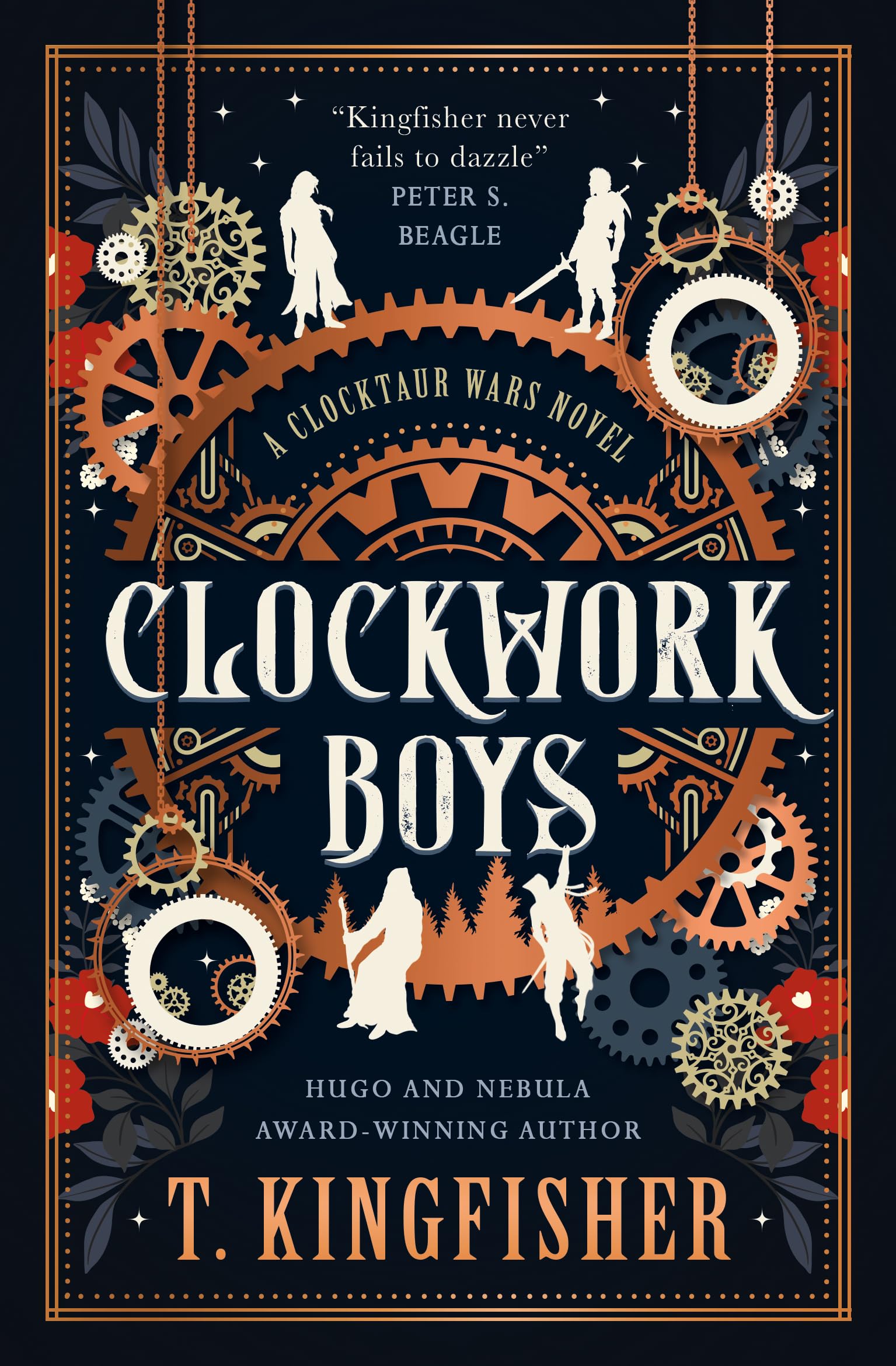
The ruling Dowager is prepared to offer all three an amnesty if they can unravel the mystery of the Clockwork Boys, an apparently unstoppable force of semi-mechanical semi-magical constructs that have issued from Anuket City and are slowly but surely conquering the Dowager’s lands on a path to her city. Previous expeditions have all failed, though some had survivors. Desperate times call for desperate measures, and this trio is clearly both. Magical tattoos prevent them from simply running away from the mission; thoughts or actions that would take them away from their task lead to pain that starts at bad and runs quickly up to debilitating. The guard captain who oversees Caliban’s tattooing says he has no idea how it works, “But if you betray us, the tattoo will eat you.” (p. 28)
The motley trio will get a little bit of support. “A scholar will accompany you,” [said the Captain]. “He’s made something of a study of arcane machinery—it’s possible that his expertise may help. In theory he has a counterpart in Anuket that should know more, but that other scholar has vanished.” (p. 27) As a setup, the beginning not as elegantly done as Swordheart or Paladin’s Grace, but it gets the story moving, and Clockwork Boys is about 100 pages shorter than Paladin’s Grace and about 150 pages shorter than Swordheart, so Kingfisher has to get the ball rolling quickly.
The scholar, when they do meet him, turns out to be very young and very very sexist. Learned Edmund has led a cloistered life for nearly as long as he can remember, can barely bring himself to speak with a woman, and certainly does not know how to take orders from one. Which is awkward because Slate is very clearly in charge of the mission. Like most Kingfisher characters, Edmund is capable of learning, especially when not learning means injury or death, and so he unbends through the course of the book.
The four of them cover some of the same roads and run into similar magical difficulties as the characters in Swordheart, though in the world’s chronology Clockwork Boys takes place quite some time before Swordheart. It was interesting to see Kingfisher’s two different takes, though I hope they do not turn up more often because they are said to be strange and rare events. There are also very funny scenes as the more city-bound characters learn to ride horses; Slate in particular gets a bit of comeuppance to balance her imperiousness in running the mission.
My one difficulty with Clockwork Boys is that it’s very much the first half, or perhaps the first third of the whole story. It took me longer than it should have to realize that at the pace events were proceeding there was no way that the characters would complete their mission. Seeing the characters interact and adjust to each other is the joy of the book; the Clockwork Boys themselves are every bit as menacing as the tales about them imply; and I have no idea how the quartet will overcome them. That, I suppose, is the matter of The Wonder Engine, which is longer and conclusive. That sequel has been out for seven years now, so I don’t really need to wait to find out. One the other hand, I have seven more Kingfisher books already at hand, so I may just relish the cliffhanger until the new, matching edition is published next March.

 Al Singh
 Doug Merrill
 Doreen Sheridan
 Emily Lauer
 John Pitzel
 Lars N. Goldschlager
 Laura Eilers
 Professor X
 Robert Maedgen
 Sylvere Ap Leanan
 The Shire
4 comments
1 ping
Skip to comment form
Doug, I loved all these books, too. My favorite Paladin book is Paladin’s Strength, the second one. But I love all the books in the world of the White Rat.
If you like Kingfisher, you might also like Megan Bannen’s books, starting with The Undertaking of Hart and Mercy.
Author
Thanks for reading, and thanks for the recommendation! First I’ve heard of the author, but now I know where to begin.
I am so excited that you have started reading T Kingfisher, I will try not to give you any spoilers. And I second Paladin’s Strength as my favorite.
Author
Thanks! 🙂
[…] gave more detail in Paladin’s Grace, the first of presently four novels that follow the lives of the seven surviving paladins of the […]