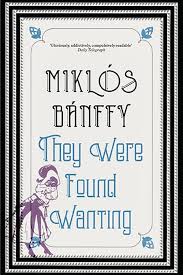
After introducing readers to the lost world of Hungarian nobility before the Great War in They Were Counted, Miklós Bánffy continues their stories toward the great catastrophe that is coming, that only a very few of them can see looming on the horizon. These two books, along with They Were Divided form Bánffy’s Transylvanian Trilogy, sometimes called The Writing on the Wall. Though it is split into three volumes, it is essentially one long tale. When he began the work, the world he wrote about was already lost in the calamity of the Great War, which blew the Austro-Hungarian Empire into its constituent parts, and whose peace settlement gave Transylvania to Romania, suddenly putting lands that the Hungarian nobility he wrote about had ruled for centuries into a foreign country. By the time that Bánffy finished the work in 1940, Hungary was again fighting in a world war, again on the losing side, as Bánffy, who had been foreign minister in the early 1920s, surely recognized. After the war, a short-lived republic gave way, under Soviet occupation, to a Communist dictatorship. These authorities had no interest in a work about a lost aristocracy, and so Bánffy’s brilliant work languished for decades.
The trilogy was translated into English in 1999, and into German in 2012. I don’t know if it’s been translated into other major languages yet; I hope that it gradually finds the vast and admiring audience it deserves. Patrick Leigh Fermor found it a remarkable work and wrote a foreword to the edition that I have. During his 1933–34 walk from the Hook of Holland to Istanbul, Fermor encountered Transylvania while Banffy was writing, and offers this perspective:
It was in the heart of Transylvania — in the old princely capital then called Koloszvar (now Cluj-Napoca) that I first came across the name of Banffy. It was impossible not to. Their palace was the most splendid in the city, just as Bonczhida was the pride of the country and both of them triumphs of the baroque style. Ever since the arrival of the Magyars [Hungarians] ten centuries ago, the family had been foremost among the magnates who conducted Hungarian and Transylvanian affairs …
Banffy is a born storyteller. There are plots, intrigues, a murder, political imbroglios and passionate love affairs, and though this particular counterpoint of town and country may sound like the stock-in-trade of melodrama … it is nothing of the sort. But it is, beyond question, dramatic. (pp. xviii–xix)
Banffy places two cousins, Laszlo and Balint, at the heart of his narrative. Both young men are part of the upper reaches of the Hungarian nobility in Transylvania. Balint is the heir to large estates throughout the region. He is the scion of an ancient and widely respected family, and in the trilogy’s first volume he takes his expected place in parliament in Budapest, though he does nothing so base as join a particular faction; his family has always stood for the general good, above partisanship, and he continues the tradition. Prior to the start of the books, he served the Austro-Hungarian Empire in various diplomatic roles, so he has friends and contacts in the imperial capital of Vienna. Where many of his colleagues in parliament consider only Hungarian issues, Balint’s view encompasses much of Europe. His interests include the down to earth as well. Balint is aware that his wealth and position come from the lands that his family owns, but that the real work is down by the many farmers, woodcutters, and others whose rents fill his bank accounts. He is also aware that the time-honored methods are being supplemented by progress in science and technology; he further knows that there are plenty of middlemen who take advantage of both the peasantry — often ignorant and illiterate — and the nobility — far away and disinclined to bother with details. Balint wants to bring modern methods to his lands, and to make sure that he is receiving his due.
Laszlo’s family is equal in stature to Balint’s, but his position within it is far more precarious. He is an orphan, take in by relations and raised among them, but some of the older generation never let him forget his origin, and he constantly carries that burden within himself. In contrast, to Balint, he will not inherit, and he will certainly not take a seat in parliament. His talents and his passions, however, do not run in that direction. He is a musical genius, and some of his ideas about composition echo those of Bela Bartok, whose work Banffy championed. Laszlo is not content with his muse; he craves social recognition that he thinks has been denied him because he is adopted. That same status has made him stiffly proud, which of course produces complications.
Balint, too, has his shortcomings. He overvalues his good intentions and underestimates how much people may have it in for him, especially for reasons he can do nothing about. One of those is, unfortunately, his own mother. She does not have it in for him, exactly, but she finds his true love completely inappropriate. She’s supported in this view by the manager of the estates, her longtime lawyer, who is extremely suspicious of Balint’s ideas about improving the lot of the peasants, and about looking closely at the accounting books. His mother’s two serving women, who have been at her side during the long years of her widowhood, are happy to feed gossip to her that reflects poorly on Balint. Given that by the time of They Were Found Wanting Balint’s love is married — to an unstable husband, just to make matters more complicated — she’s not entirely wrong in her judgement. The Countess is formidable, and Balint’s struggle to love his mother, hope for her approval, and live his own life is a struggle not limited to the upper nobility. Banffy shows the human feelings behind the social and financial manipulations; the characters feel like real people with understandable desires and flaws. Many of them are related and have known each other forever, which makes for even more cross-currents.
Though the two cousins are the mainsprings of Banffy’s overarching narrative, the large cast contains many convincing portraits, and characters who grow over the course of the trilogy. Older characters age, and try to come to terms with changes in society and their own diminishing capabilities. Schoolgirls become sophisticated debutantes, and young parents. Banffy is painting on a large canvas, and he crafts both the overall composition and the small details beautifully. The trilogy is also a work that could not have been written by a young man. The story encompasses so much lived experience, so much close observation of triumph and tragedy, that the perspective of many years is needed to bring to the page.
I am very much looking forward to its conclusion in They Were Divided, even though I know that tragedy looms. I hope that some of the characters I have come to love will find their happiness before their whole world comes to an end in the Great War. And though that world is now many times lost, Banffy’s evocation brings it back to life, and his tale shows both common humanity across the ages and the very specific ways that people live within the forms of a given time and place. Two-thirds of the way through, I think this is a brilliant work that deserves to keep finding readers for many more years to come.
+++
They Were Found Wanting picks up soon after the end of They Were Counted, and Banffy makes no effort to bring readers up to speed. Begin at the beginning and enjoy the full measure of the Transylvanian Trilogy.

 Al Singh
 Doug Merrill
 Doreen Sheridan
 Emily Lauer
 John Pitzel
 Lars N. Goldschlager
 Laura Eilers
 Professor X
 Robert Maedgen
 Sylvere Ap Leanan
 The Shire