
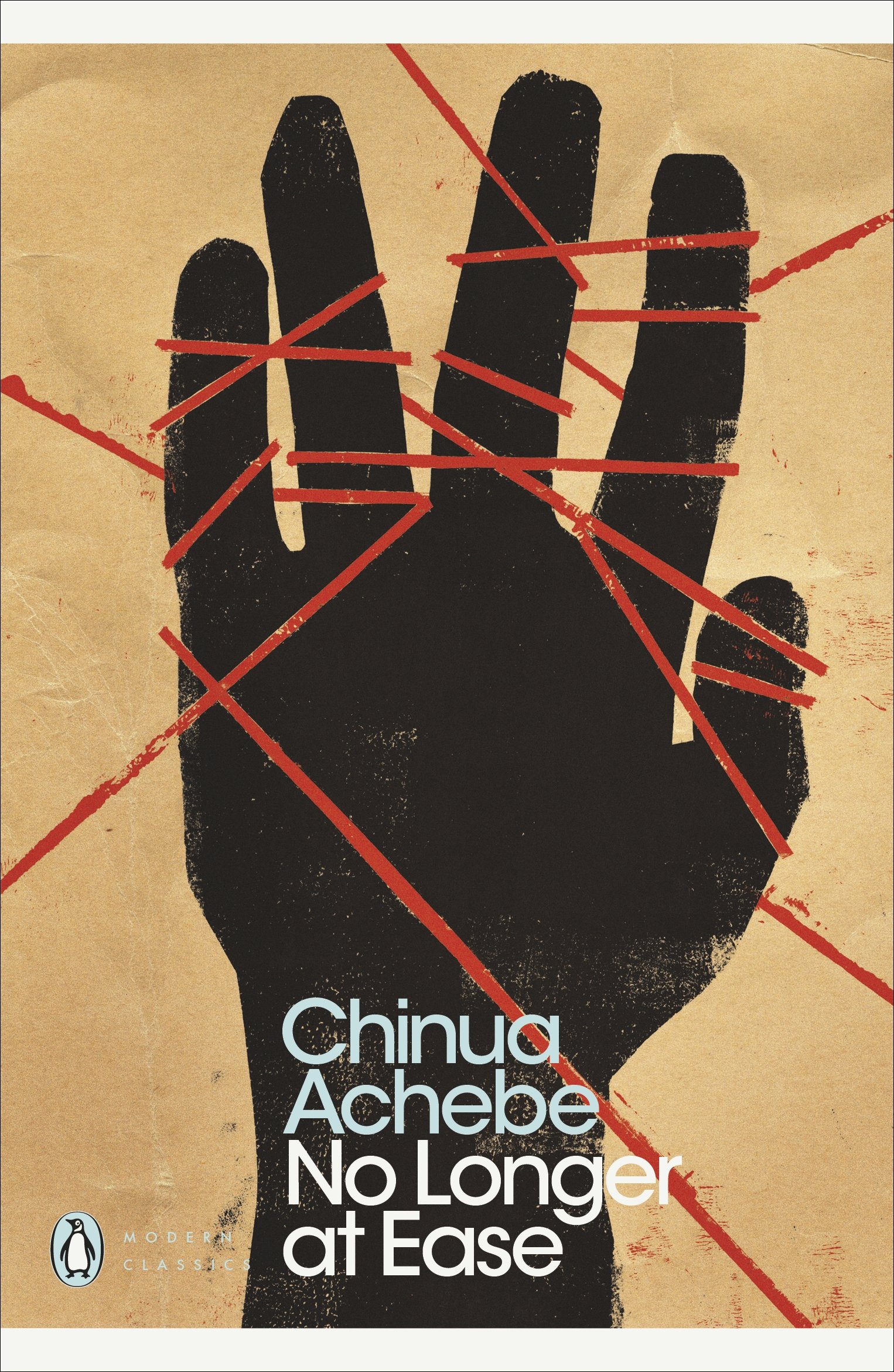
No Longer at Ease follow Things Fall Apart a generation later, although that is not immediately apparent. What is immediately apparent is that Obi Okonkwo is in a heap of trouble. He is in the dock, on trial in a case that has been the talk of Lagos for weeks, and the only thing remaining in the trial is the judgement. Achebe soon relates that Obi is on trial for taking bribes. To illustrate how unusual a trial is and how pervasive corruption is, on the very first page right after noting that the case is the talk of the town he adds “anyone who could possibly leave his job was there to hear the judgement. Some Civil Servants paid as much as ten shillings and sixpence to obtain a doctor’s certificate of illness for the day.” (p. 1)
It’s clear that the trial will not end well for Obi, and although Achebe does not spell out the sentence at the beginning of the book, the judge says “I cannot comprehend how a young man of your education and brilliant promise could have done this.” (p. 2) In the next paragraph Achebe heaps further woes upon Obi: his mother has recently died, and Clara has gone out of his life. A reader has no way to know who Clara was, but the context implies that she was important to Obi. From the outset, Obi’s fate is clear. The book is about how all of this came to pass. Telling the story in flashback in No Longer at Ease did not annoy me quite as much as it did with The Kite Runner, but it did not endear the book to me either.
Achebe makes his authorial view even clearer about a third of the way through the book:
“You think the suicide [in a book] ruins a tragedy,” said the Chairman [of the Public Service Commission].
“Yes,” [said Obi]. “Real tragedy is never resolved. It goes on hopelessly for ever. Conventional tragedy is too easy. The hero dies and we feel a purging of the emotions. A real tragedy takes place in a corner, in an untidy spot, to quote W.H. Auden. The rest of the world is unaware of it.” (p. 32)
Obi’s story will be told, but not resolved. Achebe keeps his promise to show how Obi came to the unfortunate pass at the beginning of the book, but he has given fair warning that allowing Obi or readers resolution would be too easy, and he lives up to that, too. In brief, Obi is the first young man from Umuofia to be sent to England for a university education. People from the village, and people who had moved from the village to Lagos, pooled their money to cover the expenses of four years in England so that this exceptionally smart young man may earn a degree, and all the people shine in the light of his achievement. His BA (Hons.) entitles him to a job in the senior civil service, a division that until a few years previous had been the exclusive preserve of Europeans serving in Nigeria. He is a pioneer, expected to be an example and a patron to others. That he might have other ideas he showed early on when he chose to read English at the university instead of a scientific or engineering subject. Upon his return to Nigeria, he has to balance these expectations and his own desires. He must somehow square the ideals shaped by a strict Christian upbringing and his experience in England with the informal practices of Lagos that he sees as corruption.
No Longer at Ease is a very good book and excellently crafted, but I’m afraid I didn’t like it very much. Village life in Things Fall Apart held my interest much more than the life of a young civil servant in Nigeria on the cusp of independence. I’m sure Achebe captured the era well; his character studies are quick and incisive, whether they are Europeans long in the colonial service, young Nigerians on the make in Lagos, or people from Obi’s home village who came to the city many years before but still maintain close ties to their origin. I’m sure he depicts many of the social dynamics exquisitely, whether that’s the delicate dance between Obi and his departmental secretary — nominally his subordinate but also European and thus able to report anything out of line that he might say — or among newly white-collar Nigerians who have drivers and house servants, just to take two examples.
Part of my problem was that Achebe has Obi make one poor decision after another. He also has people around him who could offer good advice singularly fail to do that. His new employers do not tell him that income tax will be due as a lump sum at the end of the tax year. I suppose that the British had had centuries of a global colonial service without happening upon the idea of withholding. Similarly, Obi buys a motorcar, as is expected of someone in his new position, but nobody mentions insurance until a significant bill shows up. Achebe does portray Obi as a headstrong young man, but either people around him were unusually reticent about his obligations, or the author was tilting events against his character in a way that strained my belief in the story.
Obi’s supposed great love struck me similarly. He met Clara briefly in England, and he was far from adroit. They are on the same ship back to Nigeria, and there he falls in love with her, or so he thinks. Achebe’s spare style, which usually conveys nuances quickly, does not make for a love affair that convinced me. Maybe that is part of his point, that Obi is merely telling himself that he is in love, that he does know what that might really be like. At any rate, Obi makes numerous foolish decisions concerning Clara, and they felt unmoored, as if Achebe is determined to show a great many ways that a young man in the big city can go astray, so there have to be poor choices in romance as well.
The parts of the book that most interested me were those that linked up with Things Fall Apart. For Obi Okwonko is the grandson of that book’s Okwonko. His father was named Nwoye as a child, but when he became a Christian he took the name Isaac, the child Abraham was willing to sacrifice. Three generations of Okwonkos all reject their father’s strictures and examples, each insisting on going his own way. Each paid a great price, and yet could not bring themselves to do otherwise. Things Fall Apart showed history entering into an apparently timeless realm; No Longer at Ease shows that village life receding almost completely, but still retaining a hold on Obi, and even more the other people from Umuofia who are also in the city. No Longer at Ease struck me as a smaller book, turning as it does on a £20 bribe. Or maybe I am just one of those readers who wants the resolution that Achebe was determined not to give.

 Al Singh
 Doug Merrill
 Doreen Sheridan
 Emily Lauer
 John Pitzel
 Lars N. Goldschlager
 Laura Eilers
 Professor X
 Robert Maedgen
 Sylvere Ap Leanan
 The Shire