
Things Fall Apart grabbed me from its very first page, even though nearly 70 years have passed since its first publication. It had fallen into the category of reputed classics that I have never quite gotten around to, what with there being a lot of books both old and new, and if not for the Süddeutsche Zeitung and a snafu at my local bookstore I might have carried on with not getting around to it. What a loss that would have been! Here’s how it happened: One of the Süddeutsche‘s sets is called Metropolen, metropolises, and it’s twenty books about twenty major cities around the world. In my rush to get the set a couple of years back, I accidentally bought the German translations of books that were originally written in English. (They’re pretty editions! I don’t regret owning them, but I feel silly reading an English-language book in German.) The Achebe book that appears on the Metropolen list is No Longer at Ease, and the local bookstore’s web site said that they had a copy on hand. When I went to buy it, though, neither I nor the clerks could find the physical object. Rather than concede entirely, and recognizing that No Longer at Ease is the second book in what came to be known as Achebe’s African Trilogy, I bought the first one, Things Fall Apart.
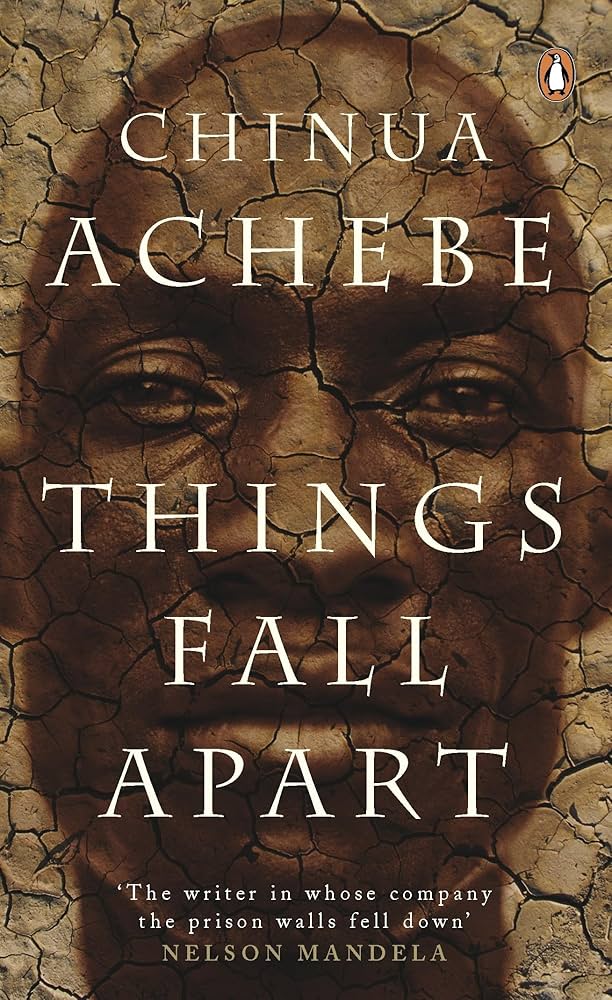
Achebe begins the novel in a timeless, almost mythological register:
Okonkwo was well known throughout the nine villages and even beyond. His fame rested on solid personal achievements. As a young man of eighteen he had brought honour to his village by throwing Amalinze the Cat. Amalinze was the great wrestler who for seven years was unbeaten from Umuofia to Mbaino. He was called the Cat because his back would never touch the ground. It was this man that Okonkwo threw in a fight which the old men agreed was one of the fiercest since the founder of their town engaged a spirit of the wild for seven days and seven nights. …
That was many years ago, twenty years or more, and during this time Okonkwo’s fame had grown like a bushfire in the harmattan. He was tall and huge, and his bushy eyebrows and wide nose gave him a very severe look. … When he walked, his heels hardly touched the ground and he seemed to walk on springs, as if he was going to pounce on somebody. And he did pounce on people quite often. He had a slight stammer and whenever he was angry and could not get his words out quickly enough, he would use his fists. He had no patience with unsuccessful men. He had had no patience with his father. (pp. 3–4)
Achebe then steps back a bit and tells, briefly, the tale of Okonkwo’s father. He had been a joyful boy, attuned to the changes of the seasons, singing with all his heart to welcome the kite birds returning from their migration. As a young man, he had played the flute and his band had gained some renown; nearby villages would ask them to come and play, and teach their songs in the village. But he was ill suited to the farming life that was the mainstay of life in their village. His wife and children barely had enough to eat; he was always running up debts and showed little likelihood of ever repaying them; people laughed behind his back. Growing up around want and mockery, Okonkwo vowed never to be like his father. Neither as a child nor as a man does Okonkwo realize that the village must have valued his father. Clan justice could be harsh, and people were driven from villages, but that never happened to Okonkwo’s father; he just accumulated debt, and people indulged him.
Okonkwo grew up big and strong, and ambitious. As the first page showed, he became a fearsome wrestler. Though the novel does not show when the village went to war, Achebe does relate that Okonkwo had beheaded five men in various battles, and later on Okonkwo worries that the village has become soft and would not be willing to go to war the way it did when he was young. His strength and diligence serve him well in farming, and he soon not only repays the people who helped him get started — for his father had left him precious little in the way of seed yams — he is able to accumulate three barns’ worth of yams each season, making him a man of substance. Respected for his work and his prowess, he is also beginning to make his way into the esteemed offices of his clan. He has his eyes set on earning the three offices, and even allows himself to think of aiming for a fourth, a rare honor that is not awarded in every generation.
Achebe does not overly romanticize village life. People die regularly of diseases they cannot treat; it happens especially commonly to children under age five. One of Okonkwo’s three wives has lost nine of ten children. She is particularly unlucky, but that is more a matter of degree than kind. In the village’s view of the world, twins are unnatural and they are not suffered to live. When they are born, they are set out in a particular part of the forest to die. People in the village can hear their cries. When, late in the book, Christians come to the region a woman who has borne multiple sets of twins and had them taken from her is one of the first converts. Okonkwo is atop the social pyramid of the social pyramid in the village and area; he is held in esteem and exhibits the manly virtues of the clan; yet he is alone and barely understands his own discontent. He beats his wives and sees that as correct behavior. “No matter how prosperous a man was, if he was unable to rule his women and children (and especially his women) he was no really a man.” (p. 50)
In one of the few acts of tenderness Achebe allows him, Okonkwo is extremely worried that his favorite daughter, Ezinma, will succumb to an illness that she has contracted. (Her mother is the one who has lost so many other children.) He asks after her continuously, and when he hears that she has worsened and is fading, he personally goes to collect herbs for a particular treatment and makes sure that she breathes deeply of their steam. She survives, and though Achebe does not show Okonkwo’s reactions, he is relieved. He also wishes Ezinma were a son.
For fate has provided him with a first son who does not resemble him very much. Nwoye is slight and sensitive; even years afterward, he can still he the cries of twins in the forest. Okonkwo sees too much of his own father in his son, and worries that all he has built will pass away at the end of his life if Nwoye does not change.
Though Okonkwo is physically strong even into late middle age, he has spent his life in fear of two things: that he will somehow end up like his father, and that the men of the clan will somehow look down on him. His truest friend, Obierike, shows greater moral strength when he says that if the clan and tradition demanded an unjust action be done, he might not stop the clan but he would not lend his own hand to the injustice. Later, when Okonkwo must spend some time outside the village, Obierike is the one who looks after his interests, and tries to tell him of the changes that are taking place. Okonkwo has worked so hard to scramble to the top of things as they are that he cannot conceive that things might be different, that they might fall apart. Or that he himself might.
The novel is short, spare, and brilliant. The apparent timelessness of the opening eventually gives over to the intrusions of history, of a world much larger than the nine villages and much more powerful than the man who threw Amalinze the Cat to the ground. Inevitably, given his choice of major figure, Achebe says a lot about manliness, though he says it all in what he shows his characters doing. Tradition and its demands also play key roles in the book’s events, with Achebe showing its costs and consolations. Almost seventy years on, the book remains fresh, gripping, and challenging. I’m sure I will enjoy No Longer at Ease, but I’m glad it was out of stock when I went looking for it, and Things Fall Apart fell into my hands.

 Al Singh
 Doug Merrill
 Doreen Sheridan
 Emily Lauer
 John Pitzel
 Lars N. Goldschlager
 Laura Eilers
 Professor X
 Robert Maedgen
 Sylvere Ap Leanan
 The Shire
1 ping
[…] Longer at Ease follow Things Fall Apart a generation later, although that is not immediately apparent. What is immediately apparent is that […]