The first two pages of The Kite Runner establish that as a child in Kabul in 1975, the first-person narrator witnessed or did something life-changing, something that so indelibly marked him that he carried it into the novel’s present day, which is December 2001. The summer of that year the narrator, who is living in San Francisco, received a call from a friend in Pakistan. “I knew it wasn’t just Rahim Khan on the line. It was my past of unatoned sins.” (p. 1) The friend offers him “a way to be good again.” (p. 2) Without any further explanation, the second chapter takes readers back to the narrator’s childhood.
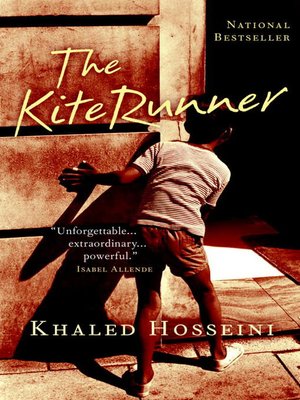
Hosseini sets up the first part of the novel with that introduction and jump. What did the narrator, whose name is Amir, do that was so bad? What happened to mark him for decades? What would it take for him to atone? This kind of very short framing, with most of the story happening in flashback, can be effective, and Hosseini’s version sets the stakes and stokes a reader’s curiosity. But it’s also a technique that gets used a lot: the protagonist is in a mess, now the author will take some time telling readers how they got there. For me, the approach has lost effectiveness with repetition, and I am beginning to think that authors use it because they want to grab readers quickly, as if they think a straightforward telling of the tale would not be interesting enough to hold the reader’s attention. In The Kite Runner, it’s also a sign that the author is going to lean very heavily on melodrama.
In 1960s Afghanistan, Amir is an extremely privileged child, but also a sad one. He is Pashtun, the dominant ethnic group; his family is rich; his father is a dynamic businessman who loves to entertain on a grand scale; his grandfather was a hunting buddy of a past Afghan king; they live in a splendid villa in Kabul. On the other hand, his mother — who had taught literature at the university — died giving birth to him, his parents’ first and thus only child. He’s also sensitive and bookish, not athletically inclined, and not particularly interested in soccer; he get carsick. All of these are in complete contrast to his father, whom he idolizes and refers to as Baba. To a certain extent Baba tries, but in many ways they are oil and water.
The main exception is in kite-fighting. When schools close for the winter break, the kits of Kabul take to the skies. Their strings are festooned with glass shards, and the fliers work to cut the strings of their opponents’ kites. When one is cut free, the children of the neighborhood run to catch and capture the defeated kite. The battle’s winner is a hero, but so is the runner who retrieves the losing kite. Running is nearly as competitive as flying but without tricks; taking a kite that someone else has successfully run is a heinous betrayal of the spirit of the sport.
Amir is of course a very good flyer. His best friend, Hassan, is an almost preternaturally good runner. Hassan is the son of Ali, the one named servant in Amir and Baba’s household. Ali and Hassan are both Hazara, in Kabul a disfavored ethnic group. Ali is humble and holy, and for practical purposes a widower because his wife ran off with some musicians not long after Hassan’s birth. Hassan is utterly devoted to Amir, clever but illiterate, as servant Hazara boys do not go to school in 1960s Afghanistan. Though both of them fly kites, when it’s tournament time the rich boy is the flyer and the poor boy is the runner.
As a contrast to Amir’s strained relationship with his father, he gets along much better with his father’s best friend, the same Rahim Khan who calls America many years later from Pakistan. Rahim understands and supports Amir’s desire to write. He gives him a special notebook, he praises his first stories, he assures him of the value of storytellers in Afghan traditions.
Hosseini is good with a propulsive story, but nuance is very much not his thing in The Kite Runner. The school bully also turns out to be a sadist and a cheater. The incident alluded to in the first chapter occurs about a third of the way through the book, and it is suitably traumatizing, all the more so because Amir reacts dishonorably, as one might very well do as an early adolescent. Traditions of honor prevent anyone from speaking with any degree of of openness, and Amir’s childhood idyll comes to an end. Soon thereafter, city and country mirror the family turmoil; the king’s deposition starts a series of evens that ends in the Soviet invasion. When they eventually flee — Baba’s position is untenable in the new order — Baba of course shows great courage in a set of incidents designed to show the brutality of the invasion and the randomness of survival.
It’s all very well, and to give Hosseini his due it’s hard to put down, but it’s also about the most straightforward melodrama available to someone writing about this time and place. A fantasy of privilege gives way to a fantasy of dangerous escape, which then gives way to a fantasy of a fallen but honorable immigrant life in America. Were there servants other than Ali in the household? The setting suggests that there must have been, but they do not play a role in the story. How corrupt was Baba, how complicit was he in the injustices of the old regime? That’s not part of The Kite Runner. Could he have tried to find a place in the also corrupt rule that followed the invasion? That might have involved shades of gray. Rashim Khan spent many more years in Afghanistan; when he left he had enough money in portable form to seek high-level medical treatment in Pakistan. How he managed that is not considered in the slightest.
I never slowed down while reading The Kite Runner but my patience with the melodrama slowly ebbed away. Rashim Khan’s call spurs Amir to go to Afghanistan in mid-2001. That his wife might have thoughts on him disappearing into a civil war and incommunicado for literally months is not mentioned. Of course Rashim Khan is dying when he delivers his message, laying the burden of final wishes onto Amir, and of course he disappears afterward, leaving his fate unknown. Of course Amir finds people who will help him beyond reason once he is in Afghanistan. Of course an orphanage director gives him information that he shouldn’t. Of course, of course, of course. Everything is turned up to 11, and none of it ends with Amir casually shot or dead from a mine or a car wreck. And of course the school bully, who played a crucial and cruel role in the childhood event that set the novel in motion, is a high-ranking and publicly sadistic Taliban official. I had a sinking feeling that would be the case — probably later than most readers spotted what was coming — but sure enough, Hosseini delivers. Does the bully-turned-butcher demand a one-on-one confrontation with Amir? He most certainly does.
Anyway, The Kite Runner has sold in the millions so obviously plenty of people like their melodrama dialed all the way up. I did finish it, but for me it’s in there with The Fault in Our Stars: beloved by many but left me uninterested in anything else by the author.

 Al Singh
 Doug Merrill
 Doreen Sheridan
 Emily Lauer
 John Pitzel
 Lars N. Goldschlager
 Laura Eilers
 Professor X
 Robert Maedgen
 Sylvere Ap Leanan
 The Shire
1 ping
[…] Telling the story in flashback in No Longer at Ease did not annoy me quite as much as it did with The Kite Runner, but it did not endear the book to me […]