I first read What It Takes in the early 1990s when its subject — the 1988 US presidential election — was, if not exactly fresh in mind, then at least not consigned to the oblivion of an election held decades ago and deemed mostly inconsequential. Cramer’s book made the election not just interesting, but riveting. With a cast of candidates that included George H.W. Bush, Bob Dole, Richard Gebhardt, Gary Hart and Michael Dukakis, that was no small achievement.
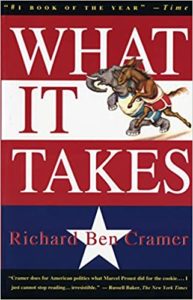
In 1986 Cramer set out to write a book about men (a woman as a major-party candidate was a long way off in 1988) who had led lives that brought them to the point where they thought not only that they could be President, but that they ought to be. Men who, as Cramer puts it, “made that final turn in the road, who got to the point where they could say, ‘Not only should I be President … I am going to be President.'” (p. viii) It’s quite a book, more than a thousand pages about a mostly forgotten campaign, a book that lives on in journalistic and political circles for the six detailed portraits of men discovering what it takes to be President. One of the blurbs on the back calls Cramer’s approach a mix of Teddy White, Tom Wolfe, and Norman Mailer — dated references by now, but signs that his writing will be up close and personal, with an attempt to capture each candidate’s tenor and voice in the chapters that describe his journey, a journey that for all but one of them will end in a potentially life-defining defeat.
Cramer had extraordinary access to the candidates and campaigns, and the people around them. He notes that “The narratives are based on interviews with more than a thousand people. Every scene in the book has come from firsthand sources, or from published sources that were verified by participants before my writing began.” (p. ix) I am sure that getting in early helped; the interest of a potential presidential biographer was probably also flattering. His Pulitzer didn’t hurt either. What were his aims?
I have tried to tell their stories in two ways—as fairly as I could from the outside, and as empathetically as I could from behind their eyes. In doing so, I have tried not only to show them, but to show what our politics is like—what it feels like to run for President; what it requires from them; what it builds in them; what it strips, or rips, from them. (p. ix)
Cramer keeps his chapters short — there are 130 in the book — so the book moves along briskly. The scenes add up quickly, and they soon gave me a sense of these men’s extraordinary stories as well as the continuous dramas within all of the campaigns, even at their earliest stages. Some bits from the book stuck with me across the nearly 30 years since I read it for the first time, such as his characterization of the Massachusetts press covering Dukakis as “the diddybop Bostons” for their blithe assumption that their city was the hub of the universe, or Cramer’s masterful disquisition of what it means to know something in Washington and how George H.W. Bush, a man known above all for being in the know, managed not to know about the illegal Iran-Contra scheme. But I didn’t pick up What It Takes again for some late 1980s nostalgia, or to marvel at Cramer’s journalistic and storytelling skills. I picked up What It Takes again because of the fourth Democrat whose life and campaign Cramer chronicles: Joe Biden.
Continue reading

 I am 100% the target audience for this humorous non-fiction book extolling the benefits and wonders of bees. Heck, I even wrote a hybrid role-playing/board game, Honey Hex, that benefits the National Wildlife Federation’s efforts to protect pollinators. In addition, I’m a big fan of Matt Kracht’s other books detailing dumb birds, a seemingly insulting yet ultimately engaging way to explore the wonders of the natural world and expose them to a wider audience.






 Al Singh
 Doug Merrill
 Doreen Sheridan
 Emily Lauer
 John Pitzel
 Lars N. Goldschlager
 Laura Eilers
 Professor X
 Robert Maedgen
 Sylvere Ap Leanan
 The Shire