A country and a century, told through what happened to a family, narrated by a member of that family’s next-to-youngest generation, dedicated to a member of the youngest generation who is trying to both escape and understand the legacy she is bearing. In The Eighth Life (For Brilka), Nino Haratischvili brings her native Georgia to life, though she wrote the novel in German, charting its course through a long twentieth century by portraying seven lives in a family that is both extraordinary and representative of the small country in the South Caucasus that, among other things, gave the world Josef Stalin. It’s a country I called home from mid-2008, just weeks before the latest Russian invasion, to the end of 2011.
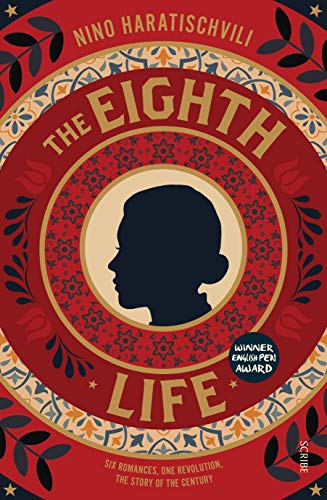
At the time Haratischvili’s narrator tells the stories that comprise The Eighth Life, she is 32, the year is 2006, and she is living in Berlin. Her mother calls from Georgia to say that her niece, twelve-year-old Brilka, has fled from a school trip to Amsterdam and been found by police just outside of Vienna. But by then the narrator is already getting ahead of herself, something she often does when telling Brilka the family’s stories, trying to make sense of them for herself — and trying to make sense of herself — by relating them to someone young and unseen. Haratischvili structures The Eighth Life as seven books plus a prologue, generally told in the third person but with enough first-person intrusions by the narrator that readers can easily keep in mind that all of the family stories are filtered through one person’s perspective, and all intended to explain the family to her young niece.
The narrator introduces herself:
My name is Niza. It contains a word: a word that, in our mother tongue, signifies “heaven.” Za. Perhaps my life up till now has been a search for this particular heaven, given to me as a promise that has accompanied me since birth. My sister’s name was Daria. Her name contains the word “chaos.” Aria. Churning up, stiffing up, the messing up and the not putting right. I am duty bound to her. I am duty bound to her chaos. I have always been duty bound to seek my heaven in her chaos. But perhaps it’s just about Brilka. Brilka, whose name has no meaning in the language of my childhood. Whose name bears no label and no stigma. Brilka who gave herself this name, and kept on insisting she be called this until others forgot what her real name was. (pp. 5–6)
By telling the stories, Niza hopes to give Brilka enough understanding of where and who she comes from that she can be free to become herself, to know the links to the past but not be weighed down by them. Niza wants that for herself, she has tried, but at least at the time of the story she has not succeeded. Many others in the Jashi family’s stories wanted to break free and tried in various ways — Niza’s great-great-grandfather journeyed to Budapest and learned secrets of the chocolatier’s trade; her great-grandmother married an army lieutenant; her grandfather joined the Party and the Red Army; her great-aunt defected to the West. Though none of them succeeded completely, none of them failed completely either. And so Niza hopes, and hopes particularly for Brilka, hopes enough to tell her more than 900 pages of family tales so that the knowledge may set her free.

 Al Singh
 Doug Merrill
 Doreen Sheridan
 Emily Lauer
 John Pitzel
 Lars N. Goldschlager
 Laura Eilers
 Professor X
 Robert Maedgen
 Sylvere Ap Leanan
 The Shire