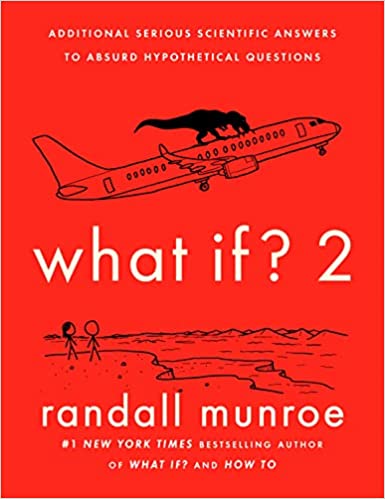
What If?, this book’s predecessor, hit the sweet spot of serious science mixed up with deadpan presentation, and proved a (periodically dangerous) garden of delights. The second book exploring “serious scientific answers to absurd hypothetical questions” does just that, boggling and amusing in nearly equal measure. If the leitmotif of the first volume is “What if we tried more power?” the two of this one are creating black holes and eradicating all life on Earth. For a book with as many apocalypses as this one, though, it’s very cheerful, probably because practically all of them can be avoided by just not doing extremely silly things. Or at least hoping that geological disasters from Earth’s past don’t repeat anytime soon.
For example, in one of the short answer sections, reader Ian asks what would happen if Mount Everest suddenly turned into pure lava. Not to worry, says Monroe, even though Everest is large for an individual human, it’s small on the scale of the earth and outside of the local area, life would be undisturbed. Monroe’s reassurance, though, is limited. Much larger lava events — up to three orders of magnitude larger than an Everest of lava — have happened in Earth’s history, and
These outpourings, which create massive rock slabs called “large igneous provinces,” are bad news for life. There are five big mass extinctions in the fossil record, and all five of them were accompanied by large amounts of lava blorping onto the surface.
Eyes first evolved about half a billion years ago, and in that time, the Permian extinction is probably the worst thing they’ve seen. A large eruption of lava in what is now Siberia injected huge amounts of CO2 into the atmosphere, causing temperatures to spike. The oceans deoxygenated and acidified. Clouds of poison gas rolled across the land. Most plant life was wiped from the continents, leaving Earth a sandy desolate wasteland. Almost everything died. (pp. 138–39)
Fortunately for humanity, large igneous provinces seem to form over geologic time scales.

 Al Singh
 Doug Merrill
 Doreen Sheridan
 Emily Lauer
 John Pitzel
 Lars N. Goldschlager
 Laura Eilers
 Professor X
 Robert Maedgen
 Sylvere Ap Leanan
 The Shire