The argument of Warsaw 1920: Lenin’s Failed Conquest of Europe is that “in the summer of 1920, outside the gates of Warsaw, there took place a battle that ranks alongside Marathon and Waterloo for its importance in history.” Zamoyski’s brisk, 148-page narrative sets out to make that argument, describe the campaign that reached its climax just across the river from downtown Warsaw, and sketch the aftermath. Six chapters take up the task, with the longest — fully one-third of the book — devoted to the dramatic August days of the battle for Warsaw itself.
Zamoyski has chosen carefully what to tell, and what to leave out. This is a book that describes fighting, battles and their consequences for a military and political narrative. While the book draws on interviews, memoirs and original documents, its main purpose is not to communicate the experience of fighting one of the sequels to World War I. Instead, as Zamoyski notes in his introduction, he has “concentrated on the military operations, and in particular on providing a synthesis accessible to the general reader and a succinct overview of what happened and how. This necessarily excludes dozens of minor actions and ignores the part played by many lesser actors, some of them of crucial importance. Nor can it give anything but a hint of the horrors and the heroism involved, or of the sense, which comes through all personal accounts and contemporary documents, that this was a crisis of European civilization.”
Continue reading
Permanent link to this article: https://www.thefrumiousconsortium.net/2014/11/11/warsaw-1920-by-adam-zamoyski/
As Stalin’s purges neared their apogee, show trials in Moscow featured heroes of the Russian Revolution confessing to the most astonishing things: that they had conspired with foreign powers, that they had plotted to kill Stalin; that they had knowingly and willfully wrecked whole sectors of the economy; and more. How could these men — leaders of the Revolution and the Civil War — say such things? Could they possibly be true? Did anyone believe them? Did they themselves believe what they were saying?
In Darkness at Noon, Arthur Koestler drew on his own experiences, both as an active Communist in the 1930s and as a prisoner under sentence of death in Franco’s Spain, to show in chilling detail how such things could come to pass. His protagonist, Rubashov is an Old Bolshevik, who was once high up in the power structure of Soviet Russia. He had been close to Lenin (referred to in the book as “the old man”) but then gotten crossways with Stalin (“No. 1”). Rubashov had thought to sit things out with a foreign assignment, but eventually the police came for him, too.
Continue reading
Permanent link to this article: https://www.thefrumiousconsortium.net/2014/11/10/darkness-at-noon-by-arthur-koestler/
Quick, cute read that is a tween-friendly adaptation of Greek mythology. Had I encountered these books at that age, I would have much preferred them to the pettiness of the actual myths. Not for purists, obviously, but not a terrible way to introduce children to the Greek myths either.
Permanent link to this article: https://www.thefrumiousconsortium.net/2014/11/09/aphrodite-the-beauty-goddess-girls-book-3-by-joan-holub-and-suzanne-williams/
Wow, I remembered so very little this re-read from the last (which was, granted, nigh on two decades ago.) The two stories that did stir memories, though faint, are likely the ones I will continue to remember, Ann Bridge’s “The Buick Saloon” and Marghanita Laski’s “The Tower”, both for the unflinching cruelty done to the heroines. I’ve come to believe that ghost stories at their best are allegories for the terrible meanness of fate, though even so I do rather like tales such as Joan Aiken’s “Sonata For Harp And Bicycle,” which showcase a delightful British pragmatism even as it allows for the worst. I also thought it interesting that stories I know would have thrilled me when younger (such as Edith Wharton’s “Afterward”) now just seem a bit much. Fun post-Halloween reading, though between this and the Nabokov I think I’ve ODed a bit on short stories.
Permanent link to this article: https://www.thefrumiousconsortium.net/2014/11/09/the-penguin-book-of-ghost-stories-edited-by-j-a-cuddon/
J.F.C. Fuller and B.H. Liddell Hart are considered the two prime British military historians of the old school, and both have written well regarded books on World War II. But I found Fuller’s book rather dull, while this one was quite enjoyable. It is primarily a strategic analysis of the war that leaves out the human dimension and the story of the ordinary soldier and sailor, but it is nonetheless interesting and readable. Hart agrees with Fuller that the use of aerial bombing against Germany was ineffectual and wasteful, but he departs from conventional wisdom in arguing that it effectively brought Japan to its knees, to the the point where the dropping of the atomic bombs was completely unnecessary. He is critical of Churchill and Montgomery, which as an Englishman he has every right to be. This is a rather long work, but its subject is worthy of such a lengthy treatment. We can only hope that there will be no need for books of comparable length on future wars.
Permanent link to this article: https://www.thefrumiousconsortium.net/2014/11/09/history-of-the-second-world-war-by-b-h-liddell-hart/
Without a Summer by Mary Robinette Kowal is the third of her Glamourist Histories series, following Shades of Milk & Honey, and Glamour in Glass. The series crosses Regency romances with alternate (but not terribly alternate) history and a dash of domestic magic that may yet admit of industrial applications.
Continue reading
Permanent link to this article: https://www.thefrumiousconsortium.net/2014/11/07/without-a-summer-by-mary-robinette-kowal/
The last fifteen books of Livy’s surviving history, covering Rome’s conquest of the Hellenistic world after the Punic Wars. Aside from a few interesting anecdotes and episodes, most of this history was tedious and unmemorable. The saga might have been livened up if Hannibal had come out of retirement, but with his defeat in the Second Punic War Rome was without any serious rivals, and most of the next hundred years was a mopping up of the Mediterranean world in a steady but inglorious series of campaigns in which Rome was invariably victorious. Most of this history could have been more briefly summarized or even omitted altogether without any serious loss to posterity. Yet it seems to illustrate that Rome was a state that could only thrive when it was at war, seemingly contradicting Clausewitz’s thesis that wars become ruinous when they are fought for their own sake. It was peace, not war, that ultimately corrupted Rome and led to her downfall.
Permanent link to this article: https://www.thefrumiousconsortium.net/2014/11/06/rome-and-the-mediterranean-by-livy/
I reviewed this earlier, but I gave it a somewhat negative review, and after I had time to think about this book some more I changed my mind about it. This is actually a beautifully written novel. I was a bit turned off by how slow it was at first, but contrary to expectations the story was actually leading somewhere, and leading somewhere in a big way. This is a story that reminds one of what Kierkegaard said about life, that it can only be lived forward but can only be understood looking back. Looking back on this story, I think I understand it better now. If you are pro-life, as I am, the story’s central theme may bother you, but if you can get past that then I think you will be impressed by Irving’s narrative craftsmanship. A lot of the seeming pointlessness of the story arc is resolved in the final chapter, and the conclusion is quite powerful. I hope my earlier review doesn’t turn anyone off from reading it. It’s worth the time.
Permanent link to this article: https://www.thefrumiousconsortium.net/2014/11/06/the-cider-house-rules-by-john-irving-revisited/
One of my commonest complaints about fantasy novels is that the setting is warmed-over England. There is so much fantasy that uses vaguely-English feudalism as its model, that it’s possible for someone to grow up reading almost nothing but, and then to embark on a career of writing in the same genre without necessarily realizing that things can be different.
Enter the witcher, or at least Andrzej Sapkowski. As the copy on the back of the book tells us, “Geralt of Rivia is a witcher. A cunning sorcerer. A merciless assassin. … His sole purpose: to destroy the monsters that plague the world. But not everything monstrous-looking is evil, and not everything fair is good … and in every fairy tale there is a grain of truth.”
Continue reading
Permanent link to this article: https://www.thefrumiousconsortium.net/2014/11/06/the-last-wish-by-andrezej-sapkowski/
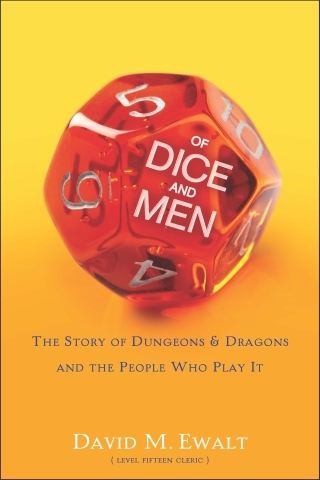
Ewalt gives his slender volume the subtitle “The Story of Dungeons & Dragons and the People Who Play It,” at which point my inner copyeditor immediately reaches for the red pencil to change it to “A Story…” and “Some of the People…” There are a lot of stories of Dungeons & Dragons, and Ewalt surely isn’t telling the only one possible. Further, as the second noun in his title indicates, the story he tells is very much dominated by boys and men. The milieu in which D&D arose was almost exclusively male, but by the time it got big plenty of girls and women were playing. Ewalt’s experience of D&D may have been all-male, but mine certainly wasn’t, and it was a bit off-putting to see his blitheness on display.
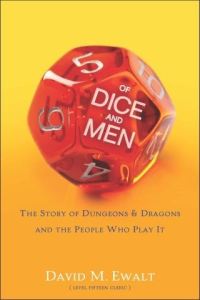
But as Ewalt says in his introduction, “Read this like you’d play in a friendly campaign. Don’t be a rules lawyer, and don’t argue with the DM.”
Continue reading
Permanent link to this article: https://www.thefrumiousconsortium.net/2014/11/05/of-dice-and-men-by-david-m-ewalt/
 Al Singh
 Doug Merrill
 Doreen Sheridan
 Emily Lauer
 John Pitzel
 Lars N. Goldschlager
 Laura Eilers
 Professor X
 Robert Maedgen
 Sylvere Ap Leanan
 The Shire