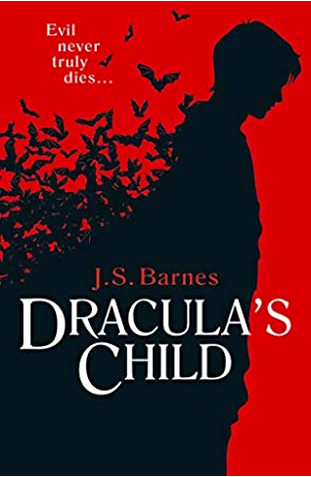
Q. Every book has its own story about how it came to be conceived and written as it did. How did Dracula’s Child evolve?
I think it’s been evolving ever since I first read Stoker’s extraordinary novel at around eleven or twelve (oddly, and I suspect not entirely coincidentally, the same age as Quincey in my book!). More recently, I was asked to adapt the original story as faithfully as possible for an audio drama starring Mark Gatiss. It was this process of adaptation – of taking the narrative apart, seeing how it functions and putting it back together again in a slightly different shape – which led me to consider a direct sequel. It seemed to me almost as if Stoker had left deliberate clues for just such a follow-up. And it struck me as quite a mystery as to why he never attempted it himself!
 Q. Bram Stoker’s Dracula has been dissected for its depiction of a Victorian-era England fearful of foreign influence and the sexual liberation of women. What social themes, if any, did you find yourself considering while writing Dracula’s Child?
It’s such a rich, dense text, full of all of the fears of the age, a good many of which have barely shifted in more than a century. In my own story, I wanted to continue what Stoker had done much as he might have done so had he set himself the task. Of course, it’s inevitably the case that, writing as I was in the twenty-first century, I’d end up reflecting a few of the concerns and terrors which are unique (or, more accurately, which seem unique) to our own age.
Q. I enjoyed the overtly political nature of Dracula’s ascension to power in the pages of your novel. In particular, the scene with the motorist refusing to assist our heroes struck a chord. What inspired in you the greater ambition of this version of Dracula?
There’s a line in the original novel when Dracula describes himself as a man “who commanded nations”. This element of his complicated personality seems very much to have fallen into abeyance by the time that Stoker introduces us to him. I wondered how his defeat in the book might have affected his psyche – whether, having been so thoroughly rejected by modernity he might not reach back into the past, to a time when he was in his pomp, and seek to recreate it. Were this case, it’s not too great a stretch to imagine that there’d be plenty of folks who’d be very happy, for their own reasons, to aid him in that objective.
Q. Do you write with any particular audience in mind? Are there any particular audiences you hope will connect with this story?

 Al Singh
 Doug Merrill
 Doreen Sheridan
 Emily Lauer
 John Pitzel
 Lars N. Goldschlager
 Laura Eilers
 Professor X
 Robert Maedgen
 Sylvere Ap Leanan
 The Shire