Hrm, well, if I’d known this was essentially a memoir by a woman in her 40s, I would have probably skipped it (as I do for memoirs by men in their 30s, and for roughly the same reasons.) I feel that the 40s are a bad age for a woman to try to do a retrospective on her life, and I think it has a lot to do with how Western thought has taught us that this is an age where we’ve achieved enough wisdom to look back on our lives and even-handedly consider them. Because, too, memoirs at this age seem to be a complacent “this is how I’ve achieved happiness” how-to, and then half the time reading them, I’m cringing because the author clearly has a lot of sublimated misery that another decade will absolutely help her figure out. Weirdly, memoirs by younger women don’t have this problem, probably because they’re not expected to have all the answers yet and are usually focused on single events or topics instead of being a whole life retrospective.
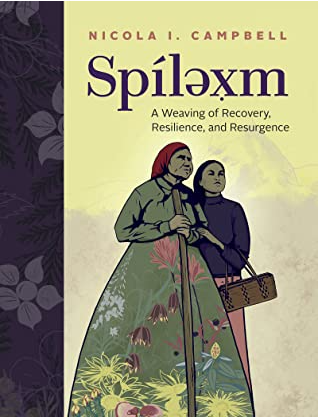 I actually didn’t realize this was a memoir at all when I started it: I thought it was the transcription of an oral history, or a collection — a weaving, as in the title — of the stories of a people, perhaps a family. And in large part, it is, or at least that’s where it begins, with letters written from Nicola I Campbell’s mom from when the author was a baby. Ms Campbell’s poetry is interspersed with short personal essays that detail her childhood and troubled adolescence, and how she assimilated her people’s culture and pain as she grew, eventually focusing on personal growth and then the upholding of her people’s ways and memories. Worthy aims certainly, and there are a lot of ways in which that last is manifested throughout this book. The use of Indigenous language and the frank discussions of the intergenerational trauma that continues to impact her and her people make for compelling reading. The poetry, too, isn’t bad.
And yet, and yet. While I appreciated the glossary at the end, I wish there’d been a pronunciation guide as well, so that my brain could spend more time on the prose and ideas rather than mulling over whether I was pronouncing the words properly in my head. Never mind not knowing what half of them meant in the moment: I could gather enough from context but kept snagging on how to correlate spelling with sound, with failure resulting in a sort of white noise effect in my head — very distracting when trying to read. There’s also a weird, crescendoing emphasis on exercise, such that when she finally mentioned she does Crossfit, my eyes rolled so far back in my head, I nearly gave myself a concussion. Contrast this with my impatience with her younger self’s waffling about canoeing in earlier chapters. As someone whose adult-onset asthma has sharply curtailed the amount of exercise I can get these past few years, I found the “just do it” chirpiness of the newly converted incredibly grating. If only, madam, if only.


 Al Singh
 Doug Merrill
 Doreen Sheridan
 Emily Lauer
 John Pitzel
 Lars N. Goldschlager
 Laura Eilers
 Professor X
 Robert Maedgen
 Sylvere Ap Leanan
 The Shire