There’s a huge caveat to my review of this book today: I got an e-galley for Kindle, which was so strangely formatted as to make me constantly second guess whether I was reading a new poem or a continuation of the last one every few stanzas. This pervading doubt is not terribly conducive to enjoyment of a poem’s flow, much less its message, so my apologies for any obtuseness on my end caused by this.
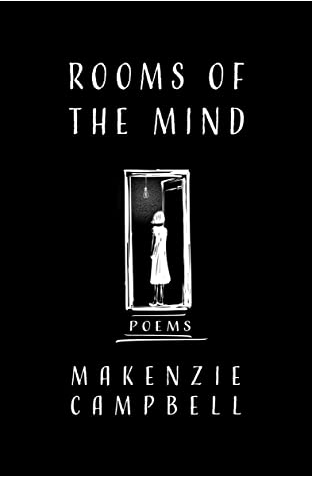 That said, I did find my brain mulling over the writing more than once, as Makenzie Campbell describes several different compartments in her mind. Mulling is a good thing, to be clear. She writes about very universal, relatable feelings, whether they be love or hope or fear or nostalgia, in ways that reminded me of chapters of my own life. The emotions felt very raw and true — even if I did sigh a little at the portentous declarations of turning a heartbroken 21, like, chiiiiild, just you wait! — and more than once, I felt snagged on a particular snapshot of feeling, and had to sit with it to ponder for a while before I could move on. Once I finished the book, I also went back and started to read again from the beginning, to see if things looked differently the second go-round. I was rewarded with greater insight on the second pass-through, as matters that had seemed opaque as I was reading the first time slid into greater clarity: this speaks to the richness of the collection.
For all that the book hangs together seamlessly enough to warrant circling back round to an immediate re-read, however, I don’t necessarily think that the thematic divisions worked as well as intended. There was a lot of overlap, particularly in the last half, and just a wee bit too much repetition. Overall, it’s a laudable attempt at structure that I think could have used greater stringency in (self-)editing.


 Al Singh
 Doug Merrill
 Doreen Sheridan
 Emily Lauer
 John Pitzel
 Lars N. Goldschlager
 Laura Eilers
 Professor X
 Robert Maedgen
 Sylvere Ap Leanan
 The Shire