
For whatever reason, I had this book’s publication date misfiled, but oh what a perfect time to read it, as the Artemis II mission reminds millions of people worldwide why so many of us initially fell in love with the idea of outer space.
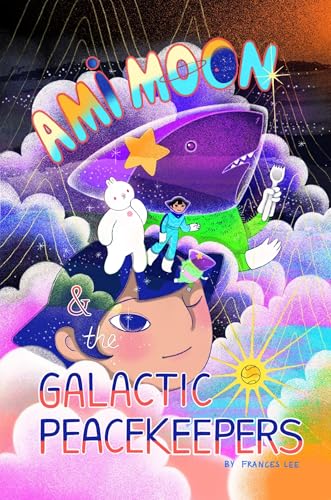 And space is, obviously, the setting for Ami Moon And The Galactic Peacekeepers. The graphic novel opens with a greeting to readers from a(n adorable) Peacekeeper named Emo, who will serve as our guide through the experience. Emo relates that the only human among the Galactic Peacekeepers before us was Ami, a girl who couldn’t remember how to get back to Earth. Funnily enough, none of the other Peacekeepers knew of a planet by that name either, so she spent her days helping on missions of peace even as she missed home and her mother terribly.
As we follow along, we learn that being a Peacekeeper means that there are a lot of things to keep both us and her occupied. Ami has been assigned to a team with the much larger, bear-shaped and gentle Sumo, and the smaller, shark-shaped and prickly (in nature if not in body) Rosa. In their downtime, the trio enjoy noodles and exploring the Peacekeepers’ headquarters planet, even as they try to avoid getting into fights with snobbier colleagues. But when their AI, whom Ami wistfully names MOM, has a mission for them, it’s all systems go.
Seeing as how they’re all novices, the missions start out pretty simply, but grow in complexity as their skills develop. Soon, they’re encountering actual dangers with psychological repercussions. Will they be able to complete their missions and return home safely, even as Ami searches for any word of Earth?
Frances Lee gently explores the different and often difficult scenarios the Peacekeepers encounter while reminding readers that there’s no one correct way to respond to many things. Ami misses home but is also happy to make the best of her new situation. Rosa doesn’t like physical contact, no matter how well-meaning. Sumo might be impervious to most physical dangers but freezes at conflict. The three friends try to support each other without prescribing what to do, feel or think. Each character is given space to figure out how to work through their issues, even if they can’t actually solve them.
That said, I was very much on Ami’s side when she was forced to deal with Julia. I’m hoping future books discuss why Julia wasn’t checked by AI while Ami was. Words can be used for violence, and while I err on the side of allowing people to spout whatever nonsense comes into their heads, I do think that when words are directed at people in such a manner as to constitute abuse, that behavior needs to be curtailed. Mental health is real and so is mental abuse.
But, again, this is a book about complex situations and reactions, and how most are valid and need to be worked through. There aren’t a lot of easy answers in life, and that can be frustrating. AMatGP just about straddles the line between acknowledging this and perpetuating it, helped along by some truly remarkable art. Ms Lee mixes multiple 20th-century space aesthetics — think Astroboy meets The Little Prince, with more than a splash of A Trip To The Moon, as well as images from the Hubble Space Telescope — and filters them all through a 21st-century artistic lens for a visually impactful volume. It’s a fanciful, beautiful idea of outer space. I’m definitely intrigued to see what she’ll do in future installments of this trilogy.
Ami Moon And The Galactic Peacekeepers by Frances Lee was published February 10 2026 by Levine Querido and is available from all good booksellers, including

 Al Singh
 Doug Merrill
 Doreen Sheridan
 Emily Lauer
 John Pitzel
 Lars N. Goldschlager
 Laura Eilers
 Professor X
 Robert Maedgen
 Sylvere Ap Leanan
 The Shire