
Most years, I set aside a couple of books that I have gotten a decent way into and decide that I am just not going to finish them. (Each year since 2020, it’s been either one or two.) This year, I’ve already DNF’d two and it’s only late January. I’m not one of those people who commits to finishing every book they start; a few years as a bookseller cured me of that. As did the loss of teen reading speed, no doubt. Nor am I one of those people who ditches a book after a couple of paragraphs or a few pages; I don’t mind a slow start from time to time, and I love big books. Nothing against folks who take either of those approaches. People read in all sorts of ways — boy howdy did a few years as a bookseller teach me that.
Here in middle age, I think I’ve gotten a pretty good handle on books that are going to interest me. I like books that show me new places (even if they are old or imaginary), new ways of seeing the world (or worlds), new ways of being. The German word for curious, neugierig, translates literally as “new-greedy,” and yes, that’s me. I’m a cat whom curiosity will probably eventually kill. I think that’s what draws me to history, to historical fiction, and to fantasy and science fiction. While I can mostly tell what I will enjoy, I don’t think I’ve fallen into a rut: last year I tried 18 authors whose work was new to me.
So a DNF feels a little bit like a failure. I chose the book for a reason, or several. There was something I was looking forward to, or something in particular drew me in, and nowadays I have plenty to choose from. I didn’t bounce immediately, I got a substantial ways into the book, and decided I didn’t want to go on at all. (Sometimes if a book is short enough, I’ll just go ahead and finish it; this is not always a good approach.) Why?
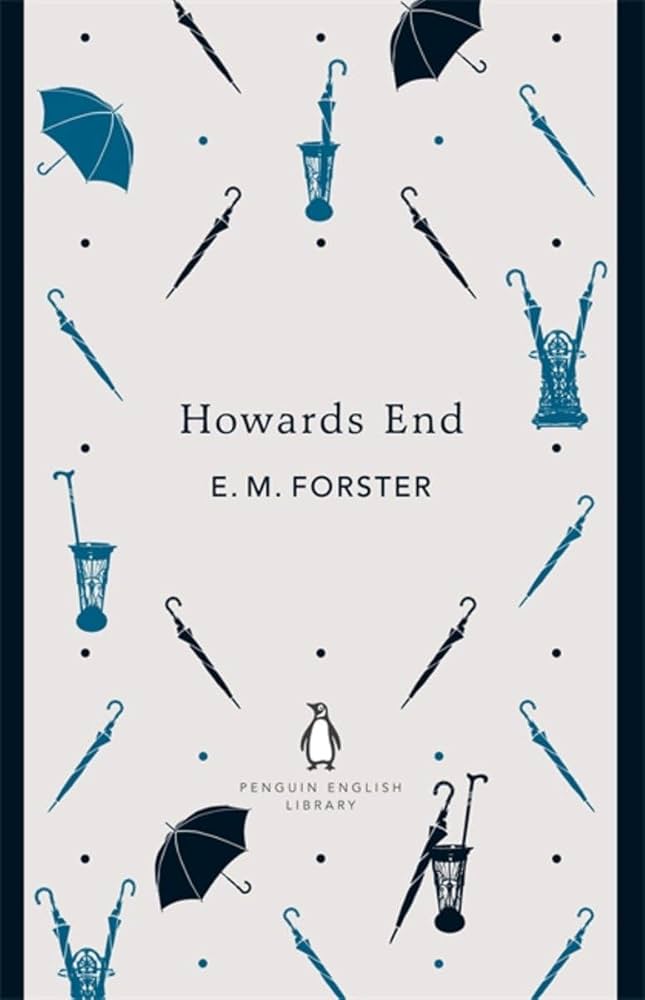
I had known about Howards End since approximately forever; I was the kind of high schooler who saw A Room With a View four or five times in the theater when it was new. I’m sure I saw the movie of Howards End in the early 1990s because I recognized scenes when I came to them in the book, but I am equally sure I had never read the book. The various series published by the Süddeutsche Zeitung have been a good source of books I would not have read otherwise, or a good prod to read something I had thought about at one time or another. Howards End, which was among the first 10 books the Süddeutsche published in its initial set of great novels of the 20th century, fell into the latter category.
The story concerns three families and a house that provides the novel its title. The owners of Howards End are headed by a wealthy industrialist. The second family, all of the younger generation, their parents having passed before the beginning of the book, have an independent income that lets the two sisters devote themselves to art and reform, while the brother soon goes up to Cambridge. Most of what I have read about the book describes the Schlegels as middle-class, but honestly, all of their expenses are met without their having to work. They’re rich, just not industrialist-grade rich. The third family is an insurance clerk and his intended, who is older and has a Past. Several coincidences lead to the families becoming entangled in various ways.
The novel gets praised as an examination of the English class system as it was in Forster’s time, which is fair enough. Clerks have it hard, though not nearly as hard as industrial workers or agricultural laborers. Above all, clerks are precarious, as the novel shows. When the Schlegels hear from the industrialist that the clerk’s company is doomed, they persuade him to leave his job. But that turns out to have been just a market rumor; the company stays in business; new employers are reluctant to take on a clerk who left a previous position for no reason that he will disclose. The industrialist’s family are shown as concerned either with getting more money in roles fitting to their station — colonial administrators and such — or pursuing hobbies, though nothing too quixotic of course. Wouldn’t do. Anyway, various scandals ensue, and of course the clerk’s intended turns out to have been a past mistress of the industrialist, because there are only a couple dozen people in London after all.
I’m sure the classes and their relations was a self-evidently interesting topic for Forster and his intended audience in England. At a remove of more than a century and in a different country altogether, I’m rather less persuaded. My reluctance could have been easily overcome if the characters had been interesting as people rather than called in to stand for types. Alas. I progressed from reading normally to reading lightly to skimming to skipping ahead several chapters to see if the rest was similar. In the end, I didn’t care what happened to those people.
+++
The other book I DNF’d in January is much newer than Howards End and comes from a very different perspective. The Tatami Galaxy, by Tomihiko Morimi, was published in 2004 (2022 in English) and takes place in and around Kyoto University. It follows an unnamed first-person narrator through college misadventures. As the story opens, he is a junior looking back on his first two years and considering that joining a particular club as a newly arrived freshman was a terrible mistake that took him away from the path to a rose-colored university career and toward two years of wasted degradation and lack of success with the opposite sex. The book is divided into four sections, and in each one he chooses a different club during his first week at the university, but each choice leads him to get to know the same people, to repeat some of the same conflicts, to encounter the same denizen of his dilapidated apartment building who claims to be a local god. Some entire paragraphs are repeated word for word in slightly different contexts. Well, maybe the fourth section is different. I don’t know because I bailed on the book early in the third. (Wikipedia says that the end of the fourth is indeed different

I think I’ve just aged out of the audience for scurrilous hijinks by a college-age guy who’s mostly a self-centered loser. He’s also detached in a way that seemed odd and off-putting to me: no family, not really any history before he arrived on campus, all of his desires inside the strictures of university society. He doesn’t really go to class, and he mostly buys his essays from paper-writing mills, so there’s no sign that he’s learning, either. He occasionally regrets his own laziness and lack of morals, but mostly he aspires to some kind of status among his peers, most of whom he doesn’t know or doesn’t like. Some of the bits are funny, and the first set of repeated incidents was amusing in a lightly meta way, but by the time that it all started happening again in the third section, I was out of patience.
Books in translation are always a way to see how things can work differently. I found the book in my local bookstore‘s science fiction section, and that led me to expect something a little more overtly unusual. The description of campus life, and the funny (sometimes ha-ha, sometimes peculiar) goings-on in Kyoto were interesting for a while. In the end, though, the lack of an overarching story, and the continued demonstration that men in their early 20s can be self-obsessed jerks with little idea of how they affect people around them was not enough to keep me reading.
+++
Another book that’s teeterig on the border of DNFland is Ehen in Philippsburg (Marriages in Philippsburg) by Martin Walser. It’s also from the Süddeutsche‘s first list of great novels, and I started it last summer. Now, I read German slowly, and last year I didn’t push too hard on the language front, but six months or more in progress is not a sign that the book is particularly gripping. Walser was something of a wunderkind of the years of the West German economic miracle, and Philippsburg was his first novel. The book takes on many of the pieties of the 1950s, and probably broke taboos of the time when it was published. He writes frankly about sex, about infidelity, about corruption in business. His lead character is a young man on the make; he catches some lucky breaks, is sweet on his fiancée’s mother, gets business tips from his future father-in-law, and looks like he’s going places in postwar Philippsburg, a fictional city in the southern parts of West Germany. I’m about a third of the way through, so maybe there’s a big fall ahead; I can’t say for sure.

What I can say for sure is that I have seen this sort of thing before, and Fifties hypocrisy is not a particularly new story anymore. Writing that was provocative in 1957 — being open about some of the squalid conditions people still lived in ten years after the end of the war, showing how back-slapping insiders kept business within closed circles, detailing how common affairs were — is not so surprising anymore. Walser is skilled, and his characters are reasonably interesting, but it’s starting to feel like the book is mostly of historical interest. One thing in favor of finishing is that reading in German is a skill, and it does me good to keep in practice.
Walser himself lived to a ripe old age, dying at 96 in 2023. Unfortunately, he curdled as he aged. One of his later novels was a brutal caricature of Germany’s most prominent literary critic, Marcel Reich-Ranicki. The book trafficked in Jewish stereotypes, and as Walser got older he was increasingly critical of how Germany took responsibility for the crimes of the Nazi era. His published concerns about “monumentalization of shame” and “lip service” were not nearly as incisive as he probably thought. The younger Walser was better than that, at least in print, but I am not sure it will be sufficient to pull me through to the end of Philippsburg.

 Al Singh
 Doug Merrill
 Doreen Sheridan
 Emily Lauer
 John Pitzel
 Lars N. Goldschlager
 Laura Eilers
 Professor X
 Robert Maedgen
 Sylvere Ap Leanan
 The Shire
1 ping
[…] (The Loser) 6: Paul Auster: City of Glass 7: Elias Canetti: Voices of Marrakesh 8: E.M. Forster: Howards End 9: Martin Walser: Ehen in Philippsburg (Marriages in Philippsburg) 10: John Irving: The Hotel New […]