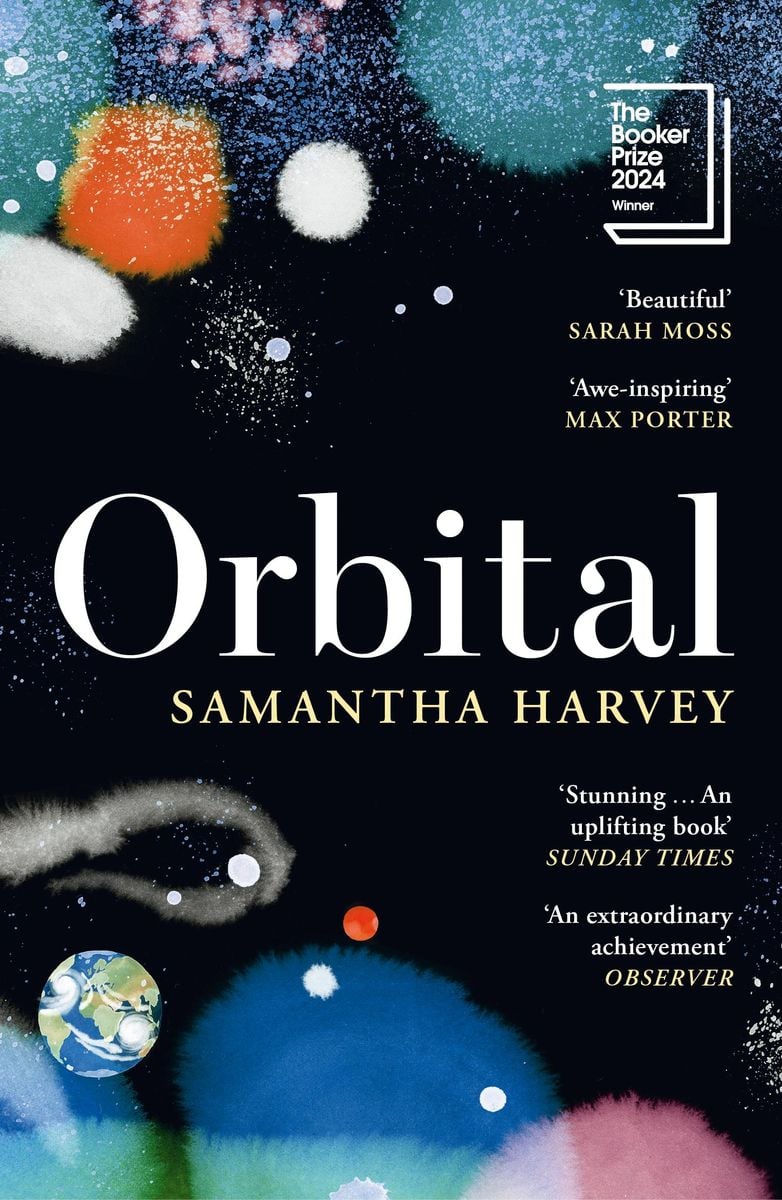
I’m glad someone told me that nothing much happens in Orbital, Samantha Harvey’s novella that won the 2024 Booker Prize. If I had been expecting action — anything from a mechanical crisis as six astronauts in the ISS orbit the earth to an alien encounter – I might have been disappointed. The book relates one day on the station, broken into 16 orbits that the ISS makes in a 24-hour period. It begins just as the astronauts wake up to start their new “day,” and ends as they are well into their next period of sleep. Orbital captures the magnificence and mundanity of human life in low earth orbit.
The story is a little bit of an alternate history, in that Harvey mentions that some of the astronauts recall the Challenger explosion from childhood while late in the first orbit a crewed mission to land on the moon launches and passes the ISS. “You aren’t even the farthest-flung humans now, says ground control. How does that feel?” (p. 10) The first item places their birth years in the mid-1970s, which makes me think their ISS mission would be in the 2010s, while the Artemis program is still years away from a landing mission. The alternity frees Harvey up a bit to concentrate on the things that interest her, while the other mission gives the astronauts a reason to consider the position of the ISS in humanity’s exploration of space, along with the relative safety of low earth orbit versus anywhere else deeper into space.
There are six astronauts, or rather four astronauts and two cosmonauts to keep the traditional name for the two Russian space travelers. Four men, two women; in addition to the two Russians there are astronauts from Italy, Japan, the US and the UK. They begin their days at the same time, with a wake-up call from mission control, making their ways out of the floating sleeping bags that they strap themselves into each evening. The station’s routines shape their days, particularly the need for exercise to counter the effects of months of microgravity. They do the scientific work that is a major reason for keeping the ISS, in addition to the overall ongoing project of studying how humans react to extended periods living and working in space. They take care of the maintenance that keeps the station in decent repair through years and years in an environment that’s relentlessly hostile to human life. And in the midst of all of this, they experience the wonder of falling around the earth, hour after hour, days after day.
From up here in space where Roman glances out in passing through the dome of windows, the view is at first indistinct. It takes a moment to orientate. An expanse of wintry nothingness, pearly cloud cover, and then the familiar gleam of ice-sheet sloping off the Antarctic Circle. Starboard, the Seven Sisters audaciously bright. Sometimes there are urges to see a particular thing — the Pyramids or the New Zealand fjords or a desert of sand dunes that are bright orange and entirely abstract and which the eye can’t fathom — the image could just as easily be a close-up of one of the heart cells they have in their Petri dishes. Sometimes they want to see the theatrics, the opera, the earth’s atmosphere, airglow, and sometimes it’s the smallest things, the lights of fishing boats off the coast of Malaysia dotted starlike in the black ocean. But now Roman can begin to see what he suspected was there, a thing they all know, with a kind of sixth sense, is there — the flexing, morphing green and red of the auroras which snake around the inside of the atmosphere fretful and magnificent like something trapped.
Nell, he says, come quick. Nell, who is passing through the module, swims up into the dome. The two of them treading air in their lookout.
The airglow is dusty greenish yellow. Beneath it in the gap between atmosphere and earth is a fuzz of neon which starts to stif. It ripples, spills, it’s smoke that pours across the face of the planet; the ice is green, the underside of the spacecraft an alien pall. The light gains edges and limbs; folds and opens. Strains against the inside of the atmosphere, writhes and flexes. Sends up plumes. Flouresces and brightens. Detonates then in towers of light. Erupts clean through the atmosphere and puts up twoers two hundred miles high. At the top of the towers is a swathe of magenta that obscures the stars, and across the globe a shimmering hum of rolling light, of flickering, quavering, flooding light, and the depth of space mapped in light. …
By now Shaun and Chie have come, and Anton is at the window in the Russian module, and Pietro in the lab, the six of them drawn moth-like. The orbit rounds out above the Antarctic and begins its ascent towards the north. It leaves waves of aurora in its wake. The towers collapsing as if exhausted, twitches of green on the magnetic field. The South Pole recedes behind. …
Remember this, each of them thinks. Remember this. (pp. 40–41)
Harvey captures the changing moods of the crew, how they have been trained to recognize common effects that time in space has, and how those feelings happen regardless of the training. She also portrays their interactions, moving among the different personalities with a third-person narration. Overall, it’s a meditative, beautiful book, one that I could return to and see differently on each pass, just as the station loops continuously around the earth, but shifts a little bit with each orbit.

 Al Singh
 Doug Merrill
 Doreen Sheridan
 Emily Lauer
 John Pitzel
 Lars N. Goldschlager
 Laura Eilers
 Professor X
 Robert Maedgen
 Sylvere Ap Leanan
 The Shire