I like seeing authors trying new things, and seeing Travis Baldree, who writes in a corner of fantasy that sometimes strikes me as authors and readers trying to connect over a menu of tags — “I’ll have a found-family, sapphic, friends-to-lovers tale with a side order of hidden magic, hold the prophecies and the Chosen One, please” — try something new is particularly welcome. Brigands & Breadknives is not entirely new, of course. He uses the same setting as in Legends & Lattes and Bookshops & Bonedust. The beginning of the book also features several of the same characters, although Baldree shifts his focus early on.
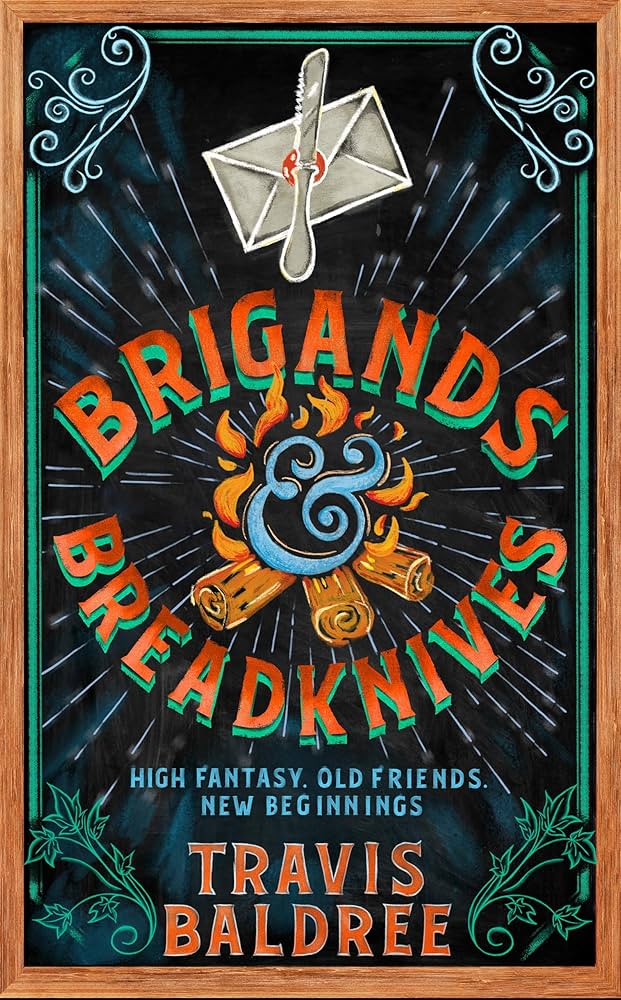
In Bookshops & Bonedust, Baldree introduced Fern, a ratkin who owned the titular bookshop. She and her shop played important roles in the growth and adventures of that book’s heroine, Viv. It looked like Fern’s happily-ever-after was the revival of her shop in her hometown of Murk. The opening of Brigands & Breadknives shows that ennui was an enemy at least as dangerous to Fern as the previous volume’s necromancer. In Murk, Fern developed a near terminal case of is-this-all-there-is and decided that the cure was to move her shop to the city where Viv is now running a thriving coffee shop. Unfortunately, as the first chapters of Brigands & Breadknives shows, she got the diagnosis all wrong. The wrong cure also meant a lot of work and support from her friends was at best misdirected.
One night, after failing again to tell her friends about her unease, Fern falls in a drunken stupor into the back of a wagon. When she awakens, she finds that she is a day and a half outside the city, foodless, and penniless. On the positive side of the ledger, the cart belongs to Astryx, a legendary elf warrior known as the Oathmaiden. She is transporting a goblin prisoner to points northward with the intent of collecting a large bounty. Fern speaks some goblin, which Astryx does not; the prisoner gives no appearance of speaking the common tongue. Astryx agrees to take Fern under her wing as something of an interpreter and something of an assistant. With each step, Fern gets further away from the people who wanted only to help her, and who have no idea what happened.
The bulk of the book concerns the picaresque adventures of Fern, Astryx and the reticent goblin, whose name is Zyll. They are adventurous enough, but I never really got past Fern’s self-sabotaging choices. A couple of things from outside the text put me out of the novel, and they’re both really puzzling choices on Baldree’s part. First, every time I saw Astryx, I thought Asterix. Why have a character whose name is so close to one featured in hundreds of millions of books? The second is a less widely known but not entirely obscure name. In Brigands and Breadknives, the characters fetch up at a monastery high up in the mountains. The monks devote themselves to worshipping and placating a capricious god named Tarim. In the long-running independent comic Cerebus, there is a god named Tarim, whose devotees, like Baldree’s monks, are known as Tarimites. It’s an odd coincidence that kept putting me out of the book during the significant time that the characters spent at the monastery. (Cerebus finished its 300-issue run more than 20 years before Baldree’s book was published, and it lost a large share of its audience 10 years before that, so there’s no reason to think the one is related to the other. But having read a lot of Cerebus, I couldn’t avoid noticing.)
In his acknowledgments, Baldree admits to his nervousness about this book. He asks, “Does anyone want a ‘cozy’ story about the grief of disappointing your friends and the agony of saying ‘no’?” I will admit that I was less charmed than I was by the two previous books. Fern’s concerns, and what look to me like more bad choices at the end of the book, will probably resonate with other readers. I’m glad that Baldree gave something new a try, and I hope he keeps trying new things.
Where the sixth book about the time-traveling historians of St Mary’s Institute dealt with a traitor in their midst, the seventh — Lies, Damned Lies, and History — deals with some major malfeasance by the series’ main character, Dr Madeleine Maxwell, “Max” to virtually everyone. The book’s first journey starts off well enough, with a trip to the coronation of George IV and how his estranged wife Caroline of Brunswick was forcibly kept away from the ceremony. So far, so usual for the historians. The next research trip takes them to look at a Welsh hill fort. They expect this one to be quiet, basically a survey of the site and maybe a little excavation. So they are very surprised to find themselves in the middle of a Saxon raid, and even more surprised at who rides to the rescue: Arthur, son of Uther Pendragon.
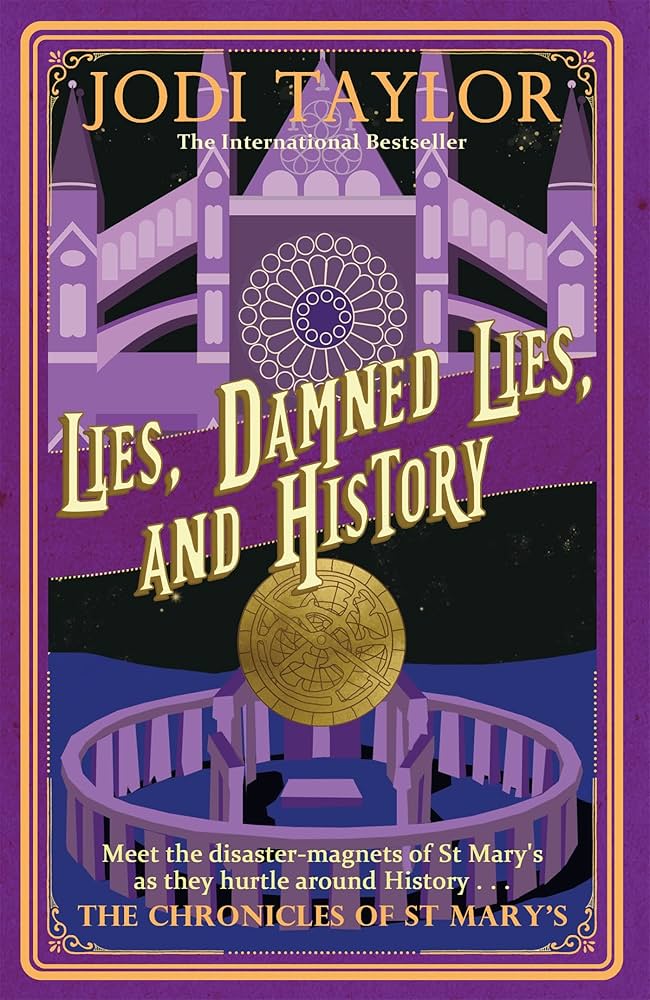
The eventual fallout from that encounter is what lands Max in a great deal of trouble, and St Mary’s in an exceptionally precarious institutional position. Taylor’s story retains the series’ characteristic madcap pace and clever solutions while also putting the characters into believable danger. During the Saxon raid, for example, Max gets herded into a barricaded building with the other women. That’s all well and good until the Saxons decide that the door is not the only way in, and that approaches other than horizontal might prove decisive. The situation for the men among the historians’ group is even worse. They are pressed into combat, but in addition to the dangers inherent in post-Roman hand-to-hand combat, there is an ironclad prohibition on killing contemporaries because of the potential repercussions in history. As has been noted throughout the series, anything a historian does that seems it might change the course of history up to their time is apt to provoke a fatal reaction from History itself. That they manage to come through alive and able to help Max stems to quick thinking on the characters’ part and a smart depiction by the author.
That joy made the subsequent repercussions even tougher for me to read. Taylor has had me invested in the good people of St Mary’s for a long time, and I hated to see them suffer, especially because it was the deserved outcome of their own actions. Still didn’t make it easy for me to read. Seeing incompetents with institutional power lording it over people who know what they are doing is never a good feeling, and late in 2025 there is so much of that about that reading it in Taylor’s novel was doubly dispiriting. Fortunately, not everything is as it seems, at least in the book.
Even when the overall situation looks dire, there’s some good farce to be had at St Mary’s. In this scene, three staff members have been picked up by a nearby present-day police force.
“Good afternoon,” I [Max] said politely, because, of course, that always works with the police. “I’ve had a telephone call about some of our people.”
[The female sergeant] consulted a document. “Lingoss, Bashford, and Sykes.”
“That’s them,” I said, ungrammatically, but you can’t do everything at once.
“No,” she said, in a tone of voice that implied it was only a matter of time before they were, and probably they’d bang up the two of us [Max and a senior professor] as well, just because they could.
Silence fell. The professor moved on to a cheerful little poster detailing the punishments incurred for not reporting Colorado beetle.
I edged towards the sergeant and lowered my voice. “I wonder…”
“Yes?”
I took out my wallet. “How much for you to keep them forever?”
She raised an eyebrow.
I raised two, because I’ve played poker with [the three detainees].
She regarded me with no expression whatsoever. Obviously, she played poker with [them] as well.
I tried again. “If you like, I’ll take them away and have them shot.”
She cheered up immediately. “That’s more like it. Wait here.” …
[The detainees are brought out.]
We contemplated each other in complete silence.
I turned to the sergeant. “Never seen him before in my life.”
“Mr Bashford,” cried Professor Rapson, apparently overjoyed to see him.”
“Hello, Professor,” he said cheerfully. “Max.”
I turned to the sergeant and demanded to know why they weren’t manacled to a wall.
“We needed the manacles for real criminals.”
“I could provide you with a set. No charge.”
“That’s very good of you, madam, but we would prefer it if you would just take them away.”
I said pleadingly, “Are you sure they’re not under arrest?”
“For what?”
“How long a list would you like?”
“Please just take them away.”
“But — shouldn’t they suffer a little first?”
“Well, they drank canteen tea. Would that do?” …
I eyed the miscreants. “Of course. What was I thinking?”
“It’s great here,” said Lingoss, beaming at me. “They let us look at the cells.”
I stared reproachfully at the sergeant. “And you didn’t think to lock them in and lose the key?”
“We’ve already lost the key. Years ago. We generally ask people to embrace the more abstract concepts of imprisonment by envisaging the lockedness of the door and promising not to try to escape. Why are you still here?”
“I’m trying to assist in your clear-up rate. … This is a career-altering opportunity that might never come your way again. I urge you to seize it.”
“If it’s all the same to you, madam, I’d prefer it if you just took them away and drowned them.”
I sagged. “Where’s their car?”
“Around the back.” (pp. 192–95)
Nothing like a little silliness to remind a reader about the heart of the series, the people of St Mary’s and how they look after each other, even in the worst of times.
+++
Lies, Damned Lies, and History is the seventh book in the series that begins with Just One Damned Thing After Another. It presumes familiarity with a dozen or so characters, their relationships, and events they have lived through together. The book is not a good place to start reading the series; begin at the beginning.

 Al Singh
 Doug Merrill
 Doreen Sheridan
 Emily Lauer
 John Pitzel
 Lars N. Goldschlager
 Laura Eilers
 Professor X
 Robert Maedgen
 Sylvere Ap Leanan
 The Shire