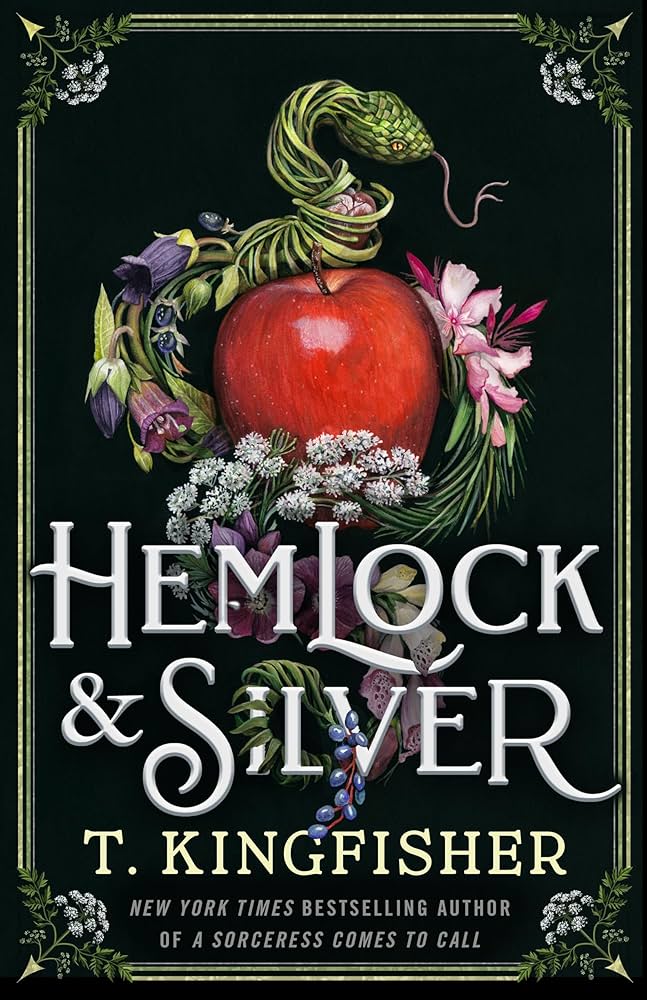
Hemlock & Silver is T. Kingfisher’s latest novel, and the sixth of her works that I have read this year. I’ve already bought six more, and I have a list of which of works are being published or re-published in 2026, so I have a lot of Kingfisher to look forward to. I’m looking forward to how she hilariously applies common sense to fantastic situations. I’m looking forward to how her characters look at things slightly askance, questioning things that the world around them takes for granted. I’m looking forward to how her ordinary, or at least ordinary-ish, people have the capacity for heroics. I’m looking forward to how her heroes have unexpected vulnerabilities. Most of all, I’m looking forward to the surprises she draws out of situations and stories I thought I already knew well.
Kingfisher also has a knack for arresting opening lines, and Hemlock & Silver is no exception: “I had just taken poison when the king arrived to inform me that he had murdered his wife.” In short order, the scene becomes both more and less explicable than that beginning as Kingfisher slowly doles out explanations while adding complications. “The poison was a distillate of chime-adder venom, which burned my sinuses when I took it off my wrist the way some people take snuff.” So the as-yet-unnamed narrator is familiar with poisons, and apparently takes them on a regular basis. But why? “I hadn’t recognized [the king] at first when he stepped through the door of the stillroom. Well, why would I? The king was someone that I had seen far off, at the head of a long table or perched on a throne. Without context, he was simply a well-dressed man who had come in without even knocking.” So the narrator is placed highly enough in society to have seen the king indoors, though from a distance, and prosperous enough to have a separate room to work in. Work that involves taking poisons. “… I thought perhaps he was one of my father’s friends, so I simply said, ‘Wait a moment, please,’ and turned back to stripping rosemary leaves off thin wooden stems. (I always process rosemary after snorting adder venom. The fragrance of the rosemary helps to clear out the awful burnt smell of the venom.)” (all quotes p. 1) So the narrator’s father has friends who might be mistaken for royalty; the narrator also snorts adder venom often enough to have developed a routine for what to do afterward.
The scene only gets more arresting as it progresses. The first external detail of the narrator emerges when she says that when she realized the man she had just given an order to really was the king, she tried to curtsy and “when I clutched my skirts I dropped the rosemary, and the leaves went spilling down over my skirt and clung to the fabric, sticky with sap.” (pp. 1–2) The ordinary course of things, if a visit from a king can ever be ordinary, does not return.
“You have doubtless heard that I killed my wife,” the widowed king said. “It’s true. I did.”
The words made no sense to me. They might have been a mouse’s squeak or a beetle’s click. I stared at the king with my sinuses full of venom and my mind full of nothing at all.
Why is he here? Father was part of a council of leading merchants who sometimes advised the king on economic matters, but he always went to the king, not the other way around. …
Perhaps he wants an antidote or some prevention against poison? That was the only thing that might make sense, but why would he come himself instead of sending a messenger? Kings had people to run errands for them. It was one of the few reasons I could imagine wanting to be king.
“Well?” he said.
I blinked at him. “Well what, Your Majesty?”
He made a quick, impatient gesture. “The rumors that I killed my wife. I told you, they’re true.”
It is very hard to respond to a statement like that. (pp. 2–3)
Eventually Anja manages to say “Ah.” A bit more explanation leads to “‘Ah,’ I said again, searching his face in hopes that everything would become clear. It didn’t.” (p. 3) Quite a lot of Hemlock & Silver is about searching in hopes that everything will become clear, and it not becoming clear, but neither Anja nor the king know that yet.
At first, Anja thinks that he might not have killed her directly, that maybe she died in childbirth and he blames himself, or something similar. Because he obviously wants to talk about it, she asks how the queen died.
If the question surprised him, the king gave no sign. “I ran her through with my sword.”
Well. So much for that theory …
“She was cutting our daughter’s heart out,” he added. …
“Forgive me, Your Majesty,” I said, forming each word carefully. “I think I need to sit down.” (p. 4)
One of the connections that will shape the book is being made in these peculiar circumstances.
“I am very sorry, Your Majesty,” I said finally. “That sounds dreadful.”
That startled him, I could tell. His eyes had been on the floor and rose sharply to my face. “Yes,” he said. “Yes, it was. Very … very dreadful. I’ve never had to … That is … killing someone in battle isn’t like that”
I suspected that this was the first time he had spoken those words. Had no one offered him sympathy? Perhaps it had simply been the wrong sort of sympathy. I could imagine everyone telling him that he had done the right thing, the needful thing, and no one actually suggesting how terrible the right thing must have been. …
“Your daughter—” I began.
“She died.”
I wasn’t surprised to hear it. Cutting someone’s heart out is a very specific process, after all. You’d have to get quite far along before it was distinguishable from mere stabbing. “Shit,” I said, and then slapped my hand over my mouth in horror. …
The king snorted. There wasn’t much humor in it, but there was a little, and I liked him better for it. …
“Don’t,” he said, gesturing to my hand. “That’s possibly the first honest thing anyone’s said to me about it.
“I’m sorry for that, too, then.” (pp. 5–6)
There’s the Kingfisher dark humor, and the value of common sense. Like other Kingfisher protagonists, Anja is not unduly deferential to people of exalted status. She knows how her society works — “Kings went where they chose in their own kingdoms, and merchants’ daughters smiled and agreed.” — but she is either confident or clueless enough to deal with the king on a human level first. This king’s intentions are entirely honorable in this case; it turned out that he has another daughter, and Snow is very sick. Something is killing her slowly, and none of the physicians can say what is wrong. They think it is shock at losing her mother and sister, but the king deeply believes that more is going on. Anja asks about symptoms. “I don’t know what is a symptom and what is simply being a grieving twelve-year-old girl. She eats little, she is very pale, her moods are erratic—but which of those is significant? And what am I overlooking?” (p. 7)
It is a request that Anja cannot deny, and both of them know it. Human connection or no, they are bound by their roles. So it is that Anja accompanies the king and his company to the relative backwater where Snow has been kept since a few weeks after the king killed the queen. At first, she seemed to get better, but then her symptoms returned. Anja must find out what is happening, and if possible reverse it.
First, though, Kingfisher relates how Anja had come to be so conversant with poisons and antidotes. The start of that chapter is almost as arresting as the book’s beginning: “My interest in poisons began when I was eleven years old.” (p. 12) Her cousin Anthony mistakes hemlock for wild carrot; within two hours of trying to show off for his younger girl cousins, he is dead. She gets stuck on the question of why there is no antidote for hemlock, and her adult life begins to take form. Her family wealth gives her access to education, and the luck of an unorthodox tutor combines with her personality to do something much like inventing the scientific method. The beginning gets to the heart of Anja’s character, plus a bit more about her world.
I was extremely lucky to have [my tutor] Scand, even though I didn’t realize it at the time. With the self-centeredness of youth and wealth, I never questioned that a tutor might spend dozens of hours a week helping their student learn about poison. … When I finally realized how unusual it was—mostly by listening to my cousins complain about their tutors—I was intensely embarrassed by how long it had taken.
When I asked him about it, many years later, he laughed. “I was bored,” he said. “I couldn’t pursue my own work any longer, and I was adrift with nothing to occupy me. And then you turned up in the library, hunched over a book as big as you were, and it interested me. I hadn’t been interested in a question in quite a long time. …
There is a crazy-wild delight that comes over you when you discover something new, something extraordinary. If you try to share that and people look at you blankly, it’s crushing. But if there’s someone else there to say really?! and take fire with enthusiasm alongside you—well, that will keep you going for a long time. Even though his great passion was optics and light and refraction, he had a good scholar’s joy in discovery, and he gave it to me unstintingly. (p. 19)
At the time of Hemlock & Silver, Anja is thirty-five, and a bit settled in her nascently scientific ways. Her urge to know has grown into an urge to help, and she is even able to save the occasional person in the capital from an opium overdose, though the failures strongly outnumber the successes. Snow’s case offers an opportunity to do both. When the king’s cavalcade arrives at Witherleaf fortress, three days’ ride from the capital, the scientific problem turns into something of a locked-room mystery, compounded by Snow’s adolescence and intelligence. Snow has her own ideas about what’s happening to her, about what’s best for her, and they do not necessarily accord with what the adults around her think. Figuring out Snow’s symptoms was never going to be easy; doing it in spite of Snow rather than with her cooperation may be more than Anja can manage.
And then the book stops being a locked-room mystery, because this is a low-magic world, not a no-magic world, and many unsettling possibilities open up. The elements of Snow White all turn up, some of them stretched and changed by Kingfisher’s characteristic cock-eyed way of looking at things. The world gets scarier and stranger, and time starts running out.
As I was reading along in Hemlock & Silver, I didn’t realize that I had wandered into a romance as well a fantasy and a mystery. That is, a story that requires a happily-ever-after for the main characters who are part of the romantic pairing, and that the question about those characters’ relationship that is supposed to engage the reader’s interest is not whether but how. In contrast to my reaction to some of Kingfisher’s other works such as Swordheart or Paladin’s Grace, I did not feel the budding attraction very much. As a result, the pairing at the end seemed understandable more than fulfilling, but I may have missed clues along the way, or read more into Anja’s self-contained manner than the author intended.
In the end, the mystery is unraveled and the day is saved. The characters have learned more than a little, sometimes to their chagrin, and their narrow escapes were thrilling. Hemlock & Silver is a treat, and I’m still looking forward to yet more Kingfisher.
+++
Emily’s discussion of Hemlock & Silver plus games of T. Kingfisher BINGO are here.

 Al Singh
 Doug Merrill
 Doreen Sheridan
 Emily Lauer
 John Pitzel
 Lars N. Goldschlager
 Laura Eilers
 Professor X
 Robert Maedgen
 Sylvere Ap Leanan
 The Shire