The thing about The Incandescent by Emily Tesh as a novel about a magic boarding school in England is that it’s told from the adults’ point of view, adults who take their responsibilities seriously, and who have real lives that are separate from what is happening to the students. Boarding-school stories often assign the teachers archetypical roles: antagonists, mentors, the clueless, the helpful, the well-meaning but bumbling, strict but with a heart of gold, and so on. In all of these coming-of-age stories, the teachers and staff are foils, there to play a role for the students to whom the tale really belongs. But in any school, the teachers are usually there long after any particular group of students has graduated and gone on with the rest of their lives. They have a different perspective on school life, and Tesh drew on her own experience as a teacher to write a magic boarding-school novel, but for grown-ups.
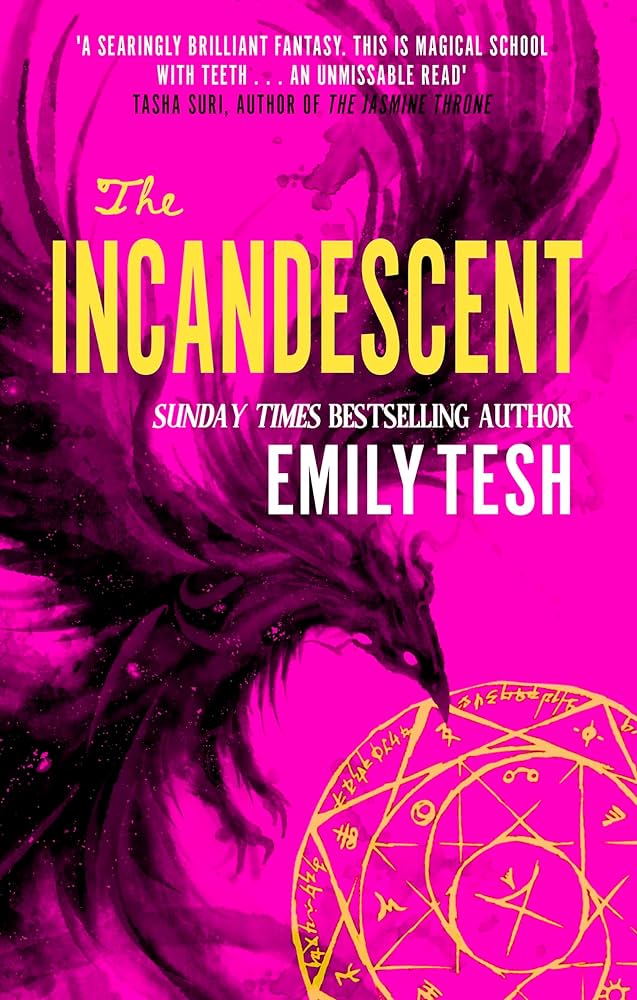
As The Incandescent opens, Dr Sapphire Walden, Saffy to friends and most colleagues, has been Director of Magic at Chetwood School for three years, and she has brought a bit more order to the Faculty of Magic that has improved the incident statistics that she tracks. Much magic in the book’s world involves summoning demons, extradimensional beings that have capabilities in the mundane world, and that also want nothing more than to stay in the world and consume as much magic and life force as they can while here. Magicians are a constant source of danger; adolescent and partly trained magicians even more so. A school full of young and barely controlled magicians is a happy hunting ground, and a big part of Saffy’s job is to keep the kids safe. Tesh shows how much care teachers take in how they look after students, heightened by the magic.
Chetwood is what an English boarding school is meant to be: centuries of history, sometimes an awkward fit in modern society, plenty of tradition but enough adaptation to have kept going through the many many years. There are old stone chapels and a Brutalist building from the 1960s; there are multi-generation Chetwood families, and students from newly immigrated families there on scholarship; old money rubs along with new money; and everywhere teenagers and younger children growing up amid all the contradictions. Saffy herself is an alum of the school, with a complicated history. She’s happy to be back and to have found a role, but also unhappy not to have gone further in the world of magical research, the world where she earned her doctorate and where she expected to be breaking new ground.
Then of course things start to go wrong.
Because The Incandescent is an Emily Tesh book, it’s much more than just jolly school-age adventures. In one of the book’s later confrontation, Tesh writes about Saffy and her reasons for teaching, about many people like her, until suddenly she is writing about something else entirely.
But there were reasons, oh there were reasons, why a person might take the job where she would be underestimated and undervalued forever. A fear of boredom, yes. A love of the work. And a certainty: this is what I have done. Here is power, and here are power’s consequences. I can point to them. I can name them. Here is the child who knows today what she did not know yesterday. She will take her knowledge away into adulthood and find her own terrible strength there. Those are her choices. These, circumscribed, limited by ancient stone and crumbling concrete, by time and tradition and school bells and boundaries—these are mine.
Selves came and went. They grew and grew. You discovered something to be and then you learned how to inhabit it with every inch of your being. And so you became old, and strong, and terrible. (pp. 331–32)
In a desperate moment, two characters have to find the heart of the school.
“The chapel?” she murmurs. “The big gate?”
Good guesses, both. Six hundred years ago they would have been the right guesses; there is a reason that those are the physical doors this key can unlock. But the institution endures the same way anything stays alive: by changing. The school boundaries spread past the great oaken gate decades ago. And how many people really go to chapel these days? …
Where is the heart of a school? Every child will give you a different answer; every adult a different answer again. Is it in the warren of classrooms, the underground maze of wire lockers, the all-encompassing social world of the quad and lunch hall and tuckshop? Is it in the staffroom, the departmental offices, the Victorian school hall with its rows of buttered benches? Is it on the rugby pitches and netball courts, or lurking amidst the ancient glamour of the mediaeval colonnade, or buried in the concrete-and-scaffolding dormitories? Perhaps there is no physical heart at all, no centre, nothing so solid; just a weight on the imagination, a dream-picture of green and gold and innocence, the lofty goals of scholarship and humanity mixed together with the sound of children’s laughter, a place of power made safe from the wicked world—
Perhaps it’s a memory. Perhaps it’s a hope. Perhaps it’s an adult’s blind fantasy. Perhaps it never existed at all. (p. 382)
The answer is particular to the moment in Saffy’s story, but the questions linger. And what is Chetwood, what is a Chetwood education in the first quarter of the twenty-first century?
Fifty thousand pounds a year per child, less whatever scholarships and bursaries a family could argue out of the endowment. People paid it. Some of them were rich—well, all of them were rich, really. Most of them did not feel that way. …
Almost no one was paying for magical boarding school because of the magic. The magic was an interesting quirk, a historical curiosity, in a few cases a genuine passion being indulged by a loving parent—but you didn’t pay fifty thousand pounds a year for magic quirks any more than you paid it for Shakespeare or the respiratory system or the ability to solve. No: Chetwood’s school fees were insurance money, a policy take out against the future. Let my child be safe. Let my child be happy. Let my child have every single possible chance at freedom, joy, hope, power.
Because an elite education was an investment in power. Magic was the least of what you gained at Chetwood. What mattered was the power to walk the walk and talk the talk, to have your résumé picked out of the pile and the interviewer already speaking your language. It was the power to know the people you ought to know, to befriend them easily over a you too? or to laugh together about how ridiculous the whole theme park experience of childhood had been. A few could afford that power. Most could not. Plenty of parents who loved their children worked appalling hours and the remortgaged their homes to pay for it. They did it for love, and for terror. You could never completely future-proof your children. But power would keep them safe from the bitter grind of survival in a way that nothing else could. (p. 323)
The adventures are thrilling, the humor both real and funny, the characters distinct, and their growth touching, but it’s sections like the three above that will stay with me long after the details of the demons and their defeat have faded from immediate recall.
Rather obviously, recall is at the heart of Lois McMaster Bujold’s novel Memory, a part of her long-running Vorkosigan saga. At present I have read not quite half of the novels in the overall saga, and while I’m generally going through in publication order, I also have a preference for the old mass-market paperback editions. That means I’ve skipped Memory‘s immediate predecessor in the sequence (Dreamweaver’s Dilemma), along with two more tales of Miles Vorkosigan in his 20s, The Vor Game and Mirror Dance. In a way, I’ve been testing how well the books can work as standalones; it also inevitably means that I have missed some character developments and may not value some relationships as much as the characters do.
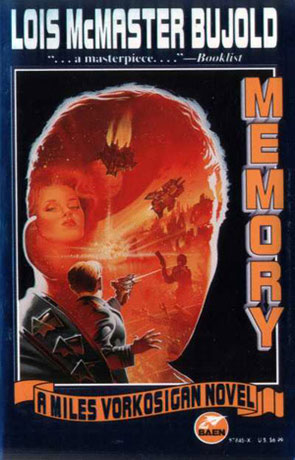
Specifically, missing Dreamweaver’s Dilemma means that I missed the rescue operation that left Miles dead for a little while, but not so completely dead that he couldn’t be fast-frozen and revived with advanced medical attention. Much of Memory is about trying to discover why Miles had a convulsion of some sort that caused the operation so much trouble. I also spent a fair chunk of Memory not liking Miles.
Early on in the novel, he makes a terrible choice. He knows it’s bad, people very close to him tell him it’s bad, and he does it anyway, knowing all the time that it’s the wrong thing to do and that the consequences could be significant, not just for him but for people who are important to him, and for causes and organizations he has devoted years to serving. I know that people in the real world do that sort of thing all the time, but this is not the type of mistake that Miles is supposed to be making. Over the course of many books, he’s been developed as an extremely competent character; his tragic flaw is overconfidence, a belief that he can figure out a solution to any problem he’s presented with, and that he and the people around him can execute it.
Lying in a report to his superiors within Imperial Security did not strike me as a mistake of overconfidence, it just seemed stupid, which is very much not how Bujold had portrayed Miles. I suppose you could stretch overconfidence into hubris to cover this mistake, a feeling that since he had gotten away with breaking rules so many other times, this time would not matter either, or it would not be noticed, or the organization would somehow not mind. It’s been said that the CIA does not mind if you are cheating on your spouse, but you had best not conceal the affair from the Agency, or your career is finished. The spies in space of Miles’ setting took a similarly dim view of his actions. It seemed out of character, and contrived, which made me unhappy with both character and book.
I’m glad I persevered, though, because Memory winds up as a deep look into the workings of Barrayar, a chance to see Miles without the resources usually at his disposal, and for him to work at problems that can’t be solved by blowing something to smithereens. There is also a good mystery involving the head of Imperial Security whose eidetic memory brain implant is malfunctioning. Emperor, organization and many more have relied on Ilyan’s memory for decades, and none of them are quite sure how to get along without it. Will they have to learn? Answering that is part of the action in Memory, and an urgent one at that because if a malevolent actor has caused the problem, they have a very deep reach.
Sometimes I think that Emperor Gregor’s sane and steady nature is the least realistic part of a space opera that takes wormhole travel across insterstellar distances for granted, especially if I have been reading accounts of historical European sovereigns. Nevertheless, I am glad to see him as an important and active character in Memory. He can separate the good of the realm and of his peoples from his personal whims; he can show loyalty and mercy at a personal level without succumbing to arbitrariness. He knows, with generous assistance from the author, when a second chance can serve greater ends.
The back matter of the book contains a timeline of the books in the Vorkosigan Saga, with quick summaries to refresh readers’ memories and keep them oriented. The entry for Memory reads, “Miles hits thirty; thirty hits back.” Memory hits hard, in the choices made, their consequences, and what it takes to recover. Memorable.

 Al Singh
 Doug Merrill
 Doreen Sheridan
 Emily Lauer
 John Pitzel
 Lars N. Goldschlager
 Laura Eilers
 Professor X
 Robert Maedgen
 Sylvere Ap Leanan
 The Shire
1 ping
[…] society. It could hardly be further from the contemporary approach shown, for example, in The Incandescent by Emily Tesh. First and foremost, the school is concerned with its own reputation; all of the […]